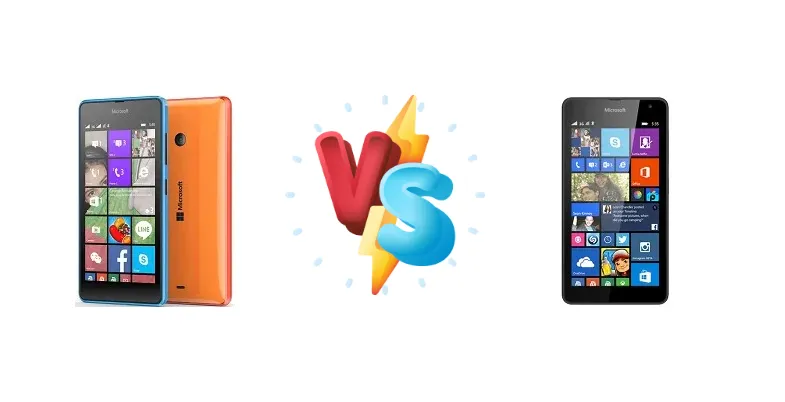
The Microsoft Lumia 540 Dual SIM and Lumia 535 represent Microsoft’s attempt to capture the budget smartphone market during the Windows Phone era. While both devices share the same Qualcomm Snapdragon 200 chipset, subtle differences in features and design cater to slightly different user needs. This comparison dissects these nuances to determine which device offers the best value.
🏆 Quick Verdict
For the average user, the Microsoft Lumia 540 Dual SIM emerges as the slightly better choice. The inclusion of Dual SIM functionality, a common requirement in emerging markets, and potentially more recent software support (depending on the specific build) gives it a practical edge over the Lumia 535, despite their identical core performance.
| Network |
|---|
| 2G bands | GSM 850 / 900 / 1800 / 1900 - SIM 1 & SIM 2 | GSM 850 / 900 / 1800 / 1900 |
| 3G bands | HSDPA 900 / 2100 | HSDPA 900 / 2100 |
| Speed | HSPA 42.2/5.76 Mbps | HSPA 42.2/5.76 Mbps |
| Technology | GSM / HSPA | GSM / HSPA |
| Launch |
|---|
| Announced | 2015, April. Released 2015, May | 2014, November. Released 2014, December |
| Status | Discontinued | Discontinued |
| Body |
|---|
| Dimensions | 144 x 73.7 x 8.6 mm (5.67 x 2.90 x 0.34 in) | 140.2 x 72.4 x 8.8 mm (5.52 x 2.85 x 0.35 in) |
| SIM | Dual SIM (Micro-SIM, dual stand-by) | Micro-SIM |
| Weight | 152 g (5.36 oz) | 146 g (5.15 oz) |
| Display |
|---|
| Protection | - | Corning Gorilla Glass 3 |
| Resolution | 720 x 1280 pixels, 16:9 ratio (~294 ppi density) | 540 x 960 pixels, 16:9 ratio (~220 ppi density) |
| Size | 5.0 inches, 68.9 cm2 (~64.9% screen-to-body ratio) | 5.0 inches, 68.9 cm2 (~67.9% screen-to-body ratio) |
| Type | IPS LCD | IPS LCD |
| | ClearBlack display | - |
| Platform |
|---|
| CPU | Quad-core 1.2 GHz Cortex-A7 | Quad-core 1.2 GHz Cortex-A7 |
| Chipset | Qualcomm Snapdragon 200 (28 nm) | Qualcomm Snapdragon 200 (28 nm) |
| GPU | Adreno 302 | Adreno 302 |
| OS | Microsoft Windows Phone 8.1 with Lumia Denim | Microsoft Windows Phone 8.1, upgradable to Microsoft Windows 10 |
| Memory |
|---|
| Card slot | microSDXC (dedicated slot) | microSDXC (dedicated slot) |
| Internal | 8GB 1GB RAM | 8GB 1GB RAM |
| | eMMC 4.5 | eMMC 4.5 |
| Main Camera |
|---|
| Features | LED flash | LED flash |
| Single | 8 MP, f/2.2, 28mm (wide), 1/4.0", AF | 5 MP, f/2.4, 28mm (wide), 1/4.0", AF |
| Video | 480p@30fps | 480p@30fps |
| Selfie camera |
|---|
| Single | 5 MP | 5 MP |
| Video | 480p | 720p |
| Sound |
|---|
| 3.5mm jack | Yes | Yes |
| 35mm jack | Yes | Yes |
| Loudspeaker | Yes | Yes |
| Comms |
|---|
| Bluetooth | 4.0, A2DP | 4.0, A2DP, LE, aptX |
| NFC | No | No |
| Positioning | GPS, GLONASS | GPS, GLONASS |
| Radio | FM radio | FM radio |
| USB | microUSB 2.0 | microUSB 2.0 |
| WLAN | Wi-Fi 802.11 b/g/n, DLNA, hotspot | Wi-Fi 802.11 b/g/n, DLNA, hotspot |
| Features |
|---|
| Sensors | Accelerometer, proximity | Accelerometer, proximity |
| Battery |
|---|
| Music play | Up to 81 h | Up to 78 h |
| Stand-by | Up to 576 h (2G) / Up to 576 h (3G) | Up to 552 h |
| Talk time | Up to 26 h (2G) / Up to 15 h (3G) | Up to 11 h (2G) / Up to 13 h (3G) |
| Type | Li-Ion 2200 mAh, removable | Li-Ion 1905 mAh, removable (BL-L4A) |
| Misc |
|---|
| Colors | Orange, white, black, gray, blue | Orange, green, white, black, gray, blue |
| Price | About 100 EUR | About 80 EUR |
| SAR | - | 0.46 W/kg (head) 0.38 W/kg (body) |
| SAR EU | - | 0.62 W/kg (head) 0.57 W/kg (body) |
Microsoft Lumia 540 Dual SIM
- Dual SIM functionality offers increased flexibility.
- Potentially more recent software updates (depending on region/carrier).
- Identical performance to the Lumia 535 at a comparable price.
- Shares the same limitations of the Snapdragon 200 chipset.
- Low-resolution camera struggles in low light.
Microsoft Lumia 535
- Simple and clean Windows Phone interface.
- Identical performance to the Lumia 540.
- May be available at a lower price point in some markets.
- Lacks Dual SIM functionality.
- Shares the same limitations of the Snapdragon 200 chipset.
Display Comparison
Both the Lumia 540 and 535 feature a 5-inch IPS LCD display with a resolution of 540 x 960 pixels. Given the identical specifications, display quality – including color accuracy and viewing angles – will be virtually indistinguishable. Neither device boasts features like high brightness nits or advanced panel technologies like LTPO, typical of their budget positioning. Bezels are similarly substantial on both models, reflecting the design trends of the time.
Camera Comparison
Both the Lumia 540 and 535 feature a 5-megapixel rear camera. While megapixel count is equal, image processing algorithms and lens quality could differ slightly, potentially leading to minor variations in image quality. The front-facing cameras are also identical at 2 megapixels. Given the limitations of the sensors, image quality will be acceptable for casual snapshots but will struggle in low-light conditions. The absence of Optical Image Stabilization (OIS) on either device further exacerbates low-light performance issues.
Performance
The core performance of both devices is identical, powered by the Qualcomm Snapdragon 200 (28nm) chipset with a quad-core 1.2 GHz Cortex-A7 CPU. This chipset was an entry-level solution, suitable for basic tasks like calling, texting, and light web browsing. The 28nm manufacturing process, while common at the time, is less efficient than newer nodes, meaning both phones will struggle with demanding applications. The shared architecture means neither device will exhibit a noticeable performance advantage in everyday use or benchmark scores. RAM capacity is not specified, but is likely 1GB in both cases, further limiting multitasking capabilities.
Battery Life
Battery capacity is not explicitly stated in the provided data. However, given their similar specifications and target market, both devices likely house batteries in the 1900-2200 mAh range. Charging wattage is also unspecified, but is expected to be relatively slow, likely utilizing a standard 5W charger. Real-world battery life will depend heavily on usage patterns, but both phones should be able to last a full day with moderate use, primarily due to the low power consumption of the Snapdragon 200 chipset.
Buying Guide
Buy the Microsoft Lumia 540 Dual SIM if you prioritize the flexibility of managing two SIM cards for cost savings or work/life separation. This is ideal for travelers or users with multiple phone numbers. Buy the Microsoft Lumia 535 if you specifically prefer its slightly different aesthetic or find it at a significantly lower price point, accepting the lack of Dual SIM capability as a trade-off.
Frequently Asked Questions
❓ Is the Snapdragon 200 chipset sufficient for modern app usage on either the Lumia 540 or 535?
No, the Snapdragon 200 is a very old and underpowered chipset. While it can handle basic tasks like calls, texts, and light web browsing, it will struggle significantly with modern apps and multitasking. Expect slow loading times and potential lag, even with optimized Windows Phone applications.
❓ Does the Lumia 540's Dual SIM functionality work with 4G LTE on both SIM cards simultaneously?
This depends on the specific model and carrier support. While the Lumia 540 supports Dual SIM, it's likely only one SIM can utilize 4G LTE at a time. The second SIM will typically fall back to 2G or 3G connectivity. Check the device specifications and your carrier's compatibility information for confirmation.
❓ Given the age of these devices, is software support still available for the Lumia 540 or 535?
Official software support from Microsoft for Windows Phone has ended. However, some users may still be able to find unofficial updates or community-maintained ROMs. Security updates are unlikely to be available, posing a potential security risk.