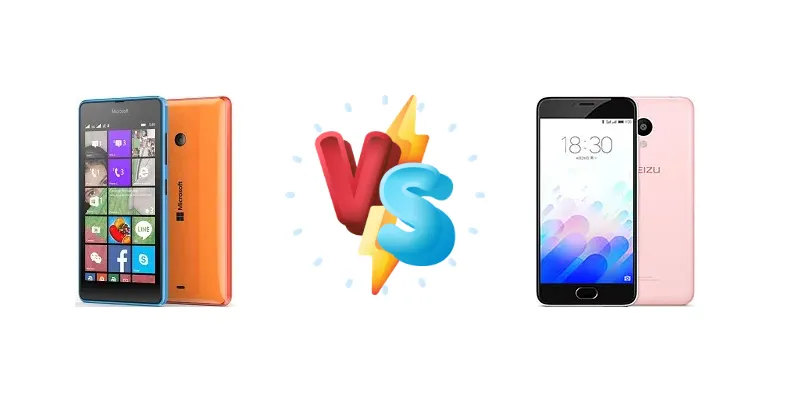
The Microsoft Lumia 540 Dual SIM and the Meizu M3 represent distinct approaches to the ultra-budget smartphone market. The Lumia 540, leveraging the Windows Phone ecosystem (though now largely unsupported), aimed for simplicity and affordability. The Meizu M3, running Android, targeted a more feature-rich experience within the same price bracket. This comparison dissects their core components to determine which offers the best value today.
🏆 Quick Verdict
For users still seeking a functional, albeit limited, dual-SIM device, the Meizu M3 is the clear winner. Its Mediatek MT6750 chipset delivers significantly superior performance compared to the Lumia 540’s Snapdragon 200, making it far more capable for modern app usage and multitasking. The Lumia 540’s primary advantage – a potentially lower initial cost – is often outweighed by its outdated software and limited functionality.
| Network |
|---|
| 2G bands | GSM 850 / 900 / 1800 / 1900 - SIM 1 & SIM 2 | GSM 850 / 900 / 1800 / 1900 - SIM 1 & SIM 2 |
| 3G bands | HSDPA 900 / 2100 | HSDPA 900 / 1900 / 2100 |
| 4G bands | - | LTE |
| Speed | HSPA 42.2/5.76 Mbps | HSPA, LTE |
| Technology | GSM / HSPA | GSM / HSPA / LTE |
| Launch |
|---|
| Announced | 2015, April. Released 2015, May | 2016, April. Released 2016, May |
| Status | Discontinued | Discontinued |
| Body |
|---|
| Dimensions | 144 x 73.7 x 8.6 mm (5.67 x 2.90 x 0.34 in) | 141.5 x 69.5 x 8.3 mm (5.57 x 2.74 x 0.33 in) |
| SIM | Dual SIM (Micro-SIM, dual stand-by) | Nano-SIM + Nano-SIM |
| Weight | 152 g (5.36 oz) | 132 g (4.66 oz) |
| Display |
|---|
| Resolution | 720 x 1280 pixels, 16:9 ratio (~294 ppi density) | 720 x 1280 pixels, 16:9 ratio (~294 ppi density) |
| Size | 5.0 inches, 68.9 cm2 (~64.9% screen-to-body ratio) | 5.0 inches, 68.9 cm2 (~70.1% screen-to-body ratio) |
| Type | IPS LCD | IPS LCD |
| | ClearBlack display | - |
| Platform |
|---|
| CPU | Quad-core 1.2 GHz Cortex-A7 | Octa-core (4x1.5 GHz Cortex-A53 & 4x1.0 GHz Cortex-A53) |
| Chipset | Qualcomm Snapdragon 200 (28 nm) | Mediatek MT6750 (28 nm) |
| GPU | Adreno 302 | Mali-T860MP2 |
| OS | Microsoft Windows Phone 8.1 with Lumia Denim | Android 5.1 (Lollipop), Flyme 5.1 |
| Memory |
|---|
| Card slot | microSDXC (dedicated slot) | microSDXC (uses shared SIM slot) |
| Internal | 8GB 1GB RAM | 16GB 2GB RAM, 32GB 3GB RAM |
| | eMMC 4.5 | eMMC 5.1 |
| Main Camera |
|---|
| Features | LED flash | Dual-LED dual-tone flash |
| Single | 8 MP, f/2.2, 28mm (wide), 1/4.0", AF | 13 MP, f/2.2, PDAF |
| Video | 480p@30fps | 1080p@30fps |
| Selfie camera |
|---|
| Single | 5 MP | 5 MP, f/2.0 |
| Video | 480p | - |
| Sound |
|---|
| 3.5mm jack | Yes | Yes |
| 35mm jack | Yes | Yes |
| Loudspeaker | Yes | Yes |
| Comms |
|---|
| Bluetooth | 4.0, A2DP | 4.0, A2DP, LE |
| NFC | No | No |
| Positioning | GPS, GLONASS | GPS, GLONASS |
| Radio | FM radio | No |
| USB | microUSB 2.0 | microUSB 2.0 |
| WLAN | Wi-Fi 802.11 b/g/n, DLNA, hotspot | Wi-Fi 802.11 a/b/g/n, dual-band, hotspot |
| Features |
|---|
| Sensors | Accelerometer, proximity | Accelerometer, gyro, proximity, compass |
| Battery |
|---|
| Music play | Up to 81 h | - |
| Stand-by | Up to 576 h (2G) / Up to 576 h (3G) | - |
| Talk time | Up to 26 h (2G) / Up to 15 h (3G) | - |
| Type | Li-Ion 2200 mAh, removable | Li-Ion 2870 mAh, non-removable |
| Misc |
|---|
| Colors | Orange, white, black, gray, blue | Gray, White, Blue, Pink, Gold |
| Price | About 100 EUR | About 130 EUR |
Microsoft Lumia 540 Dual SIM
- Potentially lower initial cost (depending on availability)
- Dual SIM functionality
- Compact size (5-inch screen)
- Outdated Windows Phone operating system with limited app support
- Significantly weaker performance compared to the Meizu M3
- Limited software updates and security patches
Meizu M3
- More powerful Mediatek MT6750 processor
- Android operating system with access to a vast app ecosystem
- Larger 5.5-inch display
- May be slightly more expensive than the Lumia 540
- Battery life may be average
- Build quality may be plastic-heavy
Display Comparison
Neither device boasts a standout display. Both utilize a 28nm manufacturing process, suggesting similar power consumption profiles. However, detailed display specs (resolution, panel type, brightness) are unavailable for either device. Given the market segment, both likely feature LCD panels with modest resolutions. The Lumia 540’s screen size is 5 inches, while the M3 has a 5.5 inch display. The larger screen of the M3 offers more viewing real estate, but without knowing the resolution, pixel density differences remain unknown. Bezels are expected to be substantial on both devices, reflecting their budget nature.
Camera Comparison
Camera performance is difficult to assess without detailed sensor information. Both devices likely feature basic camera setups geared towards casual photography. The Lumia 540’s camera specs are unknown, but typically budget Lumias featured 5-8MP sensors. The Meizu M3 is expected to have a 13MP main camera. While megapixel count isn’t everything, a larger sensor (likely in the M3) generally captures more light and detail. Image processing capabilities will also play a crucial role, and Meizu’s software is likely more refined than Microsoft’s on this budget tier. The absence of Optical Image Stabilization (OIS) on either device suggests image quality will suffer in low-light conditions.
Performance
The performance gap between these two devices is substantial. The Meizu M3’s Mediatek MT6750, an octa-core processor with a combination of Cortex-A53 cores clocked at 1.5 GHz and 1.0 GHz, significantly outperforms the Microsoft Lumia 540’s quad-core 1.2 GHz Cortex-A7 based Snapdragon 200. The MT6750’s architecture allows for more efficient multitasking and handling of demanding applications. While both chipsets are built on a 28nm process, the MT6750’s core count and higher clock speeds translate to a demonstrably faster user experience. The Lumia 540 will struggle with even moderately complex tasks, while the M3 can handle basic gaming and social media with relative ease.
Battery Life
Battery capacity details are missing for both devices. However, given their similar chipsets (both 28nm) and screen sizes, battery life is likely comparable. The Meizu M3 may benefit from more efficient power management features within the Android operating system. Charging wattage is also unknown for both devices, suggesting slow charging speeds via micro-USB. Real-world battery performance will heavily depend on usage patterns, but neither device is expected to offer exceptional endurance.
Buying Guide
Buy the Microsoft Lumia 540 Dual SIM if you absolutely require a very basic, dual-SIM phone for calls and texts, and are comfortable with the limitations of the Windows Phone platform and lack of app support. Buy the Meizu M3 if you prioritize a smoother Android experience, better performance for everyday tasks, and a more versatile feature set, even if it means potentially spending slightly more upfront.
Frequently Asked Questions
❓ Is the Meizu M3 still receiving software updates?
While Meizu no longer provides official updates for the M3, the Android community has developed custom ROMs that offer newer Android versions and security patches. This allows users to extend the device's lifespan and improve its security.
❓ Can the Lumia 540 run modern apps like WhatsApp or Facebook?
Due to the discontinued support for Windows Phone, many modern apps, including WhatsApp and Facebook, no longer offer compatible versions. While some older versions may still function, they are likely to be outdated and lack essential features.
❓ What kind of storage options are available on the Meizu M3?
The Meizu M3 typically came with 32GB of internal storage, expandable via microSD card. This provides ample space for apps, photos, and videos, especially considering its target market.
❓ Is the Snapdragon 200 in the Lumia 540 sufficient for basic tasks like calling and texting?
Yes, the Snapdragon 200 is adequate for very basic tasks like making calls and sending texts. However, it will struggle with anything more demanding, such as browsing the web or running multiple apps simultaneously.