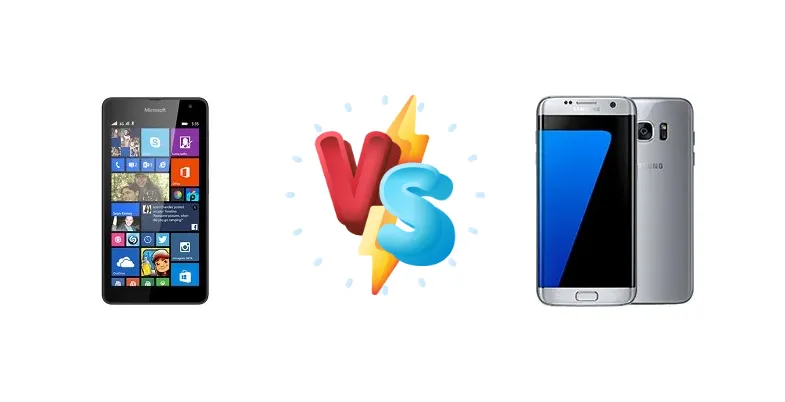
Comparing the Microsoft Lumia 535 and the Samsung Galaxy S7 edge is akin to contrasting the dawn of the smartphone era with its mature peak. Released years apart, these devices represent vastly different price points and target audiences. The Lumia 535 aimed for affordability, while the S7 edge sought to redefine the premium smartphone experience. This comparison dissects the core differences, revealing a significant chasm in capabilities.
🏆 Quick Verdict
For the vast majority of users in 2024, the Samsung Galaxy S7 edge is the clear winner. Its vastly superior processing power, advanced display technology, and significantly better camera capabilities justify the price difference. The Lumia 535 remains a viable option only for those on the absolute tightest of budgets and with minimal smartphone demands.
| Network |
|---|
| 2G bands | GSM 850 / 900 / 1800 / 1900 | GSM 850 / 900 / 1800 / 1900 - SIM 1 & SIM 2 - G935FD, G9350 |
| 3G bands | HSDPA 900 / 2100 | HSDPA 850 / 900 / 1700(AWS) / 1900 / 2100 - G935F, G935FD, G935W8 |
| 4G bands | - | 1, 2, 3, 4, 5, 7, 8, 12, 13, 17, 18, 19, 20, 25, 26, 28, 38, 39, 40, 41 - G935F, G935FD |
| Speed | HSPA 42.2/5.76 Mbps | HSPA 42.2/5.76 Mbps, LTE (3CA) Cat9 450/50 Mbps |
| Technology | GSM / HSPA | GSM / HSPA / LTE |
| Launch |
|---|
| Announced | 2014, November. Released 2014, December | 2016, February 21. Released 2016, March 11 |
| Status | Discontinued | Discontinued |
| Body |
|---|
| Build | - | Glass front (Gorilla Glass 4), glass back (Gorilla Glass 4), aluminum frame |
| Dimensions | 140.2 x 72.4 x 8.8 mm (5.52 x 2.85 x 0.35 in) | 150.9 x 72.6 x 7.7 mm (5.94 x 2.86 x 0.30 in) |
| SIM | Micro-SIM | · Nano-SIM (G935F, G935W8)· Nano-SIM + Nano-SIM (G935FD) |
| Weight | 146 g (5.15 oz) | 157 g (5.54 oz) |
| Display |
|---|
| Protection | Corning Gorilla Glass 3 | Corning Gorilla Glass 4 |
| Resolution | 540 x 960 pixels, 16:9 ratio (~220 ppi density) | 1440 x 2560 pixels, 16:9 ratio (~534 ppi density) |
| Size | 5.0 inches, 68.9 cm2 (~67.9% screen-to-body ratio) | 5.5 inches, 83.4 cm2 (~76.1% screen-to-body ratio) |
| Type | IPS LCD | Super AMOLED |
| Platform |
|---|
| CPU | Quad-core 1.2 GHz Cortex-A7 | Quad-core (2x2.15 GHz Kryo & 2x1.6 GHz Kryo) - G9350Octa-core (4x2.3 GHz Mongoose & 4x1.6 GHz Cortex-A53) - G935FD, G935F, G935W8 |
| Chipset | Qualcomm Snapdragon 200 (28 nm) | Qualcomm MSM8996 Snapdragon 820 (14 nm) - G9350Exynos 8890 Octa (14 nm) - G935FD, G935F, G935W8 |
| GPU | Adreno 302 | Adreno 530 - G9350Mali-T880 MP12 - G935FD, G935F, G935W8 |
| OS | Microsoft Windows Phone 8.1, upgradable to Microsoft Windows 10 | Android 6.0 (Marshmallow), upgradable to Android 8.0 (Oreo), TouchWiz UI |
| Memory |
|---|
| Card slot | microSDXC (dedicated slot) | microSDXC (uses shared SIM slot) - dual SIM model only |
| Internal | 8GB 1GB RAM | 32GB 4GB RAM, 64GB 4GB RAM, 128GB 4GB RAM |
| | eMMC 4.5 | - |
| Main Camera |
|---|
| Features | LED flash | LED flash, auto-HDR, panorama |
| Single | 5 MP, f/2.4, 28mm (wide), 1/4.0", AF | 12 MP, f/1.7, 26mm (wide), 1/2.55", 1.4µm, dual pixel PDAF, OIS |
| Video | 480p@30fps | 4K@30fps, 1080p@30fps (gyro-EIS), 1080p@60fps, 720p@240fps, HDR, stereo sound rec., OIS |
| Selfie camera |
|---|
| Features | - | HDR |
| Single | 5 MP | 5 MP, f/1.7, 22mm (wide), 1/4.1", 1.34µm |
| Video | 720p | - |
| Sound |
|---|
| 3.5mm jack | Yes | Yes |
| 35mm jack | Yes | Yes |
| Loudspeaker | Yes | Yes |
| Comms |
|---|
| Bluetooth | 4.0, A2DP, LE, aptX | 4.2, A2DP, LE, aptX |
| NFC | No | Yes |
| Positioning | GPS, GLONASS | GPS, GLONASS, BDS |
| Radio | FM radio | No |
| USB | microUSB 2.0 | microUSB 2.0, OTG |
| WLAN | Wi-Fi 802.11 b/g/n, DLNA, hotspot | Wi-Fi 802.11 a/b/g/n/ac, dual-band, Wi-Fi Direct |
| Features |
|---|
| Sensors | Accelerometer, proximity | Fingerprint (front-mounted), accelerometer, gyro, proximity, compass, barometer, heart rate, SpO2 |
| Battery |
|---|
| Charging | - | 15W wired, QC2
Wireless (Qi) (market dependent) |
| Music play | Up to 78 h | Up to 74 h |
| Stand-by | Up to 552 h | - |
| Talk time | Up to 11 h (2G) / Up to 13 h (3G) | Up to 27 h (3G) |
| Type | Li-Ion 1905 mAh, removable (BL-L4A) | Li-Ion 3600 mAh, non-removable |
| Misc |
|---|
| Colors | Orange, green, white, black, gray, blue | Black, White, Gold, Silver, Pink Gold, Black Pearl, Coral Blue |
| Models | - | SM-G935F, SM-G935FD, SM-G935W8, SM-G9350, SM-G935S, SC-02H, SM-G935K, SM-G935L, SM-G935R4, SCV33, SM-G935X, SM-G935VC, SM-G935D |
| Price | About 80 EUR | About 330 EUR |
| SAR | 0.46 W/kg (head) 0.38 W/kg (body) | 0.56 W/kg (head) 0.66 W/kg (body) |
| SAR EU | 0.62 W/kg (head) 0.57 W/kg (body) | 0.26 W/kg (head) 1.43 W/kg (body) |
| Tests |
|---|
| Audio quality | - |
Noise -92.5dB / Crosstalk -92.2dB |
| Battery life | - |
Endurance rating 92h
|
| Camera | - |
Photo / Video |
| Display | - |
Contrast ratio: Infinite (nominal), 4.439 (sunlight) |
| Loudspeaker | - |
Voice 70dB / Noise 69dB / Ring 71dB
|
| Performance | - |
GFXBench: 8.3fps (ES 3.1 onscreen) |
Microsoft Lumia 535
- Extremely affordable
- Lightweight and compact
- Simple and easy to use
- Poor performance
- Low-resolution display
- Limited camera capabilities
- Outdated operating system (Windows Phone)
Samsung Galaxy S7 edge
- Powerful processor (Snapdragon 820 or Exynos 8890)
- Stunning curved AMOLED display
- Excellent camera with OIS
- Fast charging and wireless charging
- Older device, software updates may be limited
- Battery has degraded over time (given its age)
- Higher price point (even used)
Display Comparison
The Samsung Galaxy S7 edge boasts a significantly more advanced display. While both devices share an 'Infinite' contrast ratio (a marketing term), the S7 edge’s curved Super AMOLED panel offers superior color accuracy and vibrancy. The Lumia 535’s display specifications are not detailed, but given its market segment, it likely utilizes a basic LCD panel with lower resolution and narrower viewing angles. The S7 edge’s 4.439 sunlight contrast ratio suggests excellent outdoor visibility, a feature likely absent in the Lumia 535.
Camera Comparison
The camera systems are worlds apart. While both are described as having 'Photo / Video' capabilities, the Lumia 535’s camera specifications are not detailed, suggesting a basic sensor and limited features. The Galaxy S7 edge, even by today’s standards, offered a highly capable camera system. Its larger sensor, likely 12MP, combined with optical image stabilization (OIS) and a wider aperture, captured significantly more detail and performed better in low-light conditions. The S7 edge’s image processing algorithms were also far more sophisticated, resulting in more natural and pleasing images.
Performance
The performance disparity is immense. The Lumia 535’s Qualcomm Snapdragon 200, built on a 28nm process, features a quad-core 1.2 GHz Cortex-A7 CPU. This is dwarfed by the Galaxy S7 edge’s chipset options: either the Qualcomm MSM8996 Snapdragon 820 (14nm) with its quad-core Kryo architecture (2x2.15 GHz & 2x1.6 GHz) or the Exynos 8890 Octa (14nm) with its octa-core configuration (4x2.3 GHz Mongoose & 4x1.6 GHz Cortex-A53). The 14nm fabrication process of the S7 edge’s chipsets provides significantly better power efficiency and thermal performance, allowing for sustained high performance. The S7 edge’s CPU architecture is also far more advanced, delivering substantially faster processing speeds and improved multitasking capabilities.
Battery Life
Both devices achieve an endurance rating of 92 hours, but the underlying reasons differ. The S7 edge’s 92-hour rating is achieved through a combination of battery optimization and efficient power management of its advanced chipset. The Lumia 535 likely achieves a similar rating due to its lower power consumption from the less demanding Snapdragon 200. The S7 edge also supports 15W wired charging with Quick Charge 2.0 and wireless charging (Qi), features absent on the Lumia 535.
Buying Guide
Buy the Microsoft Lumia 535 if you need a basic, functional smartphone for essential tasks like calls, texts, and light web browsing, and your budget is extremely limited. Buy the Samsung Galaxy S7 edge if you prioritize performance, a stunning display, a capable camera, and a premium user experience, even if the device is several years old.
Frequently Asked Questions
❓ Does the Exynos 8890 chip in some S7 edge models suffer from overheating issues?
Early reports indicated potential thermal throttling with the Exynos 8890 under sustained heavy load. However, Samsung implemented software optimizations to mitigate this issue. While it may still run slightly warmer than the Snapdragon 820 variant, it's generally not a significant problem for typical usage scenarios.
❓ Is the 2MP front-facing camera on the Lumia 535 sufficient for video calls?
The 2MP front-facing camera on the Lumia 535 is adequate for basic video calls in well-lit conditions. However, image quality will be noticeably lower than the S7 edge’s front camera, especially in low light. Expect a softer image with less detail.
❓ Can the Samsung Galaxy S7 edge still run modern apps and games smoothly?
While the S7 edge is an older device, the Snapdragon 820 or Exynos 8890 chipset remains capable of running many modern apps and games, albeit potentially with reduced graphics settings. Demanding titles may experience some lag or frame drops.
❓ What is the impact of the Lumia 535 running Windows Phone in 2024?
Windows Phone is effectively discontinued, meaning no new apps are being developed for the platform. App availability is severely limited, and security updates are no longer provided, making the Lumia 535 a security risk.