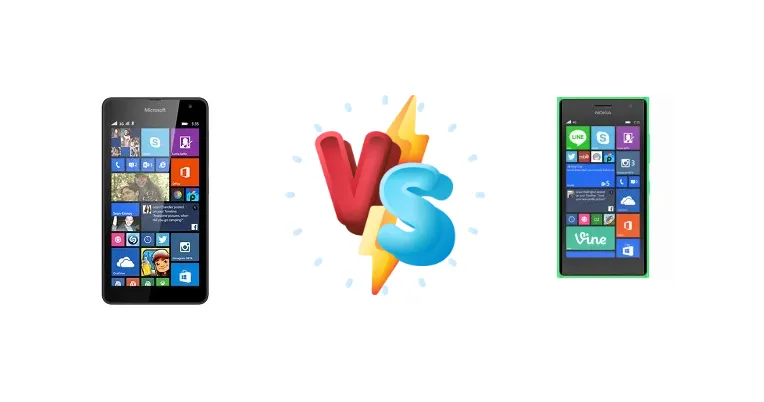
The Microsoft Lumia 535 and Nokia Lumia 735 represent a fascinating point in Windows Phone history – a transition period following Microsoft’s acquisition of Nokia’s devices division. Both aimed for the budget-conscious consumer, but diverged in key areas. This comparison dissects the differences between the Snapdragon 200-powered 535 and the Snapdragon 400-equipped 735, focusing on performance, features, and who each phone best serves.
🏆 Quick Verdict
For the average user, the Nokia Lumia 735 is the superior choice. While both phones share a similar design language, the Snapdragon 400 chipset provides a noticeable performance boost, and the addition of wireless charging adds a layer of convenience that justifies the price difference. The 535 remains a viable option for extremely budget-constrained users.
| Network |
|---|
| 2G bands | GSM 850 / 900 / 1800 / 1900 | GSM 850 / 900 / 1800 / 1900 |
| 3G bands | HSDPA 900 / 2100 | HSDPA 850 / 1700(AWS) / 1900 / 2100 - RM-1039 |
| 4G bands | - | 2, 4, 5, 7, 17 - RM-1039 |
| Speed | HSPA 42.2/5.76 Mbps | HSPA 42.2/5.76 Mbps, LTE Cat4 150/50 Mbps |
| Technology | GSM / HSPA | GSM / HSPA / LTE |
| | - | 3, 7, 20 - RM-1038 |
| Launch |
|---|
| Announced | 2014, November. Released 2014, December | 2014, September. Released 2014, September |
| Status | Discontinued | Discontinued |
| Body |
|---|
| Dimensions | 140.2 x 72.4 x 8.8 mm (5.52 x 2.85 x 0.35 in) | 134.7 x 68.5 x 8.9 mm (5.30 x 2.70 x 0.35 in) |
| SIM | Micro-SIM | Nano-SIM |
| Weight | 146 g (5.15 oz) | 134 g (4.73 oz) |
| Display |
|---|
| Protection | Corning Gorilla Glass 3 | Corning Gorilla Glass 3 |
| Resolution | 540 x 960 pixels, 16:9 ratio (~220 ppi density) | 720 x 1280 pixels, 16:9 ratio (~312 ppi density) |
| Size | 5.0 inches, 68.9 cm2 (~67.9% screen-to-body ratio) | 4.7 inches, 60.9 cm2 (~66.0% screen-to-body ratio) |
| Type | IPS LCD | OLED |
| | - | ClearBlack display |
| Platform |
|---|
| CPU | Quad-core 1.2 GHz Cortex-A7 | Quad-core 1.2 GHz Cortex-A7 |
| Chipset | Qualcomm Snapdragon 200 (28 nm) | Qualcomm Snapdragon 400 (28 nm) |
| GPU | Adreno 302 | Adreno 305 |
| OS | Microsoft Windows Phone 8.1, upgradable to Microsoft Windows 10 | Microsoft Windows Phone 8.1, upgradable to Microsoft Windows 10 |
| Memory |
|---|
| Card slot | microSDXC (dedicated slot) | microSDXC (dedicated slot) |
| Internal | 8GB 1GB RAM | 8GB 1GB RAM |
| | eMMC 4.5 | eMMC 4.5 |
| Main Camera |
|---|
| Features | LED flash | Zeiss optics, LED flash, panorama |
| Single | 5 MP, f/2.4, 28mm (wide), 1/4.0", AF | 6.7 MP (6.1 MP effective), 1/3.4", AF |
| Video | 480p@30fps | 1080p@30fps, stereo sound rec. |
| Selfie camera |
|---|
| Single | 5 MP | 5 MP |
| Video | 720p | 1080p@30fps |
| Sound |
|---|
| 3.5mm jack | Yes | Yes |
| 35mm jack | Yes | Yes |
| Loudspeaker | Yes | Yes |
| Comms |
|---|
| Bluetooth | 4.0, A2DP, LE, aptX | 4.0, A2DP, LE/ aptX after WP8 Denim update |
| NFC | No | Yes |
| Positioning | GPS, GLONASS | GPS, GLONASS, BDS |
| Radio | FM radio | FM radio |
| USB | microUSB 2.0 | microUSB 2.0 |
| WLAN | Wi-Fi 802.11 b/g/n, DLNA, hotspot | Wi-Fi 802.11 b/g/n, DLNA, hotspot |
| Features |
|---|
| Sensors | Accelerometer, proximity | Accelerometer, gyro, proximity, compass, sensor core |
| Battery |
|---|
| Charging | - | Wireless (Qi) |
| Music play | Up to 78 h | Up to 60 h |
| Stand-by | Up to 552 h | Up to 600 h |
| Talk time | Up to 11 h (2G) / Up to 13 h (3G) | Up to 22 h (2G) / Up to 17 h (3G) |
| Type | Li-Ion 1905 mAh, removable (BL-L4A) | Li-Ion 2200 mAh, removable (BV-T5A) |
| Misc |
|---|
| Colors | Orange, green, white, black, gray, blue | Orange, green, white, black |
| Price | About 80 EUR | About 220 EUR |
| SAR | 0.46 W/kg (head) 0.38 W/kg (body) | 1.38 W/kg (head) 0.78 W/kg (body) |
| SAR EU | 0.62 W/kg (head) 0.57 W/kg (body) | 0.80 W/kg (head) 0.48 W/kg (body) |
| Tests |
|---|
| Battery life | - |
Endurance rating 59h
|
| Camera | - |
Photo / Video |
Microsoft Lumia 535
- Lowest possible price for a Windows Phone
- Acceptable battery life
- Functional camera for basic snapshots
- Slow performance due to Snapdragon 200
- No wireless charging
- Limited multitasking capabilities
Nokia Lumia 735
- Noticeably faster performance with Snapdragon 400
- Convenient wireless charging (Qi)
- Potentially better camera image quality
- Higher price than the Lumia 535
- Still not a high-performance device
- Limited internal storage (likely)
Display Comparison
Neither Microsoft nor Nokia provided detailed display specifications for these models. Given their market positioning, both likely utilized LCD panels with resolutions around 480x854. The lack of detailed specs makes a direct comparison difficult, but the Lumia 735’s slightly higher price suggests a potentially better quality panel, though this is speculative. Bezels were substantial on both devices, typical for the era.
Camera Comparison
Both devices feature photo and video capabilities, but detailed sensor information is scarce. The Lumia 735 likely benefits from the more capable ISP (Image Signal Processor) within the Snapdragon 400, leading to better image processing, particularly in low-light conditions. While megapixel counts are likely similar, the 735’s chipset allows for faster image capture and potentially better dynamic range. The absence of Optical Image Stabilization (OIS) on either device means image stabilization relies solely on software, and the 735’s processing power gives it an edge here.
Performance
The core difference lies in the chipsets. The Nokia Lumia 735’s Snapdragon 400, while still a quad-core 1.2 GHz Cortex-A7 processor, represents a significant upgrade over the Lumia 535’s Snapdragon 200. The Snapdragon 400 benefits from a more efficient architecture and a better GPU, resulting in smoother app launches, faster web browsing, and improved gaming performance. While neither phone is a powerhouse, the 400 offers a more responsive user experience. Both utilize 28nm manufacturing, but the architectural improvements in the 400 are key.
Battery Life
Both the Lumia 535 and 735 boast an endurance rating of 59 hours, suggesting similar battery life despite the 735’s more powerful chipset. This indicates efficient power management on both devices. However, the Lumia 735 adds the convenience of wireless charging (Qi standard), a feature absent on the 535. This allows for effortless top-ups without needing to plug in a cable, a significant usability advantage.
Buying Guide
Buy the Microsoft Lumia 535 if you absolutely need the lowest possible price point for a Windows Phone experience and are willing to compromise on performance and features. Buy the Nokia Lumia 735 if you prioritize smoother multitasking, slightly better camera performance, and the convenience of wireless charging, even if it means spending a bit more.
Frequently Asked Questions
❓ Will the Snapdragon 200 in the Lumia 535 struggle with modern apps, even if they are available for Windows Phone?
Yes, the Snapdragon 200 is a very basic processor. While it can handle core Windows Phone functions, running more demanding apps, even those optimized for the platform, will likely result in noticeable lag and slowdowns. Multitasking will also be limited.
❓ Is the wireless charging on the Lumia 735 worth the extra cost if I already have several micro-USB chargers?
Wireless charging offers significant convenience. While you have existing micro-USB chargers, the ability to simply place the 735 on a charging pad eliminates the wear and tear on the charging port and provides a clutter-free charging experience. For many, this convenience justifies the price difference.
❓ Given the age of these phones, are software updates still available?
No. Both the Lumia 535 and 735 are no longer supported by Microsoft with software updates. They are running older versions of Windows Phone and will not receive any further feature enhancements or security patches.