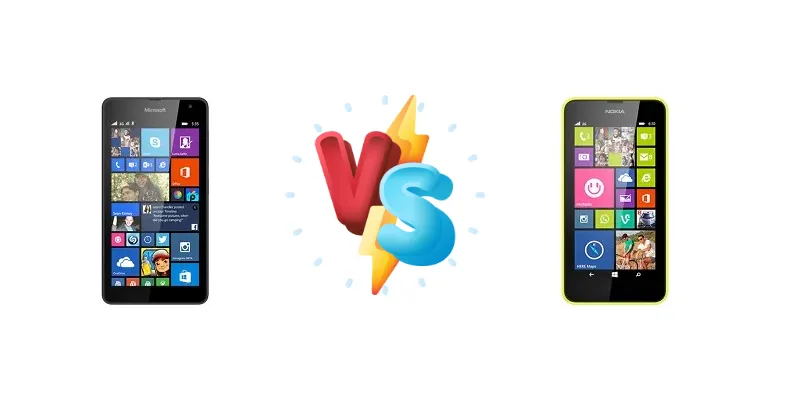
Both the Microsoft Lumia 535 and Nokia Lumia 630 represent entry points into the Windows Phone ecosystem, released within a short timeframe of each other. While both share a similar aesthetic and operating system, a key differentiator lies under the hood: the Qualcomm Snapdragon chipset. This comparison dissects the nuances between the Snapdragon 200 in the 535 and the Snapdragon 400 in the 630, revealing which device delivers a superior user experience.
🏆 Quick Verdict
For the average user, the Nokia Lumia 630 is the better choice. While both phones offer identical battery endurance ratings, the Snapdragon 400 provides a noticeable performance uplift over the Snapdragon 200, resulting in smoother multitasking and app loading times, justifying its slightly higher initial cost.
| Network |
|---|
| 2G bands | GSM 850 / 900 / 1800 / 1900 | GSM 850 / 900 / 1800 / 1900 - all versions |
| 3G bands | HSDPA 900 / 2100 | HSDPA 900 / 2100 - RM-976 |
| Speed | HSPA 42.2/5.76 Mbps | HSPA 21.1/5.76 Mbps |
| Technology | GSM / HSPA | GSM / HSPA |
| | - | HSDPA 850 / 900 / 1900 / 2100 - RM-977 |
| Launch |
|---|
| Announced | 2014, November. Released 2014, December | 2014, April. Released 2014, May |
| Status | Discontinued | Discontinued |
| Body |
|---|
| Dimensions | 140.2 x 72.4 x 8.8 mm (5.52 x 2.85 x 0.35 in) | 129.5 x 66.7 x 9.2 mm, 78.5 cc (5.10 x 2.63 x 0.36 in) |
| SIM | Micro-SIM | Micro-SIM |
| Weight | 146 g (5.15 oz) | 134 g (4.73 oz) |
| Display |
|---|
| Protection | Corning Gorilla Glass 3 | Corning Gorilla Glass 3 |
| Resolution | 540 x 960 pixels, 16:9 ratio (~220 ppi density) | 480 x 854 pixels, 16:9 ratio (~221 ppi density) |
| Size | 5.0 inches, 68.9 cm2 (~67.9% screen-to-body ratio) | 4.5 inches, 54.3 cm2 (~62.9% screen-to-body ratio) |
| Type | IPS LCD | IPS LCD |
| | - | ClearBlack display |
| Platform |
|---|
| CPU | Quad-core 1.2 GHz Cortex-A7 | Quad-core 1.2 GHz Cortex-A7 |
| Chipset | Qualcomm Snapdragon 200 (28 nm) | Qualcomm Snapdragon 400 (28 nm) |
| GPU | Adreno 302 | Adreno 305 |
| OS | Microsoft Windows Phone 8.1, upgradable to Microsoft Windows 10 | Microsoft Windows Phone 8.1 |
| Memory |
|---|
| Card slot | microSDXC (dedicated slot) | microSDXC (dedicated slot) |
| Internal | 8GB 1GB RAM | 8GB 512MB RAM |
| | eMMC 4.5 | eMMC 4.5 |
| Main Camera |
|---|
| Features | LED flash | Panorama |
| Single | 5 MP, f/2.4, 28mm (wide), 1/4.0", AF | 5 MP, 1/4.0", AF |
| Video | 480p@30fps | 720p@30fps |
| Selfie camera |
|---|
| Single | 5 MP | - |
| Video | 720p | - |
| | - | No |
| Sound |
|---|
| 3.5mm jack | Yes | Yes |
| 35mm jack | Yes | Yes |
| Loudspeaker | Yes | Yes |
| Comms |
|---|
| Bluetooth | 4.0, A2DP, LE, aptX | 4.0, A2DP, LE/ aptX after WP8 Denim update |
| NFC | No | No |
| Positioning | GPS, GLONASS | GPS, GLONASS |
| Radio | FM radio | FM radio |
| USB | microUSB 2.0 | microUSB 2.0 |
| WLAN | Wi-Fi 802.11 b/g/n, DLNA, hotspot | Wi-Fi 802.11 b/g/n, DLNA, hotspot |
| Features |
|---|
| Sensors | Accelerometer, proximity | Accelerometer, sensor core |
| Battery |
|---|
| Music play | Up to 78 h | Up to 58 h |
| Stand-by | Up to 552 h | Up to 600 h |
| Talk time | Up to 11 h (2G) / Up to 13 h (3G) | Up to 16 h 20 min (2G) / Up to 13 h 10 min (3G) |
| Type | Li-Ion 1905 mAh, removable (BL-L4A) | Li-Ion 1830 mAh, removable (BL-5H) |
| Misc |
|---|
| Colors | Orange, green, white, black, gray, blue | Bright Orange, bright green, bright yellow, white, black |
| Price | About 80 EUR | About 110 EUR |
| SAR | 0.46 W/kg (head) 0.38 W/kg (body) | 1.52 W/kg (head) 1.25 W/kg (body) |
| SAR EU | 0.62 W/kg (head) 0.57 W/kg (body) | 1.51 W/kg (head) 1.52 W/kg (body) |
| Tests |
|---|
| Battery life | - | Endurance rating 66h |
| Camera | - |
Photo / Video |
| Display | - |
Contrast ratio: 771:1 (nominal), 2.056 (sunlight) |
| Loudspeaker | - |
Voice 68dB / Noise 65dB / Ring 75dB |
Microsoft Lumia 535
- Potentially lower price point due to the less powerful chipset.
- Identical battery life to the Lumia 630.
- Similar display quality to the Lumia 630.
- Significantly slower performance compared to the Snapdragon 400.
- May struggle with multitasking and demanding apps.
- Limited future-proofing due to the older chipset.
Nokia Lumia 630
- Noticeably faster performance thanks to the Snapdragon 400.
- Smoother multitasking and app loading times.
- Better overall user experience.
- Potentially higher price compared to the Lumia 535.
- Identical battery life to the Lumia 535.
- Similar display quality to the Lumia 535.
Display Comparison
Both the Lumia 535 and 630 share the same display characteristics, boasting a contrast ratio of 771:1 (nominal) and 2.056 (sunlight). This indicates similar outdoor visibility and color reproduction. However, the specific panel technology and resolution are not specified in the provided data. Given their market positioning, it’s reasonable to assume both utilize IPS LCD panels with a resolution of 854x480, prioritizing battery life over pixel density. The identical contrast ratios suggest a similar viewing experience in various lighting conditions.
Camera Comparison
Both devices are listed as having 'Photo / Video' capabilities, but lack specific details regarding sensor size, aperture, or image processing features. Given their budget nature, it’s likely both feature similar 5-8MP rear cameras with basic image stabilization. Without further specifications, it’s difficult to definitively state which camera performs better. However, the Snapdragon 400’s slightly more powerful ISP (Image Signal Processor) *could* translate to marginally better image processing, particularly in low-light conditions, but this is speculative.
Performance
The core difference between these devices lies in their chipsets. The Nokia Lumia 630’s Snapdragon 400, while also utilizing a quad-core 1.2 GHz Cortex-A7 CPU, represents a significant architectural improvement over the Snapdragon 200 found in the Lumia 535. The Snapdragon 400 features a more efficient GPU and improved memory bandwidth, leading to faster app launches, smoother scrolling, and better multitasking performance. While both CPUs share the same clock speed and core count, the Snapdragon 400’s superior architecture translates to a more responsive user experience. The 28nm manufacturing process is shared, meaning thermal differences will be minimal, but the 400 will handle sustained loads better.
Battery Life
Interestingly, both the Lumia 535 and 630 achieve the same endurance rating of 66 hours. This suggests that despite the Snapdragon 400 being more powerful, its efficiency is balanced by the overall system optimization and battery capacity. The lack of charging wattage information makes it impossible to compare charging speeds. However, the identical endurance rating indicates that users can expect similar all-day battery life from both devices under typical usage scenarios.
Buying Guide
Buy the Microsoft Lumia 535 if your primary need is a device for basic communication – calls, texts, and light social media – and you are prioritizing the lowest possible upfront cost. Buy the Nokia Lumia 630 if you value a more responsive user experience, even for everyday tasks, and anticipate running multiple apps or engaging in occasional light gaming. The Snapdragon 400 offers a tangible improvement in performance that will be felt during daily use.
Frequently Asked Questions
❓ Will I notice a significant difference in app loading times between the Lumia 535 and 630?
Yes, you will. The Snapdragon 400 in the Lumia 630 offers a noticeable improvement in CPU and GPU performance compared to the Snapdragon 200 in the Lumia 535. This translates to faster app launches, smoother scrolling, and a more responsive overall experience, especially when opening multiple applications.
❓ Does the Snapdragon 400 in the Lumia 630 allow for better gaming performance?
While neither phone is a gaming powerhouse, the Snapdragon 400 provides a more capable GPU. This means you'll experience fewer frame drops and smoother gameplay in less demanding Windows Phone games. However, don't expect to run graphically intensive titles at high settings.
❓ If battery life is identical, does the Snapdragon 400 consume more power?
The Snapdragon 400 is more powerful, and therefore *can* consume more power under load. However, the 66-hour endurance rating suggests that the system is optimized to balance performance and efficiency. The Snapdragon 400 likely achieves its performance gains through architectural improvements rather than simply drawing more power.