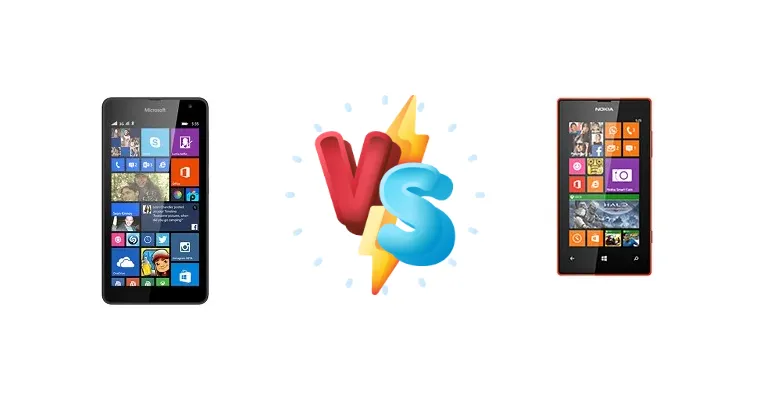
The Microsoft Lumia 535 and Nokia Lumia 525 represent distinct points in the budget Windows Phone landscape. The 525, a late-era Nokia offering, aimed for affordability with a focus on essential features. The 535, Microsoft’s first branded Lumia, attempted a slight performance bump and a refreshed design. This comparison dissects their core differences to determine which provides the best value today.
🏆 Quick Verdict
For the average user seeking a functional, albeit aging, Windows Phone experience, the Microsoft Lumia 535 is the better choice. Its quad-core Snapdragon 200 processor offers a noticeable performance advantage over the dual-core MSM8227 in the 525, making it more responsive for everyday tasks and light multitasking.
| Network |
|---|
| 2G bands | GSM 850 / 900 / 1800 / 1900 | GSM 850 / 900 / 1800 / 1900 - RM-998 |
| 3G bands | HSDPA 900 / 2100 | HSDPA 900 / 2100 - RM-998 |
| 4G bands | - | 1, 3, 7, 8, 20, 28, 38, 40 |
| Speed | HSPA 42.2/5.76 Mbps | HSPA 21.1/5.76 Mbps |
| Technology | GSM / HSPA | GSM / HSPA |
| Launch |
|---|
| Announced | 2014, November. Released 2014, December | 2013, November. Released 2014, January |
| Status | Discontinued | Discontinued |
| Body |
|---|
| Build | - | Glass front, glass back, aluminum frame |
| Dimensions | 140.2 x 72.4 x 8.8 mm (5.52 x 2.85 x 0.35 in) | 119.9 x 64 x 9.9 mm, 75.7 cc (4.72 x 2.52 x 0.39 in) |
| SIM | Micro-SIM | Micro-SIM |
| Weight | 146 g (5.15 oz) | 124 g (4.37 oz) |
| Display |
|---|
| Protection | Corning Gorilla Glass 3 | Scratch-resistant glass |
| Resolution | 540 x 960 pixels, 16:9 ratio (~220 ppi density) | 480 x 800 pixels, 5:3 ratio (~233 ppi density) |
| Size | 5.0 inches, 68.9 cm2 (~67.9% screen-to-body ratio) | 4.0 inches, 45.5 cm2 (~59.3% screen-to-body ratio) |
| Type | IPS LCD | IPS LCD |
| Platform |
|---|
| CPU | Quad-core 1.2 GHz Cortex-A7 | Dual-core 1.0 GHz |
| Chipset | Qualcomm Snapdragon 200 (28 nm) | Qualcomm MSM8227 |
| GPU | Adreno 302 | Adreno 305 |
| OS | Microsoft Windows Phone 8.1, upgradable to Microsoft Windows 10 | Microsoft Windows Phone 8, upgradable to 8.1 |
| Memory |
|---|
| Card slot | microSDXC (dedicated slot) | microSDXC (dedicated slot) |
| Internal | 8GB 1GB RAM | 8GB 1GB RAM |
| | eMMC 4.5 | - |
| Main Camera |
|---|
| Features | LED flash | LED flash, panorama, HDR |
| Single | 5 MP, f/2.4, 28mm (wide), 1/4.0", AF | 5 MP, 1/4.0", AF |
| Triple | - | 48 MP, f/1.8, 26mm (wide), 1/2.0", 0.8µm, PDAF
8 MP, f/2.2, 120˚, 15mm (ultrawide), 1/4.0", 1.12µm
5 MP, f/2.4, (depth) |
| Video | 480p@30fps | 720p@30fps |
| Selfie camera |
|---|
| Features | - | HDR |
| Single | 5 MP | 16 MP, f/1.9, 29mm (standard), 1/3.06, 1.0µm |
| Video | 720p | 4K@30fps, 1080p@30fps |
| | - | No |
| Sound |
|---|
| 3.5mm jack | Yes | Yes |
| 35mm jack | Yes | Yes |
| Loudspeaker | Yes | Yes |
| Comms |
|---|
| Bluetooth | 4.0, A2DP, LE, aptX | 4.0, A2DP, LE/ aptX after WP8 Denim update |
| NFC | No | No |
| Positioning | GPS, GLONASS | GPS, GLONASS |
| Radio | FM radio | FM Radio |
| USB | microUSB 2.0 | microUSB 2.0 |
| WLAN | Wi-Fi 802.11 b/g/n, DLNA, hotspot | Wi-Fi 802.11 b/g/n, hotspot |
| Features |
|---|
| Sensors | Accelerometer, proximity | Accelerometer, proximity |
| Battery |
|---|
| Charging | - | 15W wired, QC3
9W wireless |
| Music play | Up to 78 h | Up to 48 h |
| Stand-by | Up to 552 h | Up to 336 h (2G) / Up to 336 h (3G) |
| Talk time | Up to 11 h (2G) / Up to 13 h (3G) | Up to 17 h (2G) / Up to 10 h 40 min (3G) |
| Type | Li-Ion 1905 mAh, removable (BL-L4A) | Li-Ion 1430 mAh, removable (BL-5J) |
| Misc |
|---|
| Colors | Orange, green, white, black, gray, blue | Black, White, Yellow, Red |
| Models | - | LMG910EMW, LM-G910EMW |
| Price | About 80 EUR | About 120 EUR |
| SAR | 0.46 W/kg (head) 0.38 W/kg (body) | - |
| SAR EU | 0.62 W/kg (head) 0.57 W/kg (body) | 0.72 W/kg (head) 0.79 W/kg (body) |
Microsoft Lumia 535
- Faster quad-core processor for smoother performance
- Potentially better image processing due to the Snapdragon 200
- Microsoft branding may appeal to some users
- Charging specifications are unknown, potentially slower than the 525
- Likely similar low-resolution display to the 525
Nokia Lumia 525
- 15W wired charging with Quick Charge 3 (QC3) support
- Potentially lower price point
- Nokia’s reputation for build quality (at the time)
- Slower dual-core processor limits performance
- Less responsive user experience compared to the 535
- Older device, potentially reduced software support
Display Comparison
Neither device boasts a particularly impressive display. Specifics regarding panel type, resolution, and brightness are unavailable, but both likely utilized LCD panels typical of their price bracket. The focus here isn't display quality, but rather the overall user experience, where the faster processor of the 535 will contribute to smoother scrolling and transitions.
Camera Comparison
Both devices likely featured similar low-resolution camera setups typical of the budget segment. Without specific sensor details, a direct comparison is difficult. However, image processing capabilities are tied to the processor, giving the Lumia 535 a slight edge in post-processing speed and potentially image quality. Focusing on the processor's ability to handle image data is more relevant than sensor megapixels in this price range.
Performance
The core difference lies in the chipset. The Microsoft Lumia 535’s Qualcomm Snapdragon 200, with its quad-core 1.2 GHz Cortex-A7 CPUs, represents a significant architectural leap over the Nokia Lumia 525’s Qualcomm MSM8227 dual-core processor. While both are based on the ARM Cortex-A7 architecture, the additional cores in the Snapdragon 200 allow for better multitasking and handling of more demanding applications. The MSM8227, while efficient, will struggle with even moderate workloads. The 28nm process node of the Snapdragon 200 also suggests slightly better power efficiency compared to the MSM8227’s fabrication process.
Battery Life
Battery capacity details are missing for both devices. However, the Nokia Lumia 525’s inclusion of 15W wired charging with Quick Charge 3 (QC3) support is a notable advantage. While the Lumia 535’s charging capabilities are unknown, the 525’s QC3 support promises significantly faster charging times when paired with a compatible charger. This is particularly beneficial for users who frequently need to top up their battery quickly.
Buying Guide
Buy the Microsoft Lumia 535 if you prioritize a smoother user experience and slightly faster app loading times, even if it means sacrificing potentially faster charging. Buy the Nokia Lumia 525 if you value potentially faster charging (QC3 support) and are willing to accept a more basic level of performance, particularly if you find a significantly lower price point.
Frequently Asked Questions
❓ Does the Nokia Lumia 525's Quick Charge 3.0 support actually make a noticeable difference in charging speed?
Yes, Quick Charge 3.0 allows the Lumia 525 to draw more power from a compatible charger, significantly reducing charging times compared to standard USB charging. This is a key advantage if you frequently need to quickly replenish the battery.
❓ Will I notice a significant performance difference between the Lumia 535 and 525 when using basic apps like WhatsApp and Facebook?
While both phones can handle basic apps, the Lumia 535’s quad-core processor will provide a smoother and more responsive experience. You’ll likely notice less lag when switching between apps or scrolling through feeds on the 535.
❓ Given these phones are older, what is the current software support situation?
Both devices are past their end-of-life for official software updates from Microsoft. While some community efforts may exist, you should expect limited or no further updates, potentially impacting security and app compatibility.