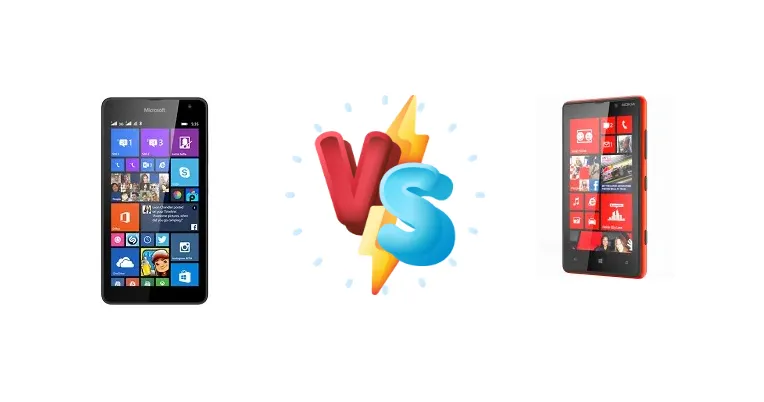
The Microsoft Lumia 535 Dual SIM and the Nokia Lumia 820 represent different eras and priorities within the Windows Phone ecosystem. The 535, released after Microsoft’s acquisition of Nokia’s devices division, aimed for affordability and accessibility with features like dual-SIM support. The 820, a Nokia-branded device, was a more premium offering focused on a compact form factor and solid performance for its time. This comparison dissects their key differences to help users understand which device best suits their needs, especially given their current status as older, budget-friendly options.
🏆 Quick Verdict
For the average user today, the Nokia Lumia 820 is the better choice. While both phones are aging, the Snapdragon S4 Plus chipset provides a significantly smoother experience than the Snapdragon 200 in the Lumia 535. The 820’s superior processing power translates to faster app loading and better multitasking, outweighing the 535’s dual-SIM functionality for most.
| Network |
|---|
| 2G bands | GSM 850 / 900 / 1800 / 1900 | GSM 850 / 900 / 1800 / 1900 |
| 3G bands | HSDPA 900 / 2100 - RM-1090 | HSDPA 850 / 900 / 1900 / 2100 |
| 4G bands | - | 1, 3, 7, 8, 20 |
| EDGE | - | Class 12 |
| GPRS | - | Class 12 |
| Speed | HSPA 42.2/5.76 Mbps | HSPA 42.2/5.76 Mbps, LTE Cat3 100/50 Mbps |
| Technology | GSM / HSPA | GSM / HSPA / LTE |
| | HSDPA 850 / 900 / 1900 / 2100 - RM-1092 | - |
| Launch |
|---|
| Announced | 2014, November. Released 2014, December | 2012, September. Released 2012, November |
| Status | Discontinued | Discontinued |
| Body |
|---|
| Dimensions | 140.2 x 72.4 x 8.8 mm (5.52 x 2.85 x 0.35 in) | 123.8 x 68.5 x 9.9 mm, 83.5 cc (4.87 x 2.70 x 0.39 in) |
| SIM | Dual SIM (Micro-SIM, dual stand-by) | Micro-SIM |
| Weight | 146 g (5.15 oz) | 160 g (5.64 oz) |
| Display |
|---|
| Protection | Corning Gorilla Glass 3 | - |
| Resolution | 540 x 960 pixels, 16:9 ratio (~220 ppi density) | 480 x 800 pixels, 5:3 ratio (~217 ppi density) |
| Size | 5.0 inches, 68.9 cm2 (~67.9% screen-to-body ratio) | 4.3 inches, 52.6 cm2 (~62.1% screen-to-body ratio) |
| Type | IPS LCD | AMOLED |
| | - | Nokia ClearBlack display |
| Platform |
|---|
| CPU | Quad-core 1.2 GHz Cortex-A7 | Dual-core 1.5 GHz Krait |
| Chipset | Qualcomm Snapdragon 200 (28 nm) | Qualcomm MSM8960 Snapdragon S4 Plus |
| GPU | Adreno 302 | Adreno 225 |
| OS | Microsoft Windows Phone 8.1 | Microsoft Windows Phone 8, upgradable to 8.1 |
| Memory |
|---|
| Card slot | microSDXC (dedicated slot) | microSDXC (dedicated slot) |
| Internal | 8GB 1GB RAM | 8GB 1GB RAM |
| | eMMC 4.5 | - |
| Main Camera |
|---|
| Features | LED flash | Carl Zeiss optics, dual-LED flash |
| Single | 5 MP, f/2.4, 28mm (wide), 1/4.0", AF | 8 MP, AF |
| Video | 480p@30fps | 1080p@30fps |
| Selfie camera |
|---|
| Single | 5 MP | VGA |
| Sound |
|---|
| 3.5mm jack | Yes | Yes |
| 35mm jack | Yes | Yes |
| Loudspeaker | Yes | Yes |
| Comms |
|---|
| Bluetooth | 4.0, A2DP, LE, aptX | 4.0, A2DP, EDR, LE/ aptX after WP8 Denim update |
| NFC | No | Yes |
| Positioning | GPS, GLONASS | GPS, A-GPS, GLONASS |
| Radio | FM radio | FM radio |
| USB | microUSB 2.0 | microUSB 2.0 |
| WLAN | Wi-Fi 802.11 b/g/n, DLNA, hotspot | Wi-Fi 802.11 a/b/g/n, dual-band, Wi-Fi Direct |
| Features |
|---|
| Sensors | Accelerometer, proximity | Accelerometer, gyro, proximity, compass |
| Battery |
|---|
| Music play | Up to 78 h | Up to 55 h |
| Stand-by | Up to 336 h | Up to 330 h (2G) / Up to 330 h (3G) |
| Talk time | Up to 11 h (2G) / Up to 13 h (3G) | Up to 14 h (2G) / Up to 8 h (3G) |
| Type | Li-Ion 1905 mAh, removable (BL-L4A) | Removable Li-Ion 1650 mAh battery (BP-5T) |
| Misc |
|---|
| Colors | Orange, green, white, black, gray, blue | Black, Gray, Red, Yellow, White, Blue, Violet |
| Price | About 80 EUR | About 170 EUR |
| SAR | 0.49 W/kg (head) 0.44 W/kg (body) | 1.37 W/kg (head) 0.71 W/kg (body) |
| SAR EU | 0.60 W/kg (head) 0.55 W/kg (body) | 0.79 W/kg (head) |
| Tests |
|---|
| Audio quality |
Noise -93.9dB / Crosstalk -94.2dB |
Noise -82.2dB / Crosstalk -81.4dB |
| Battery life | Endurance rating 44h |
Endurance rating 40h
|
| Camera |
Photo |
Photo / Video |
| Display | - |
Contrast ratio: Infinite (nominal) / 2.193:1 (sunlight) |
| Loudspeaker |
Voice 66dB / Noise 64dB / Ring 71dB |
Voice 67dB / Noise 66dB / Ring 70dB
|
Microsoft Lumia 535 Dual SIM
- Dual-SIM functionality for managing multiple numbers.
- Lower price point, making it accessible on a budget.
- Relatively lightweight and portable.
- Significantly slower processor compared to the Lumia 820.
- Limited camera capabilities with no video recording.
- Lack of detailed display specifications suggests a lower-quality screen.
Nokia Lumia 820
- More powerful Snapdragon S4 Plus processor for smoother performance.
- Video recording capabilities for capturing moving images.
- Better display contrast ratio for improved outdoor visibility.
- Lacks dual-SIM functionality.
- May be harder to find and potentially more expensive than the Lumia 535.
- Older device with limited software support.
Display Comparison
The Nokia Lumia 820 boasts a display with a contrast ratio of Infinite (nominal) / 2.193:1 in sunlight, suggesting better visibility in bright conditions compared to the Lumia 535, which lacks detailed display specifications. While both likely utilize LCD technology common for the period, the 820’s contrast ratio indicates superior outdoor readability. The Lumia 820’s smaller screen size (assumed, based on its compact flagship positioning) likely contributes to a higher pixel density, resulting in a sharper image, though this is not explicitly stated in the provided data. The 535’s display details are absent, making a direct comparison difficult, but it likely targets a lower price point with a less refined panel.
Camera Comparison
Both devices feature a 'Photo' camera, but the Nokia Lumia 820 goes a step further by also offering 'Video' recording capabilities. This suggests a more versatile camera experience. While sensor sizes and apertures are not specified, the Lumia 820, being a higher-tier device, likely incorporates a superior image sensor and lens. The absence of detailed camera specs on the Lumia 535 suggests a more basic camera experience focused on casual snapshots. The Lumia 820’s inclusion of video recording is a key differentiator for users who want to capture moving images.
Performance
The performance gap between these devices is substantial. The Nokia Lumia 820’s Qualcomm MSM8960 Snapdragon S4 Plus, featuring a dual-core 1.5 GHz Krait processor, significantly outperforms the Microsoft Lumia 535’s quad-core 1.2 GHz Cortex-A7 processor on the Snapdragon 200. The Krait architecture is more efficient and powerful than the Cortex-A7, resulting in faster processing speeds and smoother multitasking. The Snapdragon S4 Plus also benefits from a more advanced manufacturing process (28nm) compared to the Snapdragon 200, contributing to better thermal management and sustained performance. Users will notice a marked difference in app loading times and overall responsiveness on the Lumia 820.
Battery Life
Both phones offer similar endurance ratings, with the Lumia 535 achieving 44 hours and the Lumia 820 at 40 hours. However, this doesn’t tell the whole story. The Snapdragon S4 Plus in the Lumia 820 is more power-efficient than the Snapdragon 200 in the Lumia 535, meaning it can deliver comparable battery life with potentially less strain on the battery. While charging wattage isn’t specified for either device, the Lumia 820’s more efficient processor could translate to slightly longer real-world usage, especially during demanding tasks.
Buying Guide
Buy the Microsoft Lumia 535 Dual SIM if you absolutely require dual-SIM functionality on a very tight budget and are willing to compromise on performance. It’s suitable for basic communication and light tasks. Buy the Nokia Lumia 820 if you prioritize a more responsive user experience, better camera capabilities, and a more refined build quality, even if it means sacrificing dual-SIM support. It’s ideal for users who want a functional, albeit older, smartphone for everyday use.
Frequently Asked Questions
❓ Is the Snapdragon 200 in the Lumia 535 sufficient for basic social media and messaging?
While the Snapdragon 200 can handle basic tasks like social media and messaging, it will struggle with more demanding applications or multitasking. Expect noticeable lag and slow loading times. It's best suited for users with very limited smartphone needs.
❓ Does the Nokia Lumia 820 still receive software updates, and is Windows Phone security a concern?
No, the Nokia Lumia 820 no longer receives official software updates from Microsoft. This means it's vulnerable to security risks. Using it requires caution, such as avoiding sensitive transactions and limiting app installations to trusted sources. Consider the security implications before using it for personal data.
❓ How does the dual-SIM functionality on the Lumia 535 benefit users?
The dual-SIM capability allows you to use two separate SIM cards in the same phone, ideal for managing personal and work numbers, or for taking advantage of different carrier plans simultaneously. This is particularly useful for frequent travelers or those who want to avoid roaming charges.