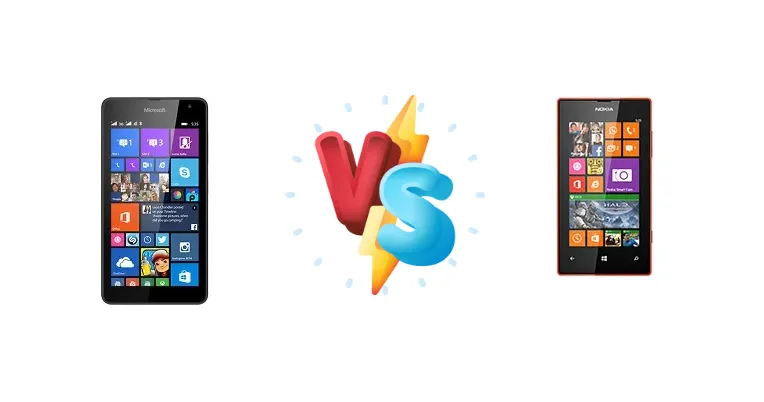
The Microsoft Lumia 535 Dual SIM and the Nokia Lumia 525 represent two points in the evolution of affordable Windows Phone devices. The 525, a late-era Nokia offering, aimed for value, while the 535 marked Microsoft’s first fully branded smartphone. This comparison dissects their core differences to determine which provides the best experience for today’s user.
🏆 Quick Verdict
For the average user seeking a slightly more modern experience and the convenience of dual SIM functionality, the Microsoft Lumia 535 is the better choice. Its quad-core processor offers a noticeable performance uplift over the Lumia 525’s dual-core chip, despite both being based on the Cortex-A7 architecture. However, the Lumia 525’s charging capabilities are superior.
| Network |
|---|
| 2G bands | GSM 850 / 900 / 1800 / 1900 | GSM 850 / 900 / 1800 / 1900 - RM-998 |
| 3G bands | HSDPA 900 / 2100 - RM-1090 | HSDPA 900 / 2100 - RM-998 |
| 4G bands | - | 1, 3, 7, 8, 20, 28, 38, 40 |
| Speed | HSPA 42.2/5.76 Mbps | HSPA 21.1/5.76 Mbps |
| Technology | GSM / HSPA | GSM / HSPA |
| | HSDPA 850 / 900 / 1900 / 2100 - RM-1092 | - |
| Launch |
|---|
| Announced | 2014, November. Released 2014, December | 2013, November. Released 2014, January |
| Status | Discontinued | Discontinued |
| Body |
|---|
| Build | - | Glass front, glass back, aluminum frame |
| Dimensions | 140.2 x 72.4 x 8.8 mm (5.52 x 2.85 x 0.35 in) | 119.9 x 64 x 9.9 mm, 75.7 cc (4.72 x 2.52 x 0.39 in) |
| SIM | Dual SIM (Micro-SIM, dual stand-by) | Micro-SIM |
| Weight | 146 g (5.15 oz) | 124 g (4.37 oz) |
| Display |
|---|
| Protection | Corning Gorilla Glass 3 | Scratch-resistant glass |
| Resolution | 540 x 960 pixels, 16:9 ratio (~220 ppi density) | 480 x 800 pixels, 5:3 ratio (~233 ppi density) |
| Size | 5.0 inches, 68.9 cm2 (~67.9% screen-to-body ratio) | 4.0 inches, 45.5 cm2 (~59.3% screen-to-body ratio) |
| Type | IPS LCD | IPS LCD |
| Platform |
|---|
| CPU | Quad-core 1.2 GHz Cortex-A7 | Dual-core 1.0 GHz |
| Chipset | Qualcomm Snapdragon 200 (28 nm) | Qualcomm MSM8227 |
| GPU | Adreno 302 | Adreno 305 |
| OS | Microsoft Windows Phone 8.1 | Microsoft Windows Phone 8, upgradable to 8.1 |
| Memory |
|---|
| Card slot | microSDXC (dedicated slot) | microSDXC (dedicated slot) |
| Internal | 8GB 1GB RAM | 8GB 1GB RAM |
| | eMMC 4.5 | - |
| Main Camera |
|---|
| Features | LED flash | LED flash, panorama, HDR |
| Single | 5 MP, f/2.4, 28mm (wide), 1/4.0", AF | 5 MP, 1/4.0", AF |
| Triple | - | 48 MP, f/1.8, 26mm (wide), 1/2.0", 0.8µm, PDAF
8 MP, f/2.2, 120˚, 15mm (ultrawide), 1/4.0", 1.12µm
5 MP, f/2.4, (depth) |
| Video | 480p@30fps | 720p@30fps |
| Selfie camera |
|---|
| Features | - | HDR |
| Single | 5 MP | 16 MP, f/1.9, 29mm (standard), 1/3.06, 1.0µm |
| Video | - | 4K@30fps, 1080p@30fps |
| | - | No |
| Sound |
|---|
| 3.5mm jack | Yes | Yes |
| 35mm jack | Yes | Yes |
| Loudspeaker | Yes | Yes |
| Comms |
|---|
| Bluetooth | 4.0, A2DP, LE, aptX | 4.0, A2DP, LE/ aptX after WP8 Denim update |
| NFC | No | No |
| Positioning | GPS, GLONASS | GPS, GLONASS |
| Radio | FM radio | FM Radio |
| USB | microUSB 2.0 | microUSB 2.0 |
| WLAN | Wi-Fi 802.11 b/g/n, DLNA, hotspot | Wi-Fi 802.11 b/g/n, hotspot |
| Features |
|---|
| Sensors | Accelerometer, proximity | Accelerometer, proximity |
| Battery |
|---|
| Charging | - | 15W wired, QC3
9W wireless |
| Music play | Up to 78 h | Up to 48 h |
| Stand-by | Up to 336 h | Up to 336 h (2G) / Up to 336 h (3G) |
| Talk time | Up to 11 h (2G) / Up to 13 h (3G) | Up to 17 h (2G) / Up to 10 h 40 min (3G) |
| Type | Li-Ion 1905 mAh, removable (BL-L4A) | Li-Ion 1430 mAh, removable (BL-5J) |
| Misc |
|---|
| Colors | Orange, green, white, black, gray, blue | Black, White, Yellow, Red |
| Models | - | LMG910EMW, LM-G910EMW |
| Price | About 80 EUR | About 120 EUR |
| SAR | 0.49 W/kg (head) 0.44 W/kg (body) | - |
| SAR EU | 0.60 W/kg (head) 0.55 W/kg (body) | 0.72 W/kg (head) 0.79 W/kg (body) |
| Tests |
|---|
| Audio quality |
Noise -93.9dB / Crosstalk -94.2dB | - |
| Battery life | Endurance rating 44h | - |
| Camera |
Photo | - |
| Loudspeaker |
Voice 66dB / Noise 64dB / Ring 71dB | - |
Microsoft Lumia 535 Dual SIM
- Quad-core processor offers better performance
- Dual SIM functionality provides added convenience
- More modern software experience (potentially)
- Charging speed is likely slower
- No wireless charging support
Nokia Lumia 525
- Faster charging with QC3 and 15W wired
- Wireless charging support (9W)
- Potentially lower price point on the used market
- Dual-core processor limits multitasking
- Single SIM functionality
Display Comparison
Neither device boasts a particularly impressive display. Specifics regarding panel type, resolution, or brightness are unavailable, but both likely utilize LCD panels typical of their price bracket. The focus here isn't on visual fidelity, but rather functionality. The Lumia 535’s slightly larger form factor may translate to a marginally more immersive viewing experience, but the difference is unlikely to be significant.
Camera Comparison
Both devices feature a basic photo camera, but detailed specifications are lacking. Given the market segment, image quality is unlikely to be a strong suit for either. The Lumia 535’s camera benefits from the processing power of the Snapdragon 200, potentially allowing for slightly faster image capture and processing. However, without knowing sensor size or aperture, it’s difficult to definitively say which camera performs better. The absence of Optical Image Stabilization (OIS) on either device suggests low-light performance will be limited.
Performance
The core difference lies in the processing power. The Lumia 535’s Qualcomm Snapdragon 200, featuring a quad-core 1.2 GHz Cortex-A7 CPU, represents a clear upgrade over the Nokia Lumia 525’s Qualcomm MSM8227, a dual-core 1.0 GHz processor. While both CPUs are based on the same Cortex-A7 architecture, the additional cores in the Snapdragon 200 will result in smoother multitasking and faster app loading times. The Snapdragon 200’s 28nm manufacturing process, while not cutting-edge, is comparable to the MSM8227 and doesn’t introduce a significant thermal disadvantage. Users will notice the performance difference in everyday tasks.
Battery Life
The Lumia 535 has an endurance rating of 44 hours, indicating moderate battery life. The Lumia 525 lacks a specific endurance rating, but its lower processing demands *could* translate to comparable battery life. However, the Lumia 525 boasts significantly faster charging capabilities with 15W wired charging and QC3 support, and even 9W wireless charging. This is a major advantage, allowing for quicker top-ups compared to the Lumia 535’s unspecified charging speed. The inclusion of Quick Charge 3.0 on the 525 is a notable feature for its time.
Buying Guide
Buy the Microsoft Lumia 535 Dual SIM if you need a device capable of handling basic multitasking and benefit from the flexibility of using two SIM cards simultaneously. Buy the Nokia Lumia 525 if you prioritize faster charging and are content with a simpler, single-SIM experience, and are looking for a potentially lower price point on the used market.
Frequently Asked Questions
❓ Is the Lumia 535’s Snapdragon 200 powerful enough for modern apps, even if they are lightweight?
While the Snapdragon 200 is a low-end processor, it’s sufficient for basic tasks like calling, texting, browsing, and running lightweight apps. However, demanding applications or heavy multitasking will likely result in noticeable slowdowns. It's important to manage expectations given the phone's age and original price point.
❓ Does the Lumia 525’s wireless charging make it a better option for overnight charging?
The Lumia 525’s 9W wireless charging is a convenient feature, but it’s significantly slower than wired charging. While suitable for overnight charging, it will take considerably longer to reach a full charge compared to using the 15W wired charger. The convenience factor is the primary benefit here.
❓ Given both phones are older, are software updates still available?
Neither the Lumia 535 nor the Lumia 525 receive official software updates from Microsoft anymore. Both are running older versions of Windows Phone 8.1, and app compatibility may be limited. Security updates are also no longer provided, making them potentially vulnerable to security threats.