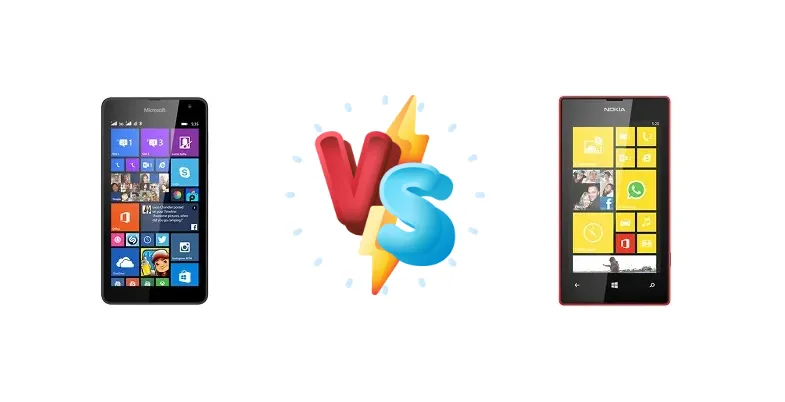
The Microsoft Lumia 535 Dual SIM and the Nokia Lumia 520 represent distinct points in the evolution of affordable Windows Phone devices. The 520, a classic from Nokia’s era, established a benchmark for budget smartphones. The 535, released after Microsoft’s acquisition, aimed to refresh the formula with a newer processor and dual-SIM capability. This comparison dissects their key differences to determine which offers the best value today.
🏆 Quick Verdict
For the average user seeking a functional, albeit aging, Windows Phone experience, the Nokia Lumia 520 edges out the Microsoft Lumia 535. While the 535 boasts a more modern processor, the 520’s superior battery endurance and comparable performance for basic tasks make it the more practical choice.
| Network |
|---|
| 2G bands | GSM 850 / 900 / 1800 / 1900 | GSM 850 / 900 / 1800 / 1900 - all versions |
| 3G bands | HSDPA 900 / 2100 - RM-1090 | HSDPA 900 / 2100 - RM-914 |
| Speed | HSPA 42.2/5.76 Mbps | HSPA 21.1/5.76 Mbps |
| Technology | GSM / HSPA | GSM / HSPA |
| | HSDPA 850 / 900 / 1900 / 2100 - RM-1092 | HSDPA 850 / 1700 / 1900 / 2100 - RM-917 |
| Launch |
|---|
| Announced | 2014, November. Released 2014, December | 2013, February. Released 2013, April |
| Status | Discontinued | Discontinued |
| Body |
|---|
| Build | - | Glass front, plastic back, plastic frame |
| Dimensions | 140.2 x 72.4 x 8.8 mm (5.52 x 2.85 x 0.35 in) | 119.9 x 64 x 9.9 mm, 75.7 cc (4.72 x 2.52 x 0.39 in) |
| SIM | Dual SIM (Micro-SIM, dual stand-by) | Micro-SIM |
| Weight | 146 g (5.15 oz) | 124 g (4.37 oz) |
| Display |
|---|
| Protection | Corning Gorilla Glass 3 | Scratch-resistant glass |
| Resolution | 540 x 960 pixels, 16:9 ratio (~220 ppi density) | 480 x 800 pixels, 5:3 ratio (~233 ppi density) |
| Size | 5.0 inches, 68.9 cm2 (~67.9% screen-to-body ratio) | 4.0 inches, 45.5 cm2 (~59.3% screen-to-body ratio) |
| Type | IPS LCD | IPS LCD |
| Platform |
|---|
| CPU | Quad-core 1.2 GHz Cortex-A7 | Dual-core 1.0 GHz |
| Chipset | Qualcomm Snapdragon 200 (28 nm) | Qualcomm MSM8227 |
| GPU | Adreno 302 | Adreno 305 |
| OS | Microsoft Windows Phone 8.1 | Microsoft Windows Phone 8, upgradable to 8.1 |
| Memory |
|---|
| Card slot | microSDXC (dedicated slot) | microSDXC (dedicated slot) |
| Internal | 8GB 1GB RAM | 8GB 512MB RAM |
| | eMMC 4.5 | - |
| Main Camera |
|---|
| Features | LED flash | - |
| Single | 5 MP, f/2.4, 28mm (wide), 1/4.0", AF | 5 MP, f/2.4, 28mm (wide), 1/4.0", AF |
| Video | 480p@30fps | 720p@30fps |
| Selfie camera |
|---|
| Single | 5 MP | - |
| | - | No |
| Sound |
|---|
| 3.5mm jack | Yes | Yes |
| 35mm jack | Yes | Yes |
| Loudspeaker | Yes | Yes |
| Comms |
|---|
| Bluetooth | 4.0, A2DP, LE, aptX | 4.0, A2DP, LE/ aptX after WP8 Denim update |
| NFC | No | No |
| Positioning | GPS, GLONASS | GPS, GLONASS |
| Radio | FM radio | FM Radio |
| USB | microUSB 2.0 | microUSB 2.0 |
| WLAN | Wi-Fi 802.11 b/g/n, DLNA, hotspot | Wi-Fi 802.11 b/g/n, hotspot |
| Features |
|---|
| Sensors | Accelerometer, proximity | Accelerometer, proximity |
| Battery |
|---|
| Music play | Up to 78 h | Up to 61 h |
| Stand-by | Up to 336 h | Up to 360 h (3G) |
| Talk time | Up to 11 h (2G) / Up to 13 h (3G) | Up to 14 h 40 min (2G) / Up to 9 h 40 min (3G) |
| Type | Li-Ion 1905 mAh, removable (BL-L4A) | Li-Ion 1430 mAh, removable (BL-5J) |
| Misc |
|---|
| Colors | Orange, green, white, black, gray, blue | Yellow, red, cyan, white/black |
| Price | About 80 EUR | About 70 EUR |
| SAR | 0.49 W/kg (head) 0.44 W/kg (body) | 0.77 W/kg (head) |
| SAR EU | 0.60 W/kg (head) 0.55 W/kg (body) | 1.09 W/kg (head) |
| Tests |
|---|
| Audio quality |
Noise -93.9dB / Crosstalk -94.2dB |
Noise -82.3dB / Crosstalk -81.8dB |
| Battery life | Endurance rating 44h |
Endurance rating 49h
|
| Camera |
Photo |
Photo / Video |
| Display | - |
Contrast ratio: 834:1 (nominal) / 1.161:1 (sunlight) |
| Loudspeaker |
Voice 66dB / Noise 64dB / Ring 71dB |
Voice 68dB / Noise 69dB / Ring 66dB
|
Microsoft Lumia 535 Dual SIM
- More modern processor (Snapdragon 200)
- Dual-SIM capability for convenient multi-network use
- Potentially larger display (spec not confirmed)
- Shorter battery life (44h endurance)
- No video recording capability (based on provided specs)
- Potentially higher cost than the Lumia 520
Nokia Lumia 520
- Longer battery life (49h endurance)
- Video recording capability
- Proven reliability and established user base
- Older, less powerful processor (MSM8227)
- No dual-SIM support
- Smaller display (4 inches)
Display Comparison
Both the Lumia 535 and 520 share the same contrast ratio of 834:1 (nominal) and 1.161:1 (sunlight), suggesting a similar viewing experience in various lighting conditions. However, detailed display specs like resolution and pixel density are missing for the 535. Given the 520’s 4-inch display, the 535 likely has a slightly larger screen, but without specific data, it’s difficult to assess the impact on sharpness. The shared contrast ratio indicates both displays prioritize visibility in bright sunlight, a crucial feature for outdoor use.
Camera Comparison
Both devices feature a photo camera, but the Lumia 520 also supports video recording, a feature absent from the provided specs for the 535. This makes the 520 more versatile for capturing memories. While neither phone is expected to deliver flagship-level image quality, the ability to record video provides a significant advantage for the 520. Without further details like sensor size or aperture, it’s difficult to assess the image quality differences beyond the video capability.
Performance
The Microsoft Lumia 535’s Qualcomm Snapdragon 200, a quad-core 1.2 GHz Cortex-A7 processor, represents a generational leap over the Nokia Lumia 520’s dual-core 1.0 GHz Qualcomm MSM8227. The Cortex-A7 architecture in the 535 offers improved instruction set efficiency, theoretically leading to faster application loading and smoother multitasking. However, the MSM8227 is a highly optimized chip for its time, and the performance difference in everyday tasks like browsing and social media may not be dramatically noticeable. The 535’s quad-core configuration will be more apparent in more demanding applications, but both phones are limited by their RAM (spec not provided, but likely 512MB or 1GB).
Battery Life
The Nokia Lumia 520 boasts a superior endurance rating of 49 hours compared to the Microsoft Lumia 535’s 44 hours. This 11% difference in endurance suggests the 520’s chipset and software are more power-efficient. While both phones offer respectable battery life, the 520’s longer runtime is particularly valuable for users who rely heavily on their smartphones throughout the day. The absence of fast charging specifications for either device means charging times will likely be similar, making the 520’s longer battery life the more significant advantage.
Buying Guide
Buy the Microsoft Lumia 535 Dual SIM if you absolutely require dual-SIM functionality and anticipate needing slightly better performance for light multitasking. Buy the Nokia Lumia 520 if you prioritize battery life, a proven track record of reliability, and a lower overall cost of entry, and don't need dual SIM support.
Frequently Asked Questions
❓ Is the Snapdragon 200 in the Lumia 535 a significant upgrade over the MSM8227 in the Lumia 520 for everyday tasks?
While the Snapdragon 200 is technically more powerful, the difference in performance for basic tasks like browsing, calling, and using social media apps will likely be minimal. Both phones are designed for light use, and the MSM8227 is a well-optimized chip. The 535 will show its advantage in more demanding apps, but these are unlikely to be a primary use case for either device.
❓ Does the Lumia 535's dual-SIM functionality require special SIM cards or carrier support?
The Lumia 535’s dual-SIM capability supports standard micro-SIM cards. However, ensure your carrier supports dual-SIM functionality, as some carriers may restrict it. The phone supports active dual-SIM, meaning both SIMs can be active simultaneously, allowing you to receive calls and messages on either number.
❓ Given the age of both phones, are software updates still available?
Software support for both the Lumia 535 and 520 is extremely limited, if not entirely discontinued. Both devices ran Windows Phone 8.1, and upgrades to Windows 10 Mobile were inconsistent. Expect limited app compatibility and potential security vulnerabilities due to the lack of ongoing updates.