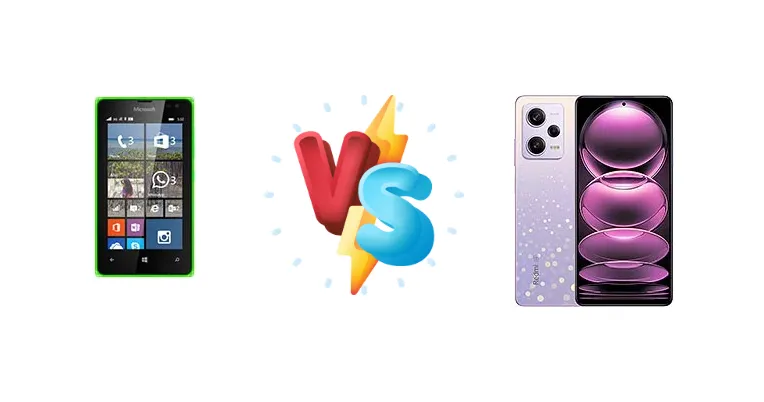
The Microsoft Lumia 532 represents a bygone era of ultra-budget Windows Phones, while the Xiaomi Redmi Note 12 Pro embodies the modern, feature-rich mid-range Android experience. This comparison isn't about direct competition, but rather understanding the dramatic advancements in smartphone technology over the past decade and whether the Redmi Note 12 Pro justifies its higher price tag for users still considering the Lumia 532 for basic connectivity.
🏆 Quick Verdict
For the vast majority of users, the Xiaomi Redmi Note 12 Pro is the clear winner. Its significantly faster processor, superior display, and rapid 67W charging offer a vastly improved experience compared to the aging Lumia 532. While the Lumia 532 boasts respectable endurance for its time, the Redmi Note 12 Pro’s combination of battery life and charging speed is far more practical.
| Network |
|---|
| 2G bands | GSM 850 / 900 / 1800 / 1900 | GSM 850 / 900 / 1800 / 1900 |
| 3G bands | HSDPA 850 / 900 / 1900 / 2100 | HSDPA 800 / 850 / 900 / 1900 / 2100 |
| 4G bands | - | 1, 2, 3, 4, 5, 7, 8, 12, 13, 17, 18, 19, 20, 26, 28, 32, 38, 40, 41, 66 - International |
| 5G bands | - | 1, 3, 5, 7, 8, 20, 28, 38, 40, 41, 66, 77, 78 SA/NSA - International |
| Speed | HSPA 42.2/5.76 Mbps | HSPA, LTE, 5G |
| Technology | GSM / HSPA | GSM / CDMA / HSPA / EVDO / LTE / 5G |
| | - | 1, 3, 5, 8, 28, 38, 41, 77, 78 SA/NSA - China |
| Launch |
|---|
| Announced | 2015, January. Released 2015, February | 2022, October 27 |
| Status | Discontinued | Available. Released 2022, November 01 |
| Body |
|---|
| Build | - | Glass front (Gorilla Glass 5), glass back, plastic frame |
| Dimensions | 118.9 x 65.5 x 11.6 mm (4.68 x 2.58 x 0.46 in) | 163 x 76 x 8 mm (6.42 x 2.99 x 0.31 in) |
| SIM | Micro-SIM | Nano-SIM + Nano-SIM |
| Weight | 136.3 g (4.80 oz) | 187 g (6.60 oz) |
| | - | IP53, dust and splash resistant |
| Display |
|---|
| Protection | - | Corning Gorilla Glass 5 |
| Resolution | 480 x 800 pixels, 5:3 ratio (~233 ppi density) | 1080 x 2400 pixels, 20:9 ratio (~395 ppi density) |
| Size | 4.0 inches, 45.5 cm2 (~58.5% screen-to-body ratio) | 6.67 inches, 107.4 cm2 (~86.7% screen-to-body ratio) |
| Type | IPS LCD, | AMOLED, 1B colors, 120Hz, Dolby Vision, HDR10+, 500 nits (typ), 900 nits (HBM) |
| Platform |
|---|
| CPU | Quad-core 1.2 GHz Cortex-A7 | Octa-core (2x2.6 GHz Cortex-A78 & 6x2.0 GHz Cortex-A55) |
| Chipset | Qualcomm MSM8212 Snapdragon 200 (28 nm) | Mediatek Dimensity 1080 (6 nm) |
| GPU | Adreno 302 | Mali-G68 MC4 |
| OS | Microsoft Windows Phone 8.1 | Android 12, MIUI 13 |
| Memory |
|---|
| Card slot | microSDXC (dedicated slot) | No |
| Internal | 8GB 1GB RAM | 128GB 6GB RAM, 128GB 8GB RAM, 256GB 8GB RAM, 256GB 12GB RAM |
| | eMMC 4.5 | UFS 2.2 |
| Main Camera |
|---|
| Features | - | Dual-LED dual-tone flash, HDR, panorama |
| Single | 5 MP, f/2.4, 28mm (wide) | - |
| Triple | - | 50 MP, f/1.9, 24mm (wide), 1/1.56", 1.0µm, PDAF, OIS
8 MP, f/2.2, 120˚ (ultrawide), 1/4.0", 1.12µm
2 MP (macro) |
| Video | 480p@30fps | 4K@30fps, 1080p@30/60/120fps, 720p@960fps |
| Selfie camera |
|---|
| Features | - | HDR |
| Single | VGA | 16 MP, f/2.5, (wide), 1/3.06", 1.0µm |
| Video | 480p | 1080p@30/60fps |
| Sound |
|---|
| 3.5mm jack | Yes | Yes |
| 35mm jack | Yes | Yes |
| Loudspeaker | Yes | Yes, with stereo speakers |
| | - | 24-bit/192kHz audio |
| Comms |
|---|
| Bluetooth | 4.0, A2DP | 5.2, A2DP, LE |
| Infrared port | - | Yes |
| NFC | No | Yes (market/region dependent) |
| Positioning | A-GPS, GLONASS | GPS (L1), GLONASS (G1), BDS (B1I+B1c), GALILEO (E1), QZSS (L1) |
| Radio | FM radio, RDS | No |
| USB | microUSB 2.0 | USB Type-C 2.0, OTG |
| WLAN | Wi-Fi 802.11 b/g/n, hotspot | Wi-Fi 802.11 a/b/g/n/ac/6, dual-band, Wi-Fi Direct |
| Features |
|---|
| Sensors | Accelerometer, proximity | Fingerprint (side-mounted), accelerometer, gyro, proximity, compass |
| Battery |
|---|
| Charging | - | 67W wired, PD3.0, 50% in 15 min, 100% in 46 min |
| Music play | Up to 61 h | - |
| Stand-by | Up to 528 h (2G) / Up to 528 h (3G) | - |
| Talk time | Up to 21 h (2G) / Up to 12 h (3G) | - |
| Type | Li-Ion 1560 mAh, removable | Li-Po 5000 mAh |
| Misc |
|---|
| Colors | Black, White, Green, Orange | Frosted Blue (Sky Blue), Onyx Black (Midnight Black), Polar White, Stardust Purple |
| Models | - | 22101316C, 22101316I, 23013RK75C, 22101316G |
| Price | About 90 EUR | € 148.54 / $ 142.17 / £ 149.99 / ₹ 19,999 |
| SAR | - | 1.09 W/kg (head) 1.06 W/kg (body) |
| SAR EU | - | 0.99 W/kg (head) 0.99 W/kg (body) |
| Tests |
|---|
| Battery life | Endurance rating 55h |
Endurance rating 97h
|
| Camera | - |
Photo / Video |
| Display | - |
Contrast ratio: Infinite (nominal) |
| Loudspeaker | - |
-26.6 LUFS (Good)
|
| Performance | - |
AnTuTu: 490526 (v9)
GeekBench: 2209 (v5.1), 2372 (v6)
GFXBench: 22fps (ES 3.1 onscreen) |
Microsoft Lumia 532
- Extremely affordable (if found)
- Decent battery endurance for its time
- Compact and lightweight
- Outdated Windows Phone OS with limited app support
- Slow processor and limited performance
- Poor camera quality compared to modern standards
Xiaomi Redmi Note 12 Pro
- Fast 67W charging
- Bright and vibrant display
- Powerful MediaTek Dimensity 1080 processor
- Higher price point
- May include bloatware
- Larger size and weight compared to the Lumia 532
Display Comparison
The Redmi Note 12 Pro’s display is a substantial upgrade. Its measured peak brightness of 890 nits dwarfs whatever the Lumia 532 offered, making it easily viewable outdoors. While the Lumia 532’s display resolution is unknown, it’s safe to assume it’s significantly lower than the Redmi Note 12 Pro’s, resulting in a less sharp image. The Redmi Note 12 Pro’s 'Infinite' contrast ratio (typical of OLED/AMOLED panels) delivers richer blacks and more vibrant colors, a feature absent on the Lumia 532’s likely LCD panel.
Camera Comparison
Both devices feature 'Photo / Video' capabilities, but the Redmi Note 12 Pro’s camera system is expected to be far superior. While specific sensor details are missing, the Redmi Note 12 Pro likely boasts a much larger main sensor and more advanced image processing algorithms. The Lumia 532’s camera was adequate for its time, but it cannot compete with the image quality and features offered by modern mid-range smartphones like the Redmi Note 12 Pro. The Redmi Note 12 Pro’s camera will excel in low-light conditions and offer more detailed and vibrant photos.
Performance
The performance gap is immense. The Lumia 532’s Qualcomm MSM8212 Snapdragon 200, with its quad-core 1.2 GHz Cortex-A7 CPU, was designed for basic tasks. The Redmi Note 12 Pro’s MediaTek Dimensity 1080, featuring an octa-core configuration (2x2.6 GHz Cortex-A78 & 6x2.0 GHz Cortex-A55), offers a massive leap in processing power. The Dimensity 1080’s 6nm manufacturing process is far more efficient than the Snapdragon 200’s 28nm node, resulting in better performance and thermal management. The Redmi Note 12 Pro will handle multitasking, gaming, and demanding apps with ease, while the Lumia 532 will struggle with even moderate workloads.
Battery Life
The Redmi Note 12 Pro’s endurance rating of 97 hours significantly exceeds the Lumia 532’s 55-hour rating. However, the real advantage lies in charging speed. The Redmi Note 12 Pro’s 67W wired charging, with 50% charge in 15 minutes and 100% in 46 minutes, is a game-changer. The Lumia 532’s charging speed is unknown but would be considerably slower. While the Lumia 532’s endurance is respectable for its age, the Redmi Note 12 Pro offers both longer battery life *and* the convenience of incredibly fast charging.
Buying Guide
Buy the Microsoft Lumia 532 if you absolutely need a basic, extremely affordable phone for calls and texts, and are comfortable with the limitations of the Windows Phone ecosystem and its lack of app support. Buy the Xiaomi Redmi Note 12 Pro if you prioritize performance, a vibrant display, fast charging, and a modern Android experience with access to a vast app library and regular software updates.
Frequently Asked Questions
❓ Is the Redmi Note 12 Pro’s Dimensity 1080 chipset capable of handling demanding games like Genshin Impact?
Yes, the MediaTek Dimensity 1080 is a capable chipset for gaming. While it won't deliver the absolute highest frame rates at maximum settings, it can comfortably run Genshin Impact and other popular titles at medium to high settings with stable performance. The 6nm process also helps to manage thermals during extended gaming sessions.
❓ Can I still find apps I need on the Lumia 532, or is the Windows Phone app ecosystem truly dead?
The Windows Phone app ecosystem is effectively defunct. While some core apps may still be available, the vast majority of modern applications are not compatible with the platform. This severely limits the functionality of the Lumia 532 and makes it unsuitable for users who rely on a wide range of apps.
❓ How does the Redmi Note 12 Pro’s 67W charging compare to standard smartphone charging?
67W charging is significantly faster than standard smartphone charging (typically 15W-25W). It allows you to charge the Redmi Note 12 Pro from 0% to 50% in just 15 minutes and fully charge it in under an hour. This is a major convenience for users who are always on the go.