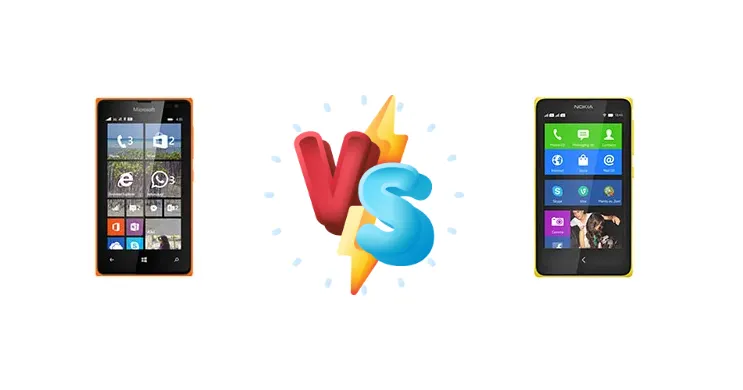
The Microsoft Lumia 435 and Nokia X represent distinct approaches to the entry-level smartphone market. The Lumia 435, arriving later, offered Windows Phone 8.1 on a Qualcomm Snapdragon 200 platform, while the Nokia X was an early attempt to bring Android-compatible apps to Nokia's Asha platform via a heavily customized Android fork. This comparison dissects their hardware and software to determine which provides the better user experience, especially considering their age and current availability.
🏆 Quick Verdict
For users seeking the longest possible battery life and a more modern (though now unsupported) operating system, the Microsoft Lumia 435 is the better choice. Its Snapdragon 200 chipset, while slower, is more efficient, resulting in a significantly longer endurance rating of 58 hours compared to the Nokia X’s 38 hours. However, the Nokia X’s Android compatibility, even in its modified form, may appeal to those seeking broader app access.
| Network |
|---|
| 2G bands | GSM 850 / 900 / 1800 / 1900 | GSM 850 / 900 / 1800 / 1900 - SIM 1 & SIM 2 (dual-SIM model only) |
| 3G bands | HSDPA 900 / 2100 | HSDPA 900 / 2100 |
| 4G bands | - | 1, 3, 5, 7, 8, 20, 28, 38, 40, 41 - International |
| Speed | HSPA 42.2/5.76 Mbps | HSPA 7.2/5.76 Mbps |
| Technology | GSM / HSPA | GSM / HSPA |
| | - | GSM 850 / 900 / 1800 / 1900 |
| Launch |
|---|
| Announced | 2015, January. Released 2015, March | 2014, February. Released 2014, March |
| Status | Discontinued | Discontinued |
| Body |
|---|
| Dimensions | 118.1 x 64.7 x 11.7 mm (4.65 x 2.55 x 0.46 in) | 115.5 x 63 x 10.4 mm, 73.2 cc (4.55 x 2.48 x 0.41 in) |
| SIM | Micro-SIM | Single SIM (Micro-SIM) or Dual SIM (Micro-SIM, dual stand-by) |
| Weight | 134.1 g (4.73 oz) | 128.7 g (4.52 oz) |
| Display |
|---|
| Resolution | 480 x 800 pixels, 5:3 ratio (~233 ppi density) | 480 x 800 pixels, 5:3 ratio (~233 ppi density) |
| Size | 4.0 inches, 45.5 cm2 (~59.6% screen-to-body ratio) | 4.0 inches, 45.5 cm2 (~62.6% screen-to-body ratio) |
| Type | IPS LCD, | IPS LCD |
| Platform |
|---|
| CPU | Dual-core 1.2 GHz Cortex-A7 | Dual-core 1.0 GHz Cortex-A5 |
| Chipset | Qualcomm MSM8210 Snapdragon 200 (28 nm) | Qualcomm MSM8225 Snapdragon S4 Play |
| GPU | Adreno 302 | Adreno 203 |
| OS | Microsoft Windows Phone 8.1, upgradable to Windows 10 | Android 4.1.2 (Jelly Bean), X platform 1.1 |
| Memory |
|---|
| Card slot | microSDXC (dedicated slot) | microSDHC (dedicated slot) |
| Internal | 8GB 1GB RAM | 4GB 512MB RAM |
| | eMMC 4.5 | - |
| Main Camera |
|---|
| Features | - | LED flash, HDR, panorama |
| Quad | - | 48 MP, f/1.8, (wide), PDAF
5 MP, 13mm (ultrawide)
2 MP, (macro)
2 MP, (depth) |
| Single | 2 MP, f/2.7, 36mm (standard), 1/5.0" | 3.15 MP, 1/5.0" |
| Video | 480p@30fps | 480p@30fps |
| Selfie camera |
|---|
| Single | VGA | 16 MP, f/2.0, (wide) |
| Video | 480p | 1080p@30fps |
| | - | No |
| Sound |
|---|
| 3.5mm jack | Yes | Yes |
| 35mm jack | Yes | Yes |
| Loudspeaker | Yes | Yes |
| Comms |
|---|
| Bluetooth | 4.0, A2DP | 3.0, A2DP |
| NFC | No | No |
| Positioning | A-GPS, GLONASS | GPS |
| Radio | FM radio, RDS | Stereo FM radio |
| USB | microUSB 2.0 | microUSB 2.0 |
| WLAN | Wi-Fi 802.11 b/g/n, hotspot | Wi-Fi 802.11 b/g/n, hotspot |
| Features |
|---|
| Sensors | Accelerometer, proximity | Accelerometer, proximity |
| Battery |
|---|
| Charging | - | 10W wired |
| Music play | Up to 64 h | Up to 26 h |
| Stand-by | Up to 504 h (2G) / Up to 504 h (3G) | Up to 408 h |
| Talk time | Up to 21 h (2G) / Up to 11 h 45 min (3G) | Up to 13 h 20 min (2G) / Up to 10 h 30 min (3G) |
| Type | Li-Ion 1560 mAh, removable | Li-Ion 1500 mAh, removable (BN-01) |
| Misc |
|---|
| Colors | Black, White, Green, Orange | Bright green, bright red, cyan, yellow, black, white |
| Models | - | TA-1333, TA-1340, TA-1337, TA-1328, TA-1325 |
| Price | About 70 EUR | About 100 EUR |
| SAR | 0.81 W/kg (head) 0.53 W/kg (body) | 1.30 W/kg (head) 1.44 W/kg (body) |
| SAR EU | 0.58 W/kg (head) 0.54 W/kg (body) | 1.14 W/kg (head) 0.90 W/kg (body) |
| Pricing |
|---|
| 128GB 4GB RAM | - | $ 174.99 |
| 64GB 4GB RAM | - | $ 305.00 |
| 64GB 6GB RAM | - | ₹ 13,999 |
| Tests |
|---|
| Battery life |
Endurance rating 58h
|
Endurance rating 38h
|
| Camera | - |
Photo |
| Display | - |
Contrast ratio: 637:1 (nominal), 1.291 (sunlight) |
| Loudspeaker | - |
Voice 67dB / Noise 66dB / Ring 75dB
|
Microsoft Lumia 435
- Significantly longer battery life (58h endurance)
- More modern (though unsupported) operating system (Windows Phone 8.1)
- More efficient processor (Snapdragon 200)
- Limited app ecosystem compared to Android
- Lack of current software support
- Camera specifications are unknown
Nokia X
- Android app compatibility (albeit heavily customized)
- Decent display contrast ratio for outdoor visibility
- 10W wired charging
- Significantly shorter battery life (38h endurance)
- Older and less efficient processor (Snapdragon S4 Play)
- Heavily customized Android experience may be buggy or outdated
Display Comparison
Both devices share a similar contrast ratio of 637:1 (nominal) and 1.291 (sunlight), suggesting comparable outdoor visibility. However, the Nokia X’s display specifications are more detailed, hinting at a potentially better-optimized panel. The Lumia 435’s display details are absent, leaving its color accuracy and viewing angles unknown, but typical for its price point. The Nokia X’s contrast ratio indicates a decent ability to display deep blacks and vibrant colors under direct sunlight, a crucial factor for outdoor use.
Camera Comparison
Both devices are listed with a simple 'Photo' camera specification, offering no details on sensor size, resolution, or features. This suggests both cameras are basic and intended for casual snapshots. Without further information, it’s impossible to determine which camera performs better. The absence of details implies neither device is a strong contender for photography enthusiasts.
Performance
The Lumia 435’s dual-core 1.2 GHz Cortex-A7 CPU, paired with the Qualcomm MSM8210 Snapdragon 200 chipset (built on a 28nm process), offers a modest performance uplift over the Nokia X’s dual-core 1.0 GHz Cortex-A5 CPU and Snapdragon S4 Play (MSM8225). While both are entry-level processors, the Cortex-A7 architecture is more efficient and capable. The Snapdragon 200’s 28nm fabrication process also contributes to better power efficiency. However, the Nokia X’s chipset was released earlier, and its performance will likely feel more sluggish in modern app scenarios, even with Android compatibility.
Battery Life
The most significant difference lies in battery endurance. The Lumia 435 boasts an impressive 58-hour endurance rating, significantly exceeding the Nokia X’s 38 hours. This advantage is likely due to the more efficient Snapdragon 200 chipset and potentially a larger battery capacity (though not specified). The Nokia X offers 10W wired charging, a standard feature for the time, but the Lumia 435’s charging specifications are unavailable. The Lumia 435’s superior endurance makes it a better choice for users who prioritize long-term use between charges.
Buying Guide
Buy the Microsoft Lumia 435 if you prioritize battery life above all else and are comfortable with the limitations of the Windows Phone ecosystem (and its lack of current support). It’s ideal for users needing a reliable, basic phone for calls, texts, and light tasks. Buy the Nokia X if you specifically want a device that attempts to bridge the gap between feature phones and smartphones with Android app compatibility, understanding that the experience will be heavily customized and potentially outdated.
Frequently Asked Questions
❓ Is the Nokia X’s Android experience similar to stock Android?
No, the Nokia X runs on a heavily modified version of Android called Nokia X OS, built on AOSP. It lacks Google Play Services and relies on a forked app store, resulting in a significantly different user experience than standard Android. App compatibility can be limited.
❓ Can I still find apps for the Microsoft Lumia 435 given Windows Phone is discontinued?
While Microsoft has ended support for Windows Phone, a limited number of apps remain available through the Windows Phone Store. However, the app selection is significantly smaller and many apps are outdated. Sideloading is possible, but carries security risks.
❓ Which phone is better for basic tasks like calling and texting?
Both phones are perfectly capable of handling basic tasks like calling and texting. However, the Lumia 435’s superior battery life makes it a more reliable choice for users who primarily need a phone for communication.
❓ Does the Snapdragon S4 Play in the Nokia X struggle with multitasking?
Yes, the Snapdragon S4 Play is a relatively weak processor, and the Nokia X’s limited RAM (details vary by configuration) will likely result in noticeable slowdowns and lag when multitasking or running demanding apps.