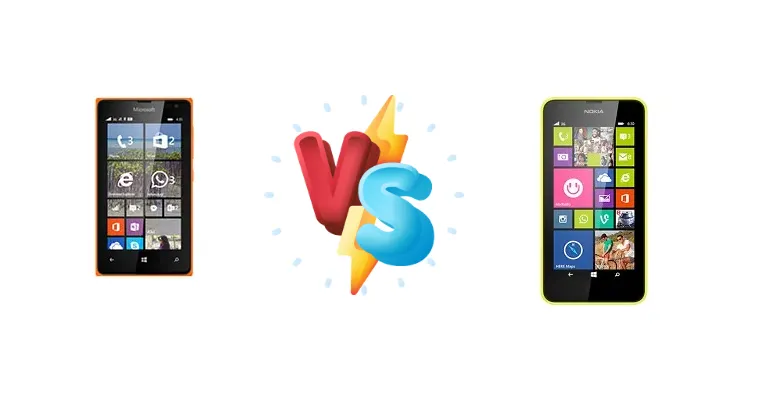
The Microsoft Lumia 435 and Nokia Lumia 630, both dual-SIM capable, represent Microsoft’s attempts to dominate the ultra-budget smartphone market. While both run Windows Phone 8.1, significant internal differences dictate which device is better suited for specific user needs. This comparison focuses on the core hardware distinctions, particularly the chipset and their impact on performance and battery life.
🏆 Quick Verdict
For the average user prioritizing responsiveness and multitasking, the Nokia Lumia 630 is the clear winner. Its quad-core Snapdragon 400 provides a noticeable performance boost over the Lumia 435’s dual-core Snapdragon 200. However, the Lumia 435’s endurance rating is identical, making it a viable option for those prioritizing longevity and minimal cost.
| Network |
|---|
| 2G bands | GSM 850 / 900 / 1800 / 1900 - SIM 1 & SIM 2 | GSM 850 / 900 / 1800 / 1900 - SIM 1 & SIM 2 |
| 3G bands | HSDPA 900 / 2100 | HSDPA 900 / 2100 |
| Speed | HSPA 42.2/5.76 Mbps | HSPA 21.1/5.76 Mbps |
| Technology | GSM / HSPA | GSM / HSPA |
| Launch |
|---|
| Announced | 2015, January. Released 2015, February | 2014, April. Released 2014, May |
| Status | Discontinued | Discontinued |
| Body |
|---|
| Dimensions | 118.1 x 64.7 x 11.7 mm (4.65 x 2.55 x 0.46 in) | 129.5 x 66.7 x 9.2 mm, 78.5 cc (5.10 x 2.63 x 0.36 in) |
| SIM | Dual SIM (Micro-SIM, dual stand-by) | Dual SIM (Micro-SIM, dual stand-by) |
| Weight | 134.1 g (4.73 oz) | 134 g (4.73 oz) |
| Display |
|---|
| Protection | - | Corning Gorilla Glass 3 |
| Resolution | 480 x 800 pixels, 5:3 ratio (~233 ppi density) | 480 x 854 pixels, 16:9 ratio (~221 ppi density) |
| Size | 4.0 inches, 45.5 cm2 (~59.6% screen-to-body ratio) | 4.5 inches, 54.3 cm2 (~62.9% screen-to-body ratio) |
| Type | IPS LCD, | IPS LCD |
| | - | ClearBlack display |
| Platform |
|---|
| CPU | Dual-core 1.2 GHz Cortex-A7 | Quad-core 1.2 GHz Cortex-A7 |
| Chipset | Qualcomm MSM8210 Snapdragon 200 (28 nm) | Qualcomm Snapdragon 400 (28 nm) |
| GPU | Adreno 302 | Adreno 305 |
| OS | Microsoft Windows Phone 8.1, upgradable to Windows 10 | Microsoft Windows Phone 8.1 |
| Memory |
|---|
| Card slot | microSDXC (dedicated slot) | microSDXC (dedicated slot) |
| Internal | 8GB 1GB RAM | 8GB 512MB RAM |
| | eMMC 4.5 | eMMC 4.5 |
| Main Camera |
|---|
| Features | - | Panorama |
| Single | 2 MP, f/2.7, 36mm (standard), 1/5.0" | 5 MP, 1/4.0", AF |
| Video | 480p@30fps | 720p@30fps |
| Selfie camera |
|---|
| Single | VGA | - |
| Video | 480p | - |
| | - | No |
| Sound |
|---|
| 3.5mm jack | Yes | Yes |
| 35mm jack | Yes | Yes |
| Loudspeaker | Yes | Yes |
| Comms |
|---|
| Bluetooth | 4.0, A2DP | 4.0, A2DP, LE/ aptX after WP8 Denim update |
| NFC | No | No |
| Positioning | A-GPS, GLONASS | GPS, GLONASS |
| Radio | FM radio, RDS | FM radio |
| USB | microUSB 2.0 | microUSB 2.0 |
| WLAN | Wi-Fi 802.11 b/g/n, hotspot | Wi-Fi 802.11 b/g/n, DLNA, hotspot |
| Features |
|---|
| Sensors | Accelerometer, proximity | Accelerometer, sensor core |
| Battery |
|---|
| Music play | Up to 64 h | Up to 58 h |
| Stand-by | Up to 504 h (2G) / Up to 504 h (3G) | Up to 648 h |
| Talk time | Up to 21 h (2G) / Up to 11 h 45 min (3G) | Up to 16 h 20 min (2G) / Up to 13 h 10 min (3G) |
| Type | Li-Ion 1560 mAh, removable | Li-Ion 1830 mAh, removable (BL-5H) |
| Misc |
|---|
| Colors | Black, White, Green, Orange | Bright Orange, bright green, bright yellow, white, black |
| Price | About 70 EUR | About 140 EUR |
| SAR | 1.05 W/kg (head) 0.57 W/kg (body) | 1.23 W/kg (head) 1.13 W/kg (body) |
| SAR EU | 0.58 W/kg (head) 0.54 W/kg (body) | 1.51 W/kg (head) 1.52 W/kg (body) |
| Tests |
|---|
| Battery life | Endurance rating 64h | - |
Microsoft Lumia 435 Dual SIM
- Lowest possible price point
- Acceptable battery endurance (64h)
- Dual SIM functionality for cost-effective communication
- Significantly slower performance due to dual-core CPU
- Limited multitasking capabilities
- Basic camera performance
Nokia Lumia 630 Dual SIM
- Faster and more responsive performance with quad-core CPU
- Improved multitasking capabilities
- Potentially better camera image processing
- Slightly higher price than the Lumia 435
- Battery life may be marginally lower under heavy load
- Still a budget device with limited features
Display Comparison
Neither device boasts a particularly impressive display. Both likely utilize LCD panels, typical for this price point. Detailed specifications regarding brightness, color accuracy, or resolution are unavailable, but the focus here is clearly not on visual fidelity. Bezels are expected to be substantial on both models, reflecting their budget nature. The display serves primarily as a functional interface, not a multimedia showcase.
Camera Comparison
Camera details are sparse. Given the market segment, both devices likely feature basic camera sensors. Without specific megapixel counts or aperture information, it’s difficult to make a definitive statement. However, the Snapdragon 400’s image signal processor (ISP) is generally more capable than the one found in the Snapdragon 200, potentially leading to slightly better image quality in the Lumia 630, particularly in low-light conditions. Expect limited features and image processing capabilities on both.
Performance
The core difference lies in the chipset. The Nokia Lumia 630’s Qualcomm Snapdragon 400, featuring a quad-core 1.2 GHz Cortex-A7 CPU, offers a significant architectural advantage over the Microsoft Lumia 435’s Snapdragon 200 with its dual-core 1.2 GHz Cortex-A7 CPU. While both utilize the same Cortex-A7 architecture, the increased core count in the Snapdragon 400 translates to superior multitasking capabilities and a more fluid user experience. The Snapdragon 400 can handle more simultaneous processes without significant slowdown, benefiting users who frequently switch between apps. Both chipsets are fabricated on a 28nm process, meaning thermal efficiency is comparable, but the 630 will likely exhibit less strain under load.
Battery Life
Both the Lumia 435 and 630 share an endurance rating of 64 hours, suggesting similar real-world battery performance despite the differing chipsets. This indicates that Microsoft and Nokia optimized software and power management to compensate for the Snapdragon 400’s increased power consumption. Charging speeds are likely similar, given the lack of fast-charging technology in these models. Users can expect a full charge to take several hours using the included charger.
Buying Guide
Buy the Microsoft Lumia 435 Dual SIM if you need a supremely affordable smartphone with acceptable battery life for basic tasks like calls, texts, and light app usage. Buy the Nokia Lumia 630 Dual SIM if you prefer a smoother, more responsive user experience, especially when multitasking or running slightly more demanding applications, and are willing to accept potentially slightly lower battery life in heavy usage scenarios.
Frequently Asked Questions
❓ Will the Lumia 630 handle basic games like Angry Birds or Candy Crush Saga without significant lag?
Yes, the Snapdragon 400 in the Lumia 630 is sufficiently powerful to run casual games like Angry Birds and Candy Crush Saga smoothly. The quad-core processor provides enough headroom for these less demanding titles, offering a more enjoyable gaming experience compared to the Lumia 435.
❓ Is the dual SIM functionality on either phone truly useful, or is it just a marketing gimmick?
The dual SIM functionality is genuinely useful for users who need to manage two separate phone numbers, such as one for work and one for personal use, or for travelers who want to use a local SIM card while retaining access to their home number. Both phones support active dual SIM, allowing both SIMs to be active simultaneously.
❓ Given the age of these phones, are software updates still available?
Software support for both the Lumia 435 and 630 has ended. They were originally released with Windows Phone 8.1 and received the Windows 10 Mobile update, but no further updates are being released by Microsoft. This means users will not receive the latest security patches or feature enhancements.