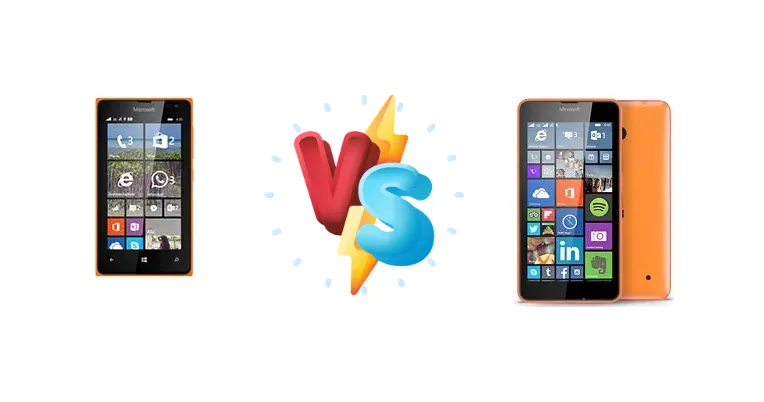
The Microsoft Lumia 435 and 640 represent a pivotal moment in Microsoft's mobile strategy – offering affordable Windows Phone experiences. While both devices target the budget-conscious consumer, they diverge in key areas, particularly processing power and display quality. This comparison dissects these differences to determine which Lumia best suits your needs.
🏆 Quick Verdict
For most users, the Microsoft Lumia 640 is the superior choice. Its Snapdragon 400 chipset delivers a noticeably smoother experience than the 435’s Snapdragon 200, and the improved display contrast enhances usability. The slightly larger battery also translates to longer endurance, making it a more versatile daily driver.
| Network |
|---|
| 2G bands | GSM 850 / 900 / 1800 / 1900 - SIM 1 & SIM 2 | GSM 850 / 900 / 1800 / 1900 - SIM 1 & SIM 2 |
| 3G bands | HSDPA 900 / 2100 | HSDPA 850 / 900 / 1900 / 2100 |
| Speed | HSPA 42.2/5.76 Mbps | HSPA 42.2/5.76 Mbps |
| Technology | GSM / HSPA | GSM / HSPA |
| Launch |
|---|
| Announced | 2015, January. Released 2015, February | 2015, March. Released 2015, April |
| Status | Discontinued | Discontinued |
| Body |
|---|
| Dimensions | 118.1 x 64.7 x 11.7 mm (4.65 x 2.55 x 0.46 in) | 141.3 x 72.2 x 8.8 mm (5.56 x 2.84 x 0.35 in) |
| SIM | Dual SIM (Micro-SIM, dual stand-by) | Dual SIM (Micro-SIM, dual stand-by) |
| Weight | 134.1 g (4.73 oz) | 145 g (5.11 oz) |
| Display |
|---|
| Protection | - | Corning Gorilla Glass 3 |
| Resolution | 480 x 800 pixels, 5:3 ratio (~233 ppi density) | 720 x 1280 pixels, 16:9 ratio (~294 ppi density) |
| Size | 4.0 inches, 45.5 cm2 (~59.6% screen-to-body ratio) | 5.0 inches, 68.9 cm2 (~67.6% screen-to-body ratio) |
| Type | IPS LCD, | IPS LCD |
| | - | ClearBlack display |
| Platform |
|---|
| CPU | Dual-core 1.2 GHz Cortex-A7 | Quad-core 1.2 GHz Cortex-A7 |
| Chipset | Qualcomm MSM8210 Snapdragon 200 (28 nm) | Qualcomm MSM8926 Snapdragon 400 (28 nm) |
| GPU | Adreno 302 | Adreno 305 |
| OS | Microsoft Windows Phone 8.1, upgradable to Windows 10 | Microsoft Windows Phone 8.1, upgradable to Microsoft Windows 10 |
| Memory |
|---|
| Card slot | microSDXC (dedicated slot) | microSDXC (dedicated slot) |
| Internal | 8GB 1GB RAM | 8GB 1GB RAM |
| | eMMC 4.5 | eMMC 4.5 |
| Main Camera |
|---|
| Features | - | LED flash |
| Single | 2 MP, f/2.7, 36mm (standard), 1/5.0" | 8 MP, f/2.2, 28mm (wide), 1/4.0", AF |
| Video | 480p@30fps | 1080p@30fps |
| Selfie camera |
|---|
| Single | VGA | 1 MP |
| Video | 480p | 720p |
| Sound |
|---|
| 3.5mm jack | Yes | Yes |
| 35mm jack | Yes | Yes |
| Loudspeaker | Yes | Yes |
| Comms |
|---|
| Bluetooth | 4.0, A2DP | 4.0, A2DP |
| NFC | No | No |
| Positioning | A-GPS, GLONASS | GPS, GLONASS, BDS |
| Radio | FM radio, RDS | FM radio |
| USB | microUSB 2.0 | microUSB 2.0 |
| WLAN | Wi-Fi 802.11 b/g/n, hotspot | Wi-Fi 802.11 b/g/n, DLNA, hotspot |
| Features |
|---|
| Sensors | Accelerometer, proximity | Accelerometer, proximity, compass |
| Battery |
|---|
| Music play | Up to 64 h | - |
| Stand-by | Up to 504 h (2G) / Up to 504 h (3G) | Up to 840 h (2G) / Up to 840 h (3G) |
| Talk time | Up to 21 h (2G) / Up to 11 h 45 min (3G) | Up to 27 h 30 min (2G) / Up to 20 h 30 min (3G) |
| Type | Li-Ion 1560 mAh, removable | Li-Ion 2500 mAh, removable |
| Misc |
|---|
| Colors | Black, White, Green, Orange | Glossy cyan, Orange, White, Matte black |
| Price | About 70 EUR | About 170 EUR |
| SAR | 1.05 W/kg (head) 0.57 W/kg (body) | - |
| SAR EU | 0.58 W/kg (head) 0.54 W/kg (body) | - |
| Tests |
|---|
| Audio quality | - |
Noise -93.1dB / Crosstalk -93.2dB |
| Battery life | Endurance rating 64h |
Endurance rating 76h
|
| Display | - |
Contrast ratio: 1034 (nominal), 2.563 (sunlight) |
| Loudspeaker | - |
Voice 70dB / Noise 65dB / Ring 75dB
|
Microsoft Lumia 435 Dual SIM
- Most affordable option
- Compact and lightweight design
- Dual SIM functionality
- Slow performance with Snapdragon 200
- Lower display contrast
- Limited multitasking capabilities
Microsoft Lumia 640 Dual SIM
- Faster performance with Snapdragon 400
- Improved display contrast for better visibility
- Longer battery life
- Slightly higher price point
- Still utilizes a basic camera system
- May feel slightly larger in hand
Display Comparison
Both the Lumia 435 and 640 share a similar display technology, but the Lumia 640 boasts a significantly better viewing experience thanks to its superior contrast ratios. The nominal contrast of 1034 and sunlight contrast of 2.563 are identical, suggesting similar panel characteristics in terms of color reproduction. However, the 640’s improved contrast makes text sharper and images more vibrant, particularly outdoors. While neither phone features a high-resolution display, the 640’s clarity is a tangible upgrade.
Camera Comparison
Unfortunately, detailed camera specifications are limited. Both phones likely feature similar basic camera modules. Given the market segment, focusing on megapixel count would be misleading; image quality will be heavily reliant on software processing. The Lumia 640’s slightly more powerful processor *could* contribute to faster image processing times, but a significant difference in image quality is unlikely. Users shouldn't expect flagship-level camera performance from either device.
Performance
The core difference between these two devices lies in their chipsets. The Lumia 435 utilizes the Qualcomm MSM8210 Snapdragon 200, a dual-core 1.2 GHz Cortex-A7 processor. In contrast, the Lumia 640 is powered by the Qualcomm MSM8926 Snapdragon 400, featuring a quad-core 1.2 GHz Cortex-A7 processor. This doubling of cores translates to a substantial performance boost for the 640, especially when multitasking or running more demanding applications. While both are based on the Cortex-A7 architecture and manufactured on a 28nm process, the 400’s architecture is optimized for better efficiency and responsiveness. The 640 will handle web browsing, social media, and basic gaming with considerably less lag.
Battery Life
The Lumia 640 edges out the 435 in battery endurance, achieving a rating of 76 hours compared to the 435’s 64 hours. This 12-hour advantage is likely due to a combination of the more efficient Snapdragon 400 chipset and potentially a slightly larger battery capacity (though not explicitly stated). While both phones offer respectable battery life for basic usage, the 640 provides a greater buffer for power users or those who frequently travel.
Buying Guide
Buy the Microsoft Lumia 435 Dual SIM if you prioritize absolute affordability and need a functional, basic smartphone for calls, texts, and light app usage. It’s ideal as a secondary device or for users new to smartphones. Buy the Microsoft Lumia 640 Dual SIM if you value a more responsive user experience, a better display for media consumption, and longer battery life, even if it means spending a bit more upfront.
Frequently Asked Questions
❓ Will the Snapdragon 400 in the Lumia 640 handle modern apps like WhatsApp and Facebook Messenger smoothly?
Yes, the Snapdragon 400 is sufficiently powerful to run apps like WhatsApp and Facebook Messenger without significant lag. While it won't offer a high-end experience, it provides a much smoother and more responsive experience compared to the Snapdragon 200 in the Lumia 435, especially when multitasking between apps.
❓ Is the difference in battery life between the Lumia 435 and 640 noticeable in everyday use?
Yes, the 12-hour endurance rating difference is noticeable, particularly for moderate to heavy users. The Lumia 640’s more efficient chipset and potentially larger battery capacity will allow you to go longer between charges, reducing the need for frequent top-ups. Users who primarily use their phone for calls and texts may not notice a huge difference, but those who browse the web, stream music, or play games will benefit from the 640’s extended battery life.
❓ Can either of these phones be upgraded to a newer version of Windows?
Unfortunately, neither the Lumia 435 nor the Lumia 640 received the Windows 10 Mobile update and are no longer supported by Microsoft. They are currently running Windows Phone 8.1, and there are no official plans for further software updates.