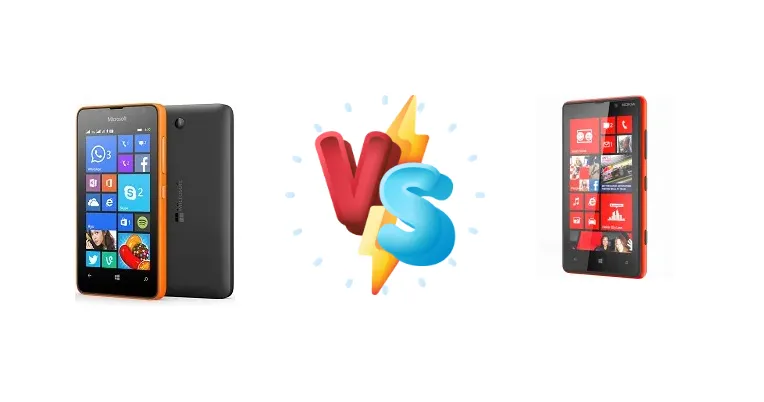
The Microsoft Lumia 430 Dual SIM and the Nokia Lumia 820 represent different eras of Windows Phone. The 430 aimed for ultimate affordability, while the 820 was a mid-range offering with more advanced features. This comparison dissects their key differences to help users still invested in the Windows ecosystem – or those curious about these older devices – make an informed decision.
🏆 Quick Verdict
For the average user seeking a functional, if basic, Windows Phone experience, the Nokia Lumia 820 is the superior choice. Its Snapdragon S4 Plus chipset delivers significantly better performance than the 430’s Snapdragon 200, making it more responsive for everyday tasks and offering a smoother user experience despite both phones having similar battery endurance ratings.
| Network |
|---|
| 2G bands | GSM 850 / 900 / 1800 / 1900 - SIM 1 & SIM 2 | GSM 850 / 900 / 1800 / 1900 |
| 3G bands | HSDPA 900 / 2100 | HSDPA 850 / 900 / 1900 / 2100 |
| 4G bands | - | 1, 3, 7, 8, 20 |
| EDGE | - | Class 12 |
| GPRS | - | Class 12 |
| Speed | HSPA 42.2/5.76 Mbps | HSPA 42.2/5.76 Mbps, LTE Cat3 100/50 Mbps |
| Technology | GSM / HSPA | GSM / HSPA / LTE |
| Launch |
|---|
| Announced | 2015, March. Released 2015, May | 2012, September. Released 2012, November |
| Status | Discontinued | Discontinued |
| Body |
|---|
| Dimensions | 120.5 x 63.2 x 10.6 mm (4.74 x 2.49 x 0.42 in) | 123.8 x 68.5 x 9.9 mm, 83.5 cc (4.87 x 2.70 x 0.39 in) |
| SIM | Dual SIM (Micro-SIM, dual stand-by) | Micro-SIM |
| Weight | 127.9 g (4.52 oz) | 160 g (5.64 oz) |
| Display |
|---|
| Resolution | 480 x 800 pixels, 5:3 ratio (~235 ppi density) | 480 x 800 pixels, 5:3 ratio (~217 ppi density) |
| Size | 4.0 inches, 44.8 cm2 (~58.8% screen-to-body ratio) | 4.3 inches, 52.6 cm2 (~62.1% screen-to-body ratio) |
| Type | IPS LCD, | AMOLED |
| | - | Nokia ClearBlack display |
| Platform |
|---|
| CPU | Dual-core 1.2 GHz Cortex-A7 | Dual-core 1.5 GHz Krait |
| Chipset | Qualcomm MSM8210 Snapdragon 200 (28 nm) | Qualcomm MSM8960 Snapdragon S4 Plus |
| GPU | Adreno 302 | Adreno 225 |
| OS | Microsoft Windows Phone 8.1, upgradable to Windows 10 | Microsoft Windows Phone 8, upgradable to 8.1 |
| Memory |
|---|
| Card slot | microSDXC (dedicated slot) | microSDXC (dedicated slot) |
| Internal | 8GB 1GB RAM | 8GB 1GB RAM |
| | eMMC 4.5 | - |
| Main Camera |
|---|
| Features | - | Carl Zeiss optics, dual-LED flash |
| Single | 2 MP, f/2.2, 1/5.0" | 8 MP, AF |
| Video | 480p@30fps | 1080p@30fps |
| Selfie camera |
|---|
| Single | VGA | VGA |
| Video | 480p | - |
| Sound |
|---|
| 3.5mm jack | Yes | Yes |
| 35mm jack | Yes | Yes |
| Loudspeaker | Yes | Yes |
| Comms |
|---|
| Bluetooth | 4.0, A2DP | 4.0, A2DP, EDR, LE/ aptX after WP8 Denim update |
| NFC | No | Yes |
| Positioning | A-GPS, GLONASS | GPS, A-GPS, GLONASS |
| Radio | FM radio | FM radio |
| USB | microUSB 2.0 | microUSB 2.0 |
| WLAN | Wi-Fi 802.11 b/g/n, hotspot | Wi-Fi 802.11 a/b/g/n, dual-band, Wi-Fi Direct |
| Features |
|---|
| Sensors | Accelerometer, proximity | Accelerometer, gyro, proximity, compass |
| Battery |
|---|
| Music play | Up to 47 h | Up to 55 h |
| Stand-by | Up to 720 h (2G) / Up to 720 h (3G) | Up to 330 h (2G) / Up to 330 h (3G) |
| Talk time | Up to 13 h (2G) / Up to 8 h 30 min (3G) | Up to 14 h (2G) / Up to 8 h (3G) |
| Type | Li-Ion 1500 mAh, removable | Removable Li-Ion 1650 mAh battery (BP-5T) |
| Misc |
|---|
| Colors | Black, Orange | Black, Gray, Red, Yellow, White, Blue, Violet |
| Price | About 70 EUR | About 170 EUR |
| SAR | - | 1.37 W/kg (head) 0.71 W/kg (body) |
| SAR EU | - | 0.79 W/kg (head) |
| Tests |
|---|
| Audio quality | - |
Noise -82.2dB / Crosstalk -81.4dB |
| Battery life | - |
Endurance rating 40h
|
| Camera | - |
Photo / Video |
| Display | - |
Contrast ratio: Infinite (nominal) / 2.193:1 (sunlight) |
| Loudspeaker | - |
Voice 67dB / Noise 66dB / Ring 70dB
|
Microsoft Lumia 430 Dual SIM
- Dual SIM functionality for convenient management of multiple numbers.
- Extremely affordable price point.
- Compact and lightweight design.
- Significantly weaker performance compared to the Lumia 820.
- Likely lower-quality display.
- Limited camera capabilities.
Nokia Lumia 820
- Faster and more responsive performance thanks to the Snapdragon S4 Plus.
- Potentially better camera quality.
- More refined user experience.
- Higher price compared to the Lumia 430.
- Battery life may be slightly reduced under heavy use due to the more powerful processor.
- No dual SIM support.
Display Comparison
Both the Lumia 430 and 820 share a similar contrast ratio of infinite (nominal) and 2.193:1 in sunlight, suggesting comparable outdoor visibility. However, detailed display specifications like resolution and pixel density are missing for the 430. Given the 820’s positioning, it likely boasts a sharper and more vibrant display, offering a better viewing experience for media consumption. The lack of detailed display specs for the 430 indicates a focus on cost reduction, likely resulting in a lower-quality panel.
Camera Comparison
Both phones feature photo and video capabilities, but specifics are limited. Without megapixel counts or sensor sizes, a direct comparison is difficult. However, the Lumia 820, being a mid-range device, likely incorporates a more capable camera sensor and image processing algorithms. Nokia was known for its camera technology, and the 820 likely benefits from this expertise. The 430’s camera is likely a basic module intended for casual snapshots.
Performance
The performance gap between these devices is substantial. The Nokia Lumia 820’s Qualcomm MSM8960 Snapdragon S4 Plus, with its dual-core 1.5 GHz Krait architecture, significantly outperforms the Microsoft Lumia 430’s Qualcomm MSM8210 Snapdragon 200 (1.2 GHz Cortex-A7). The Krait architecture is known for its efficiency and performance advantages over the Cortex-A7. This translates to faster app loading times, smoother multitasking, and a more responsive overall user experience on the 820. The 430’s Snapdragon 200 was designed for entry-level devices and struggles with demanding tasks.
Battery Life
Interestingly, both devices share an endurance rating of 40 hours. This suggests similar battery life despite the performance difference. The Snapdragon S4 Plus in the 820 is built on a 28nm process, similar to the Snapdragon 200 in the 430, contributing to comparable power efficiency. However, the 820’s more demanding processor might draw more power during intensive tasks, potentially reducing real-world battery life under heavy use.
Buying Guide
Buy the Microsoft Lumia 430 Dual SIM if you absolutely need a secondary, ultra-budget phone for basic communication and dual SIM functionality, and performance is not a priority. Buy the Nokia Lumia 820 if you prefer a more responsive and capable Windows Phone experience, even if it means paying a premium, and value a slightly more refined feature set.
Frequently Asked Questions
❓ Is the Lumia 430 suitable for running modern apps, even if they are older Windows Phone apps?
The Snapdragon 200 in the Lumia 430 is a very basic processor. While it can handle core Windows Phone functions, running even older apps may be sluggish and frustrating. The limited RAM and processing power will struggle with anything beyond the most basic tasks.
❓ Given both phones are quite old, is battery replacement readily available, and what is the expected cost?
Battery replacement for both devices can be challenging. Original batteries are becoming increasingly scarce. Third-party batteries are available, but quality can vary significantly. Expect to pay between $15-$30 for a replacement battery, plus the cost of tools or professional installation.
❓ Does the Lumia 820 support expandable storage via microSD card?
Yes, the Nokia Lumia 820 supports microSD card expansion up to 64GB, allowing you to increase storage for photos, videos, and other files. The Lumia 430 does not have information on expandable storage.