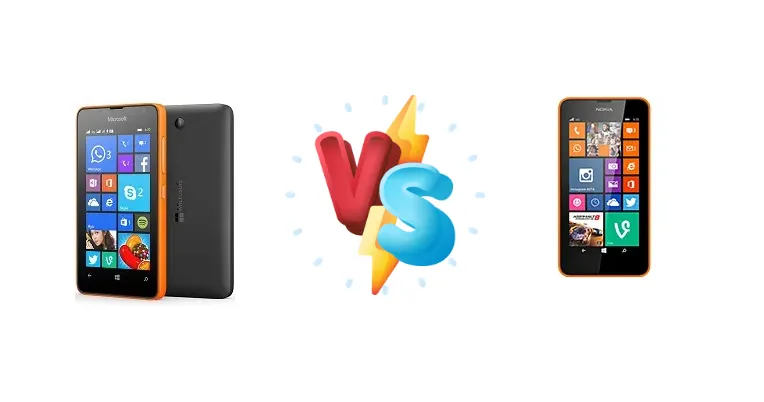
The Microsoft Lumia 430 Dual SIM and Nokia Lumia 635 represent two points in the evolution of Microsoft’s budget Windows Phone strategy. While both aimed for affordability, they differed in core hardware. This comparison dissects those differences, focusing on the impact of the Snapdragon 200 versus the Snapdragon 400 on real-world performance and user experience.
🏆 Quick Verdict
For the average user prioritizing responsiveness and multitasking, the Nokia Lumia 635 is the better choice. Its Snapdragon 400 chipset, with four Cortex-A7 cores, provides a significantly smoother experience than the dual-core Snapdragon 200 in the Lumia 430, despite both phones sharing an identical 66-hour endurance rating.
| Network |
|---|
| 2G bands | GSM 850 / 900 / 1800 / 1900 - SIM 1 & SIM 2 | GSM 850 / 900 / 1800 / 1900 |
| 3G bands | HSDPA 900 / 2100 | HSDPA 850 / 900 / 2100 - RM-974 |
| 4G bands | - | 3, 7, 20 - RM-974 |
| Speed | HSPA 42.2/5.76 Mbps | HSPA 42.2/5.76 Mbps, LTE Cat3 100/50 Mbps |
| Technology | GSM / HSPA | GSM / HSPA / LTE |
| | - | 2, 4, 5, 7, 17 - RM-975 |
| Launch |
|---|
| Announced | 2015, March. Released 2015, May | 2014, April. Released 2014, June |
| Status | Discontinued | Discontinued |
| Body |
|---|
| Dimensions | 120.5 x 63.2 x 10.6 mm (4.74 x 2.49 x 0.42 in) | 129.5 x 66.7 x 9.2 mm, 78.5 cc (5.10 x 2.63 x 0.36 in) |
| SIM | Dual SIM (Micro-SIM, dual stand-by) | Micro-SIM |
| Weight | 127.9 g (4.52 oz) | 134 g (4.73 oz) |
| Display |
|---|
| Protection | - | Corning Gorilla Glass 3 |
| Resolution | 480 x 800 pixels, 5:3 ratio (~235 ppi density) | 480 x 854 pixels, 16:9 ratio (~221 ppi density) |
| Size | 4.0 inches, 44.8 cm2 (~58.8% screen-to-body ratio) | 4.5 inches, 54.3 cm2 (~62.9% screen-to-body ratio) |
| Type | IPS LCD, | IPS LCD |
| | - | ClearBlack display |
| Platform |
|---|
| CPU | Dual-core 1.2 GHz Cortex-A7 | Quad-core 1.2 GHz Cortex-A7 |
| Chipset | Qualcomm MSM8210 Snapdragon 200 (28 nm) | Qualcomm Snapdragon 400 (28 nm) |
| GPU | Adreno 302 | Adreno 305 |
| OS | Microsoft Windows Phone 8.1, upgradable to Windows 10 | Microsoft Windows Phone 8.1 |
| Memory |
|---|
| Card slot | microSDXC (dedicated slot) | microSDXC (dedicated slot) |
| Internal | 8GB 1GB RAM | 8GB 512MB 8GB 1GB RAM |
| | eMMC 4.5 | eMMC 4.5 |
| Main Camera |
|---|
| Features | - | Panorama |
| Single | 2 MP, f/2.2, 1/5.0" | 5 MP, 1/4.0", AF |
| Video | 480p@30fps | 720p@30fps |
| Selfie camera |
|---|
| Single | VGA | - |
| Video | 480p | - |
| | - | No |
| Sound |
|---|
| 3.5mm jack | Yes | Yes |
| 35mm jack | Yes | Yes |
| Loudspeaker | Yes | Yes |
| Comms |
|---|
| Bluetooth | 4.0, A2DP | 4.0, A2DP, LE/ aptX after WP8 Denim update |
| NFC | No | No |
| Positioning | A-GPS, GLONASS | GPS, GLONASS |
| Radio | FM radio | FM radio |
| USB | microUSB 2.0 | microUSB 2.0 |
| WLAN | Wi-Fi 802.11 b/g/n, hotspot | Wi-Fi 802.11 b/g/n, DLNA, hotspot |
| Features |
|---|
| Sensors | Accelerometer, proximity | Accelerometer, sensor core |
| Battery |
|---|
| Music play | Up to 47 h | Up to 58 h |
| Stand-by | Up to 720 h (2G) / Up to 720 h (3G) | Up to 648 h |
| Talk time | Up to 13 h (2G) / Up to 8 h 30 min (3G) | Up to 12 h (2G) / Up to 14 h (3G) |
| Type | Li-Ion 1500 mAh, removable | Li-Ion 1830 mAh, removable (BL-5H) |
| Misc |
|---|
| Colors | Black, Orange | Bright Orange, bright green, bright yellow, white, black |
| Price | About 70 EUR | About 110 EUR |
| SAR | - | 0.97 W/kg (head) 0.77 W/kg (body) |
| SAR EU | - | 0.75 W/kg (head) 0.79 W/kg (body) |
| Tests |
|---|
| Battery life | - |
Endurance rating 66h
|
| Display | - |
Contrast ratio: 771:1 (nominal), 2.056 (sunlight) |
| Loudspeaker | - |
Voice 68dB / Noise 65dB / Ring 75dB
|
Microsoft Lumia 430 Dual SIM
- Dual SIM functionality for managing multiple numbers.
- Lowest possible price point for a Windows Phone.
- Acceptable battery life (66h endurance).
- Significantly slower performance due to Snapdragon 200.
- Limited multitasking capabilities.
- Potentially lower camera quality.
Nokia Lumia 635
- Faster and more responsive performance with Snapdragon 400.
- Improved multitasking and app launch speeds.
- Better gaming experience (casual titles).
- Lacks dual SIM functionality.
- Slightly higher price than the Lumia 430.
- Battery life is comparable, not superior.
Display Comparison
Both the Lumia 430 and 635 share the same display characteristics, boasting a contrast ratio of 771:1 (nominal) and 2.056 (sunlight). This suggests similar outdoor visibility and color reproduction. However, the specific panel technology and resolution remain unspecified, implying both likely utilized LCD panels common in this price bracket. The shared contrast ratio indicates a similar viewing experience, but the lack of detailed display specs prevents a deeper analysis of color accuracy or viewing angles.
Camera Comparison
Detailed camera specifications are absent for both devices. Given their budget positioning, it’s safe to assume both feature basic camera sensors. Without knowing megapixel counts, sensor sizes, or aperture values, a direct comparison is impossible. However, the Lumia 635, being slightly higher positioned, *may* have benefitted from slightly better image processing algorithms, but this is speculative. Focusing on the core hardware, the Snapdragon 400’s ISP (Image Signal Processor) is likely more capable than the 200’s, potentially leading to slightly better image quality in favorable conditions.
Performance
The core difference lies in the chipsets. The Nokia Lumia 635’s Snapdragon 400, featuring a quad-core 1.2 GHz Cortex-A7 CPU, offers a substantial advantage over the Microsoft Lumia 430’s dual-core 1.2 GHz Cortex-A7 Snapdragon 200. While both utilize the same Cortex-A7 architecture, doubling the core count translates to significantly improved multitasking capabilities and smoother app launches. The Snapdragon 400’s more powerful Adreno 305 GPU (implied, given the chipset) also provides a better experience for light gaming. The 28nm manufacturing process is shared, meaning thermal efficiency differences are minimal, but the 400 will handle sustained loads better.
Battery Life
Both devices are rated for an endurance rating of 66 hours, suggesting similar battery life despite the differing chipsets. This indicates efficient power management and comparable battery capacities. The Snapdragon 400’s increased processing power is offset by optimized software and potentially a slightly larger battery (though this is unconfirmed). The shared endurance rating suggests that neither phone will require daily charging with moderate usage, but heavy users will likely find themselves reaching for a charger before the end of the day.
Buying Guide
Buy the Microsoft Lumia 430 Dual SIM if you absolutely need dual SIM functionality on the absolute lowest budget and are willing to accept compromises in performance. It’s suitable for basic communication – calls, texts, and light app usage. Buy the Nokia Lumia 635 if you prioritize a more responsive user experience, even for everyday tasks, and value slightly better overall performance for a minimal price increase. It’s ideal for users who occasionally browse the web, use social media, or play casual games.
Frequently Asked Questions
❓ Will the Lumia 430 struggle with modern apps, even after Windows 10 Mobile updates?
Yes, the Snapdragon 200’s limited processing power will likely result in sluggish performance with newer, more demanding apps, even after software updates. The dual-core CPU and limited RAM will struggle to handle complex tasks, leading to noticeable lag and slowdowns.
❓ Is the difference in performance between the Snapdragon 200 and 400 noticeable in everyday tasks like browsing and social media?
Absolutely. The Snapdragon 400’s quad-core CPU provides a significantly smoother experience when browsing the web, scrolling through social media feeds, and switching between apps. The Lumia 430 will exhibit noticeable lag and delays in these scenarios, impacting usability.
❓ Does the Lumia 635 support 4G LTE, and if so, are there any regional compatibility concerns?
Yes, the Nokia Lumia 635 supports 4G LTE. However, compatibility varies by region and carrier. It’s crucial to verify that the specific model you purchase supports the LTE bands used by your mobile carrier to ensure optimal data speeds.
❓ Given the age of these devices, are software updates still available, and what security risks should potential buyers be aware of?
Official software updates from Microsoft have ceased for both devices. This poses a security risk, as they are no longer receiving critical security patches. Using these phones for sensitive tasks like online banking is not recommended. Consider using a robust mobile security solution if you choose to use either device.