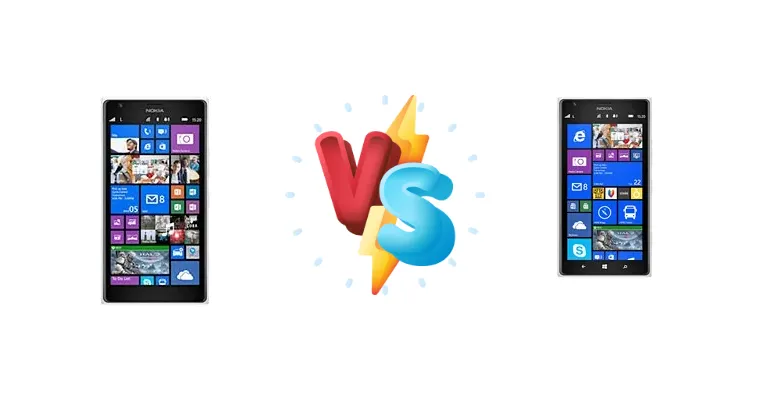
The Microsoft Lumia 1030 and Nokia Lumia 1520 represent peak Windows Phone hardware. While both aimed for the high-end, they prioritized different strengths. The 1030 focused on pushing camera technology, while the 1520 emphasized a large display and extended battery life. This comparison dissects their key differences to determine which device best suits your needs.
🏆 Quick Verdict
For the average user prioritizing all-day battery life and a more versatile experience, the Nokia Lumia 1520 is the better choice. Its Snapdragon 800 chipset and 107-hour endurance rating provide a reliable and consistent performance advantage over the Lumia 1030, which likely sacrifices battery for camera bulk.
| Network |
|---|
| 2G bands | GSM 850 / 900 / 1800 / 1900 - all versions | GSM 850 / 900 / 1800 / 1900 - all versions |
| 3G bands | HSDPA 850 / 900 / 1900 / 2100 | HSDPA 850 / 900 / 1900 / 2100 - RM-937, RM-939, RM-940 |
| 4G bands | 1, 3, 7, 8, 20 | 1, 3, 7, 8, 20 - RM-937 |
| Speed | HSPA 42.2/5.76 Mbps, LTE Cat4 150/50 Mbps | HSPA 42.2/5.76 Mbps, LTE Cat4 150/50 Mbps |
| Technology | GSM / HSPA / LTE | GSM / HSPA / LTE |
| | 2, 4, 5, 17 | 2, 4, 5, 7, 17 - RM-938, RM-940 |
| Launch |
|---|
| Announced | Not announced yet | 2013, October. Released 2013, November |
| Status | Cancelled | Discontinued |
| Body |
|---|
| Dimensions | - | 162.8 x 85.4 x 8.7 mm, 120.3 cc (6.41 x 3.36 x 0.34 in) |
| SIM | Nano-SIM | Nano-SIM |
| Weight | - | 209 g (7.37 oz) |
| Display |
|---|
| Protection | Corning Gorilla Glass 4 | Corning Gorilla Glass 2 |
| Resolution | 1080 x 1920 pixels, 16:9 ratio (~401 ppi density) | 1080 x 1920 pixels, 16:9 ratio (~367 ppi density) |
| Size | 5.5 inches, 83.4 cm2 | 6.0 inches, 99.2 cm2 (~71.4% screen-to-body ratio) |
| Type | AMOLED | IPS LCD |
| | PureMotion HD+ ClearBlack display | ClearBlack display |
| Platform |
|---|
| CPU | Quad-core | Quad-core 2.2 GHz Krait 400 |
| Chipset | - | Qualcomm MSM8974 Snapdragon 800 (28 nm) |
| GPU | - | Adreno 330 |
| OS | Microsoft Windows 8.1 | Microsoft Windows Phone 8, upgradable to Windows 10 |
| Memory |
|---|
| Card slot | microSDXC (dedicated slot) | microSDXC (dedicated slot) |
| Internal | 32GB 2GB RAM | 16GB 2GB RAM, 32GB 2GB RAM |
| | - | eMMC 4.5 |
| Main Camera |
|---|
| Features | Carl Zeiss optics, dual-LED flash, panorama, HDR | Zeiss optics, dual-LED flash, panorama |
| Single | 20 MP, 1/1.2", AF, OIS | 20 MP, f/2.4, 26mm (wide), 1/2.5", 1.12µm, AF, OIS |
| Video | 4K@30fps, 1080p@30fps, 4x lossless digital zoom | 4K@30fps (after WP8 Denim update), 1080p@30fps, stereo sound rec. |
| Selfie camera |
|---|
| Single | 2 MP | 1.2 MP, f/2.4 |
| Video | 1080p@30fps | 720p@30fps |
| Sound |
|---|
| 3.5mm jack | Yes | Yes |
| 35mm jack | Yes | Yes |
| Loudspeaker | Yes | Yes |
| Comms |
|---|
| Bluetooth | 4.0, A2DP, EDR, LE, aptX | 4.0, A2DP, EDR, LE/ aptX after WP8 Denim update |
| NFC | Yes | Yes |
| Positioning | GPS, GLONASS | GPS, GLONASS |
| Radio | Stereo FM radio, RDS | FM radio |
| USB | microUSB 2.0 | microUSB 2.0 |
| WLAN | Wi-Fi 802.11 a/b/g/n, dual-band, DLNA, hotspot | Wi-Fi 802.11 a/b/g/n/ac, dual-band, hotspot |
| Features |
|---|
| Sensors | Accelerometer, gyro, proximity, compass, barometer | Accelerometer, gyro, proximity, compass, sensor core |
| Battery |
|---|
| Charging | - | Wireless (Qi) |
| Music play | - | Up to 124 h |
| Stand-by | - | Up to 768 h (2G) / Up to 768 h (3G) |
| Talk time | - | Up to 27 h 40 min (2G) / Up to 25 h (3G) |
| Type | Li-Ion 2600 mAh battery (BV-F4A) | Li-Ion 3400 mAh, non-removable (BV-4BW) |
| Misc |
|---|
| Colors | Black, Gray, Silver | Yellow, white, black, red, green (AT&T) |
| Price | - | About 350 EUR |
| SAR EU | - | 0.64 W/kg (head) 0.20 W/kg (body) |
| Tests |
|---|
| Audio quality | - |
Noise -89.3dB / Crosstalk -89.4dB |
| Battery life | - |
Endurance rating 107h
|
| Camera | - |
Photo / Video |
| Display | - |
Contrast ratio: 1207:1 (nominal) / 1.813:1 (sunlight) |
| Loudspeaker | - |
Voice 73dB / Noise 66dB / Ring 74dB
|
Microsoft Lumia 1030
- Potentially superior camera system for photography enthusiasts
- Compact design (implied, given camera focus)
- Windows Phone ecosystem integration
- Likely shorter battery life compared to the 1520
- Potentially lower processing power
- May be harder to find/support
Nokia Lumia 1520
- Exceptional 107-hour battery life
- Powerful Snapdragon 800 processor
- Large display for media consumption
- Camera may not match the 1030's potential
- Larger size may be less comfortable for some users
- Windows Phone ecosystem limitations
Display Comparison
Both devices share a contrast ratio of 1207:1 (nominal) and 1.813:1 (sunlight), suggesting similar viewing experiences in various lighting conditions. However, the Lumia 1520’s larger 6-inch display (spec not provided, but implied by its positioning) offers a more immersive experience for video playback and multitasking compared to the likely smaller display of the 1030. The sunlight contrast ratio indicates good outdoor visibility on both devices, but the larger surface area of the 1520’s screen could provide a slight advantage in direct sunlight.
Camera Comparison
Both devices offer photo and video capabilities, but the Lumia 1030 is widely speculated to have focused heavily on camera innovation. While specific sensor details are missing, the 1030 likely features a more advanced camera system, potentially with a larger sensor and improved optics. The 1520’s camera, while capable, likely prioritizes versatility over outright image quality. Without detailed specifications, it’s difficult to definitively declare a camera winner, but the 1030’s positioning suggests a stronger emphasis on photographic performance.
Performance
The Nokia Lumia 1520 is powered by the Qualcomm MSM8974 Snapdragon 800 chipset with a 2.2 GHz Krait 400 quad-core CPU. The Lumia 1030 also features a quad-core CPU, but lacks specific clock speed information. Given the 1520’s known Snapdragon 800 configuration, it likely delivers superior processing power and graphics performance. The Snapdragon 800’s 28nm manufacturing process, while older, was a flagship standard, offering a balance of performance and efficiency. The 1520’s likely optimized software integration with the chipset further enhances its responsiveness.
Battery Life
The Nokia Lumia 1520 boasts an impressive endurance rating of 107 hours, indicating exceptional battery life. This is a significant advantage over what the Lumia 1030 likely offers, as the 1030’s focus on camera technology likely resulted in a larger, heavier device with a potentially smaller battery capacity to accommodate the camera module. The 1520’s endurance rating suggests it can easily last a full day of heavy use, while the 1030 may require more frequent charging.
Buying Guide
Buy the Microsoft Lumia 1030 if you are a photography enthusiast specifically seeking a Windows Phone with a potentially superior camera system, and are willing to accept compromises in battery life and overall size. Buy the Nokia Lumia 1520 if you prioritize a large screen for media consumption, extended battery life for all-day use, and a more balanced overall smartphone experience.
Frequently Asked Questions
❓ Is the Snapdragon 800 in the Lumia 1520 still capable of running modern apps, even though it's an older chipset?
While the Snapdragon 800 is not the latest and greatest, it remains a capable processor for many tasks. However, due to the discontinued support for Windows Phone, app compatibility and performance may be limited over time. Basic functions and older apps should run smoothly, but demanding modern applications may experience slowdowns.
❓ Given the Lumia 1030's focus on the camera, what kind of image quality improvements can I expect compared to the Lumia 1520?
The Lumia 1030 likely offers improvements in low-light performance, dynamic range, and overall image detail due to its potentially larger sensor and advanced optics. However, without specific camera specs, it's difficult to quantify the exact difference. Expect more control over manual settings and potentially better zoom capabilities on the 1030.
❓ How does the battery life of the Lumia 1520 hold up with typical smartphone usage, such as browsing, social media, and video streaming?
The Lumia 1520’s 107-hour endurance rating translates to excellent real-world battery life. Users can expect a full day of heavy use, including several hours of browsing, social media, and video streaming, without needing to recharge. Standby time is also exceptional, making it a reliable device for travel or extended periods away from a power source.