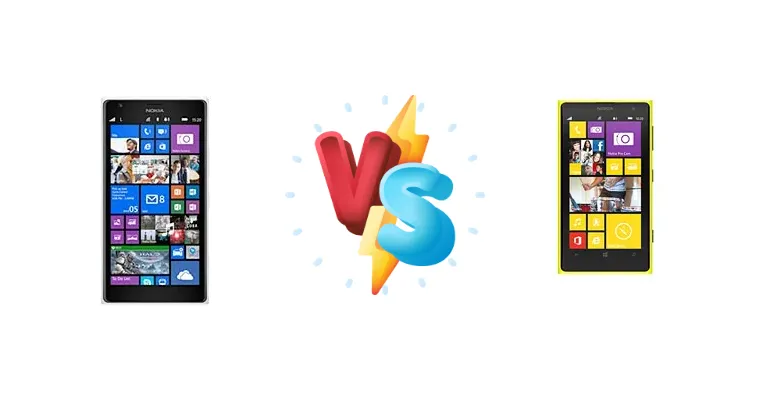
The Nokia Lumia 1020, released in 2013, set a new standard for mobile photography with its 41MP sensor. The Microsoft Lumia 1030, a later iteration, aimed to build upon this legacy by adding processing power. This comparison dissects the key differences between these two devices, focusing on how the hardware changes impact the user experience.
🏆 Quick Verdict
For the average user prioritizing camera capabilities and proven endurance, the Nokia Lumia 1020 remains the superior choice. While the Lumia 1030’s quad-core processor offers a theoretical performance boost, the 1020’s exceptional camera and 61-hour endurance rating provide a more compelling overall package.
| Network |
|---|
| 2G bands | GSM 850 / 900 / 1800 / 1900 - all versions | GSM 850 / 900 / 1800 / 1900 - all versions |
| 3G bands | HSDPA 850 / 900 / 1900 / 2100 | HSDPA 850 / 900 / 1900 / 2100 - RM-875, RM-877 |
| 4G bands | 1, 3, 7, 8, 20 | 1, 3, 7, 8, 20 - RM-875 |
| Speed | HSPA 42.2/5.76 Mbps, LTE Cat4 150/50 Mbps | HSPA 42.2/5.76 Mbps, LTE Cat3 100/50 Mbps |
| Technology | GSM / HSPA / LTE | GSM / HSPA / LTE |
| | 2, 4, 5, 17 | 2, 4, 5, 17 - RM-877 |
| Launch |
|---|
| Announced | Not announced yet | 2013, July 11. Released 2013, July 22 |
| Status | Cancelled | Discontinued |
| Body |
|---|
| Build | - | Glass front (Gorilla Glass 3), plastic back, plastic frame |
| Dimensions | - | 130.4 x 71.4 x 10.4 mm, 96.9 cc (5.13 x 2.81 x 0.41 in) |
| SIM | Nano-SIM | Micro-SIM |
| Weight | - | 158 g (5.57 oz) |
| Display |
|---|
| Protection | Corning Gorilla Glass 4 | Corning Gorilla Glass 3 |
| Resolution | 1080 x 1920 pixels, 16:9 ratio (~401 ppi density) | 768 x 1280 pixels, 5:3 ratio (~332 ppi density) |
| Size | 5.5 inches, 83.4 cm2 | 4.5 inches, 57.6 cm2 (~61.9% screen-to-body ratio) |
| Type | AMOLED | AMOLED |
| | PureMotion HD+ ClearBlack display | PureMotion HD+ ClearBlack display |
| Platform |
|---|
| CPU | Quad-core | Dual-core 1.5 GHz Krait |
| Chipset | - | Qualcomm MSM8960 Snapdragon S4 Plus |
| GPU | - | Adreno 225 |
| OS | Microsoft Windows 8.1 | Microsoft Windows Phone 8, upgradable to 8.1 |
| Memory |
|---|
| Card slot | microSDXC (dedicated slot) | No |
| Internal | 32GB 2GB RAM | 32GB 2GB RAM, 64GB 2GB RAM (Telefonica exclusive) |
| Main Camera |
|---|
| Features | Carl Zeiss optics, dual-LED flash, panorama, HDR | Carl Zeiss optics, Xenon & LED flash, panorama |
| Single | 20 MP, 1/1.2", AF, OIS | 41 MP, f/2.2, 26mm (wide), 1/1.5", 1.12µm, AF, OIS |
| Video | 4K@30fps, 1080p@30fps, 4x lossless digital zoom | 1080p@30fps, 4x lossless digital zoom |
| Selfie camera |
|---|
| Single | 2 MP | 1.2 MP |
| Video | 1080p@30fps | 720p@30fps |
| Sound |
|---|
| 3.5mm jack | Yes | Yes |
| 35mm jack | Yes | Yes |
| Loudspeaker | Yes | Yes |
| Comms |
|---|
| Bluetooth | 4.0, A2DP, EDR, LE, aptX | 4.0, A2DP, EDR, LE/ aptX after WP8 Denim update |
| NFC | Yes | Yes |
| Positioning | GPS, GLONASS | GPS, GLONASS |
| Radio | Stereo FM radio, RDS | Stereo FM radio, RDS |
| USB | microUSB 2.0 | microUSB 2.0 |
| WLAN | Wi-Fi 802.11 a/b/g/n, dual-band, DLNA, hotspot | Wi-Fi 802.11 a/b/g/n, dual-band, DLNA, hotspot |
| Features |
|---|
| Sensors | Accelerometer, gyro, proximity, compass, barometer | Accelerometer, gyro, proximity, compass, barometer |
| Battery |
|---|
| Music play | - | Up to 63 h |
| Stand-by | - | Up to 384 h (3G) |
| Talk time | - | Up to 19 h (2G) / Up to 13 h 20 min (3G) |
| Type | Li-Ion 2600 mAh battery (BV-F4A) | Li-Ion 2000 mAh, non-removable (BV-5XW) |
| Misc |
|---|
| Colors | Black, Gray, Silver | Yellow, white, black, red (AT&T exclusive) |
| Price | - | About 400 EUR |
| SAR | - | 1.23 W/kg (head) 0.97 W/kg (body) |
| SAR EU | - | 0.76 W/kg (head) 0.67 W/kg (body) |
| Tests |
|---|
| Battery life | - |
Endurance rating 61h
|
| Camera | - |
Photo / Video |
| Display | - |
Contrast ratio: Infinite (nominal), 2.103 (sunlight) |
| Loudspeaker | - |
Voice 69dB / Noise 66dB / Ring 72dB
|
Microsoft Lumia 1030
- Faster processor for improved multitasking
- Potentially improved app loading times
- Likely software optimizations for power efficiency
- Camera specifications are unknown, potentially inferior to the 1020
- Battery life may be slightly reduced compared to the 1020
Nokia Lumia 1020
- Exceptional 41MP camera with OIS
- Proven 61-hour battery endurance
- Renowned for image quality and low-light performance
- Dual-core processor may feel slower for demanding tasks
- Older chipset technology
Display Comparison
Both the Lumia 1030 and 1020 share the same display characteristics: an infinite (nominal) contrast ratio and a 2.103 contrast ratio in sunlight. This suggests both devices offer excellent visibility even in bright outdoor conditions. However, the context data lacks specifics on resolution or panel technology (OLED vs LCD), making a detailed comparison impossible. Given the 1020’s premium positioning at launch, it likely benefited from superior color calibration and viewing angles.
Camera Comparison
Both devices are equipped with photo and video capabilities, but the Lumia 1020 is widely celebrated for its 41MP sensor and advanced imaging features. While the 1030’s camera specifications are not provided, it’s reasonable to assume it aimed to match or surpass the 1020’s capabilities. The 1020’s OIS (Optical Image Stabilization) and large sensor size were key differentiators, enabling exceptional low-light performance and detail capture. Without specific details on the 1030’s sensor and lens, it’s difficult to definitively assess its photographic performance relative to the 1020.
Performance
The most significant hardware difference lies in the CPU. The Lumia 1030 boasts a quad-core processor, a substantial upgrade from the Lumia 1020’s dual-core 1.5 GHz Krait CPU based on the Qualcomm MSM8960 Snapdragon S4 Plus chipset. This architectural shift implies faster app launch times and smoother multitasking on the 1030. However, the Snapdragon S4 Plus was a well-optimized chipset for its time, and the 1020’s performance was generally considered adequate for the Windows Phone 8 operating system. The 1030’s advantage is likely most noticeable in demanding applications or when running multiple apps simultaneously.
Battery Life
Both the Lumia 1030 and 1020 achieve an impressive endurance rating of 61 hours. This suggests similar battery life performance despite the 1030’s more power-hungry quad-core processor. Microsoft likely optimized the 1030’s software and power management to compensate for the increased processing demands. However, the 1020’s proven track record of long-lasting battery life provides greater confidence for users prioritizing endurance.
Buying Guide
Buy the Microsoft Lumia 1030 if you need a slightly more responsive user interface for multitasking and app loading, and are willing to potentially sacrifice some battery life. Buy the Nokia Lumia 1020 if you prioritize exceptional image quality, long-lasting battery performance, and a device renowned for its photographic prowess, even if it means a less powerful processor.
Frequently Asked Questions
❓ Given the Lumia 1030's quad-core processor, will I notice a significant speed difference in everyday tasks compared to the Lumia 1020?
While the quad-core processor in the Lumia 1030 offers a theoretical performance advantage, the difference in everyday tasks like browsing, social media, and email may be minimal. The Snapdragon S4 Plus in the 1020 was well-optimized for Windows Phone 8. The 1030’s speed boost will be most noticeable when multitasking or running demanding applications.
❓ Is the Lumia 1030 a worthwhile upgrade for someone already owning a Lumia 1020, primarily for photography?
Unless the Lumia 1030 features a demonstrably superior camera system (which is currently unknown), it’s unlikely to be a worthwhile upgrade for photography enthusiasts. The Lumia 1020 remains a benchmark for mobile photography, and the 1030’s processor upgrade doesn’t necessarily translate to better image quality.
❓ How does the Snapdragon S4 Plus in the Lumia 1020 handle modern app requirements, considering its age?
The Snapdragon S4 Plus, while an older chipset, was capable of running Windows Phone 8 smoothly. However, some newer apps may not be fully optimized for the platform or the chipset’s architecture, potentially leading to performance issues or compatibility problems. The 1030’s newer processor mitigates this risk to some extent.