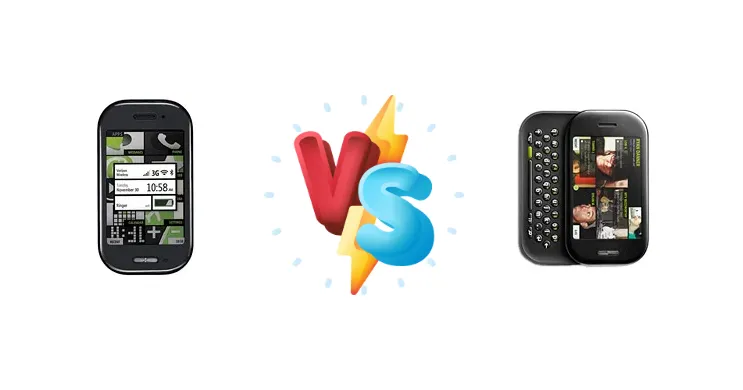
Launched in 2010, the Microsoft Kin TWOm and Kin Two represented a bold, if ultimately unsuccessful, attempt to redefine the smartphone experience around social networking. Despite sharing the same Nvidia Tegra chipset and 600MHz ARM 11 CPU, the two devices targeted slightly different users with distinct physical designs and software focuses. This comparison dissects those differences, revealing why one might have been preferable over the other.
🏆 Quick Verdict
For the average user interested in a glimpse into early smartphone social integration, the Kin Two emerges as the slightly better choice. Its slide-out QWERTY keyboard offers a more comfortable typing experience for extended social updates, a key use case for these devices, despite both phones sharing identical processing power.
| Network |
|---|
| 2G bands | CDMA 800 / 1900 | GSM 850 / 900 / 1800 / 1900 |
| 3G bands | CDMA2000 1xEV-DO | HSDPA 900 / 2100 |
| Speed | EV-DO Rev.A 3.1 Mbps | HSPA 7.2/2 Mbps |
| Technology | CDMA / EVDO | GSM / HSPA |
| Launch |
|---|
| Announced | 2010, November. Released 2010, November | 2010, April |
| Status | Discontinued | Cancelled |
| Body |
|---|
| Dimensions | 111.3 x 59.9 x 16.3 mm (4.38 x 2.36 x 0.64 in) | 115.1 x 65.3 x TBC mm |
| Keyboard | QWERTY | QWERTY |
| SIM | Mini-SIM | Mini-SIM |
| Weight | 133 g (4.69 oz) | - |
| Display |
|---|
| Resolution | 320 x 480 pixels, 3:2 ratio (~170 ppi density) | 320 x 480 pixels, 3:2 ratio (~170 ppi density) |
| Size | 3.4 inches, 34.4 cm2 (~51.6% screen-to-body ratio) | 3.4 inches, 34.4 cm2 (~45.8% screen-to-body ratio) |
| Type | TFT | TFT |
| | - |
|
| Platform |
|---|
| CPU | 600MHz ARM 11 | 600MHz ARM 11 |
| Chipset | Nvidia Tegra | Nvidia Tegra |
| Memory |
|---|
| Call records | Practically unlimited | Practically unlimited |
| Card slot | No | No |
| Internal | 8GB 256MB RAM | 8GB 256MB RAM |
| Phonebook | Practically unlimited entries and fields, Photocal | Practically unlimited entries and fields, Photocal |
| Main Camera |
|---|
| Features | LED flash | LED flash |
| Single | 8 MP, AF | 8 MP, AF |
| Video | 720p | 720p |
| Sound |
|---|
| 3.5mm jack | Yes | Yes |
| 35mm jack | Yes | Yes |
| Loudspeaker | Yes, with stereo speakers | Yes, with stereo speakers |
| Comms |
|---|
| Bluetooth | 2.1, A2DP | 2.1, A2DP |
| Positioning | No | GPS, A-GPS |
| Radio | Stereo FM radio, RDS | Stereo FM radio, RDS |
| USB | microUSB 2.0 | microUSB 2.0 |
| WLAN | Wi-Fi 802.11 b/g | Wi-Fi 802.11 b/g |
| Features |
|---|
| Browser | WAP 2.0/xHTML, HTML | WAP 2.0/xHTML, HTML |
| Games | No | Yes + downloadable |
| Java | Yes, MIDP 2.0 | Yes, MIDP 2.1 |
| Messaging | SMS(threaded view), MMS, Email, Push Email | SMS(threaded view), MMS, Email, Push Email |
| Sensors | Accelerometer, proximity | Accelerometer, proximity |
| | SNS integration
MP3/WAV/WMA/eAAC+ player
MP4/WMV/H.264 player
MS Office (Word, Excel, PowerPoint, OneNote, PDF viewer)
Voice memo/dial/commands
Predictive text input | MP3/WAV/WMA/eAAC+ player
MP4/WMV/H.264 player
Facebook and Twitter integration
YouTube client
MS Office (Word, Excel, PowerPoint, OneNote, PDF viewer)
Voice memo
Predictive text input |
| Battery |
|---|
| Stand-by | Up to 232 h | Up to 232 h |
| Talk time | Up to 6 h | - |
| Type | Removable Li-Ion battery | Removable Li-Ion 1390 mAh battery |
| Misc |
|---|
| Colors | Black | Black |
| Price | About 160 EUR | About 330 EUR |
| SAR | 1.29 W/kg (head) 0.76 W/kg (body) | - |
Microsoft Kin TWOm
- More compact and pocketable design.
- Simpler, more streamlined aesthetic.
- Potentially lighter weight for easier carrying.
- Lack of physical keyboard limits typing speed.
- Smaller screen may be less comfortable for extended use.
- Potentially smaller battery capacity.
Microsoft Kin Two
- Slide-out QWERTY keyboard for faster typing.
- Larger screen size for improved readability.
- More comfortable for composing longer social updates.
- Bulkier and less pocketable design.
- Increased weight due to keyboard mechanism.
- More complex mechanical design potentially prone to failure.
Display Comparison
Both the Kin TWOm and Kin Two feature displays designed for social interaction rather than media consumption. While exact screen sizes and resolutions aren't specified, the TWOm's smaller overall footprint suggests a correspondingly smaller display. The shared Nvidia Tegra chipset likely handles basic UI rendering adequately for the intended use case, but neither device was positioned as a multimedia powerhouse. The focus was on readability of text and social feeds, not vibrant color reproduction or high resolution.
Camera Comparison
Details regarding the camera specifications of both Kin devices are scarce. Given the social focus, the cameras were likely intended for quick snapshots and sharing, rather than high-quality photography. The absence of detailed specs suggests neither device boasted a particularly advanced camera system. Image processing would have been geared towards immediate social media upload, prioritizing speed over detail. The shared chipset likely handled basic image processing tasks.
Performance
The identical Nvidia Tegra chipset and 600MHz ARM 11 CPU mean performance between the Kin TWOm and Kin Two will be virtually indistinguishable. The ARM 11 architecture, while common for the time, is significantly less powerful than modern smartphone processors. This limits multitasking capabilities and responsiveness with demanding applications. The Tegra chipset, however, offered some GPU acceleration, likely used for basic UI animations and potentially some limited gaming. Thermal management wasn't a major concern given the low power draw of the components.
Battery Life
Battery life on both devices would have been heavily dependent on usage patterns, particularly the frequency of social network synchronization. The 600MHz ARM 11 processor is relatively power-efficient, but constant data connectivity and background processes would drain the battery quickly. Without specific mAh ratings, it's difficult to definitively say which device offered better battery life, but the TWOm's smaller size likely necessitated a smaller battery capacity.
Buying Guide
Buy the Microsoft Kin TWOm if you prioritize a more compact and pocketable form factor, valuing portability over extensive typing. Its smaller size makes it ideal for quick social interactions on the go. Buy the Microsoft Kin Two if you anticipate composing longer social posts, emails, or notes, as the slide-out QWERTY keyboard significantly enhances input speed and accuracy, making it the better option for content creators within the Kin ecosystem.
Frequently Asked Questions
❓ Given the limited processing power, how well did the Kin phones handle social network synchronization?
The 600MHz ARM 11 processor and Nvidia Tegra chipset were sufficient for basic social network synchronization, but performance would have been noticeably slower than modern smartphones. Expect delays when uploading photos or refreshing feeds, especially with multiple accounts connected. The Kin software was optimized for this limited hardware, prioritizing essential social features over complex functionality.
❓ Was the Kin Studio software essential for managing content on the Kin phones?
Yes, Kin Studio was a crucial component of the Kin experience. It was a desktop application used for backing up photos, videos, and social updates from the Kin phones. Without Kin Studio, managing and preserving content was significantly more difficult, as the phones lacked expandable storage and had limited on-device storage capacity.
❓ How did the Kin Loop feature differentiate the Kin phones from other smartphones of the time?
Kin Loop was the central feature of the Kin experience, automatically aggregating social updates from various networks into a single, chronological stream. This aimed to simplify social media consumption, presenting a unified view of a user's social life. While similar features exist today, Kin Loop was relatively novel in 2010, representing Microsoft's attempt to create a dedicated social phone experience.