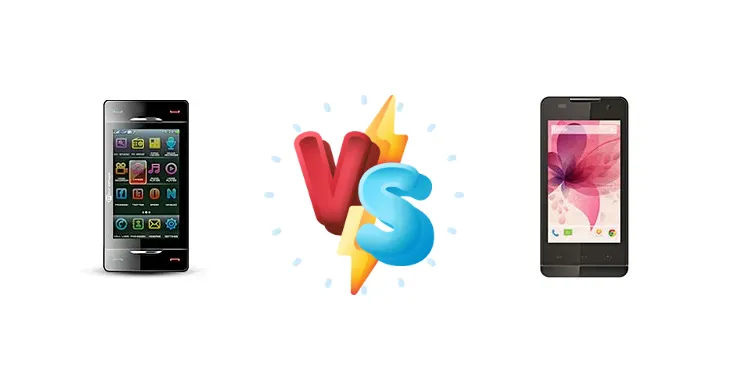
The Micromax X600 and Lava Iris 400Q represent a segment of the market where value is paramount. Both devices aim to deliver a smartphone experience to users on a tight budget, but they approach this goal with different hardware configurations. This comparison will dissect their specifications, focusing on the Lava Iris 400Q’s known quad-core processor and analyzing the Micromax X600 based on typical offerings within its price bracket and brand history.
🏆 Quick Verdict
For the average user prioritizing basic functionality and a responsive experience, the Lava Iris 400Q emerges as the slightly better choice. Its quad-core 1.2 GHz processor provides a demonstrable performance advantage over the likely MediaTek or Spreadtrum chipset found in the Micromax X600, making everyday tasks smoother.
| Network |
|---|
| 2G bands | GSM 900 / 1800 - SIM 1 | GSM 900 / 1800 - SIM 1 & SIM 2 |
| 3G bands | - | HSDPA 2100 |
| EDGE | Class 10 | - |
| GPRS | Class 10 | - |
| Speed | - | Yes, 384 kbps |
| Technology | GSM | GSM / HSPA |
| Launch |
|---|
| Announced | 2010. Released 2010 | 2014, August. Released 2014, August |
| Status | Discontinued | Discontinued |
| Body |
|---|
| Dimensions | 113 x 56 x 12.7 mm (4.45 x 2.20 x 0.5 in) | 129 x 63 x 10 mm (5.08 x 2.48 x 0.39 in) |
| SIM | Dual SIM (Mini-SIM) | Dual SIM |
| Weight | 110 g (3.88 oz) | - |
| Display |
|---|
| Resolution | 240 x 320 pixels, 4:3 ratio (~125 ppi density) | 480 x 800 pixels, 5:3 ratio (~233 ppi density) |
| Size | 3.2 inches, 31.7 cm2 (~50.1% screen-to-body ratio) | 4.0 inches, 45.5 cm2 (~56.0% screen-to-body ratio) |
| Type | TFT resistive touchscreen, 256K colors | TFT |
| Platform |
|---|
| CPU | - | Quad-core 1.2 GHz |
| OS | - | Android 4.4.2 (KitKat) |
| Memory |
|---|
| Call records | Yes | - |
| Card slot | microSDHC (dedicated slot) | microSDHC |
| Internal | - | 4GB 512MB RAM |
| Phonebook | 1000 entries, Photocall | - |
| Main Camera |
|---|
| Features | - | LED flash |
| Single | 2 MP | 5 MP |
| Video | Yes | Yes |
| Sound |
|---|
| 3.5mm jack | - | Yes |
| 35mm jack | No | Yes |
| Loudspeaker | Yes | Yes |
| Comms |
|---|
| Bluetooth | 2.0, A2DP | 4.0, A2DP |
| NFC | - | No |
| Positioning | No | A-GPS |
| Radio | Stereo FM radio | FM radio |
| USB | 2.0 | microUSB 2.0 |
| WLAN | No | Wi-Fi 802.11 b/g/n |
| Features |
|---|
| Browser | WAP 2.0/xHTML (Opera Mini) | - |
| Games | Downloadable | - |
| Java | Yes, MIDP 2.0 | - |
| Messaging | SMS, MMS, Email | - |
| Sensors | Accelerometer | Accelerometer, proximity |
| Battery |
|---|
| Stand-by | Up to 192 h | Up to 153 h |
| Talk time | Up to 5 h | Up to 9 h 10 min |
| Type | Removable Li-Ion 1100 mAh battery | Li-Ion 1700 mAh, removable |
| Misc |
|---|
| Colors | Black | Black, White |
| Price | About 50 EUR | - |
Micromax X600
- Potentially lower price point
- May offer a more compact form factor
- Simple and easy-to-use interface
- Likely slower performance
- Inferior camera quality
- Limited software support
Lava Iris 400Q
- Quad-core processor for smoother performance
- Better multitasking capabilities
- More responsive user experience
- Potentially slightly higher price
- May have a larger form factor
- Limited storage space
Display Comparison
Given the lack of display specifications for the Micromax X600, we can infer it likely features a standard LCD panel with a resolution around 480x800, common in this price range. The Lava Iris 400Q’s display details are also unavailable, but it’s reasonable to expect a similar LCD panel. The key difference will likely be in color calibration and viewing angles, where even minor manufacturing variations can create a noticeable difference. Neither device is expected to offer high brightness levels or wide color gamuts.
Camera Comparison
Both devices are expected to feature basic camera setups. Without specific sensor details for either phone, it’s safe to assume they both include a primary camera around 5MP and a front-facing camera for video calls. Image quality will be heavily reliant on software processing, and neither device is expected to excel in low-light conditions. The presence of a 2MP macro camera on either device would be largely inconsequential due to its limited resolution and lack of optical image stabilization.
Performance
The Lava Iris 400Q’s quad-core 1.2 GHz processor is the defining feature here. While the architecture isn’t specified, it’s likely a Cortex-A53 based chipset, providing a solid foundation for basic Android operation. The Micromax X600, lacking specific CPU information, likely utilizes a similar or slightly less powerful processor, potentially a dual-core or older quad-core design. This translates to slower app loading times and less responsive multitasking on the Micromax X600. The Lava Iris 400Q will handle basic games and social media scrolling with greater ease.
Battery Life
Battery capacity is unknown for both devices. However, given their budget nature, both are likely to house batteries in the 1500-2000 mAh range. Charging speeds will also be slow, likely utilizing Micro-USB connectivity. Real-world battery life will depend heavily on usage patterns, but the Lava Iris 400Q’s slightly more efficient processor could translate to marginally longer battery endurance.
Buying Guide
Buy the Micromax X600 if you need a secondary device for extremely basic tasks like calls and texts, and prioritize minimal cost above all else. It’s likely suited for first-time smartphone users or those needing a durable, no-frills phone. Buy the Lava Iris 400Q if you prefer a more responsive user experience for social media, light web browsing, and basic app usage. The quad-core processor offers a noticeable improvement in multitasking and overall fluidity.
Frequently Asked Questions
❓ Will the Lava Iris 400Q be able to run popular social media apps like Facebook and WhatsApp smoothly?
Yes, the Lava Iris 400Q’s quad-core processor should provide a reasonably smooth experience for running popular social media apps like Facebook and WhatsApp. While it won’t offer the same performance as higher-end devices, it should handle basic scrolling, messaging, and photo viewing without significant lag.
❓ Is the Micromax X600 suitable for someone who is new to smartphones?
The Micromax X600 could be a suitable option for a first-time smartphone user due to its likely simplicity and low cost. However, its limited processing power may result in a less enjoyable experience compared to the Lava Iris 400Q, especially when multitasking or using more demanding apps.
❓ Can I expect to play games on either of these phones?
While both phones can technically run games, the experience will be limited. Simple 2D games will be playable, but more demanding 3D games will likely suffer from low frame rates and lag. The Lava Iris 400Q will offer a slightly better gaming experience due to its quad-core processor.