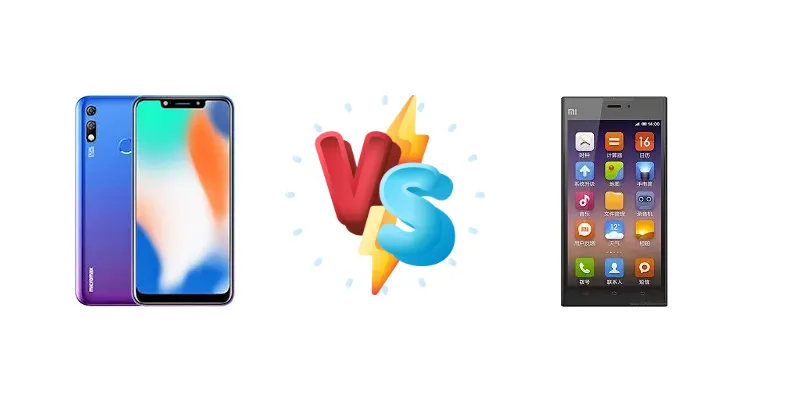
The Xiaomi Mi 3, a 2013 flagship, represents a high point in early Android performance. The Micromax Infinity N12, released much later, aims to deliver modern features at an ultra-budget price. This comparison examines how these devices stack up, considering their vastly different eras and target audiences.
🏆 Quick Verdict
For users prioritizing raw performance and a proven track record, the Xiaomi Mi 3 remains a surprisingly capable choice, despite its age. However, the Micromax Infinity N12 offers modern connectivity and a more current software experience, making it the better option for everyday tasks and users needing 4G.
| Network |
|---|
| 2G bands | GSM 850 / 900 / 1800 / 1900 | GSM 850 / 900 / 1800 / 1900 |
| 3G bands | HSDPA 900 / 2100 | HSDPA 850 / 900 / 1900 / 2100 |
| 4G bands | 1, 3, 5, 8, 40, 41 | - |
| Speed | HSPA 42.2/11.5 Mbps, LTE Cat4 150/50 Mbps | HSPA 42.2/5.76 Mbps |
| Technology | GSM / HSPA / LTE | GSM / HSPA |
| Launch |
|---|
| Announced | 2018, December. Released 2018, December | 2013, September. Released 2013, December |
| Status | Discontinued | Discontinued |
| Body |
|---|
| Build | - | Glass front (Gorilla Glass 3), plastic back, plastic frame |
| Dimensions | 156 x 76.2 x 8.5 mm (6.14 x 3.00 x 0.33 in) | 144 x 73.6 x 8.1 mm (5.67 x 2.90 x 0.32 in) |
| SIM | Nano-SIM + Nano-SIM | Mini-SIM |
| Weight | 164 g (5.78 oz) | 145 g (5.11 oz) |
| Display |
|---|
| Protection | - | Corning Gorilla Glass 3 |
| Resolution | 720 x 1500 pixels (~269 ppi density) | 1080 x 1920 pixels, 16:9 ratio (~441 ppi density) |
| Size | 6.19 inches, 96.4 cm2 (~81.1% screen-to-body ratio) | 5.0 inches, 68.9 cm2 (~65.0% screen-to-body ratio) |
| Type | IPS LCD | IPS LCD |
| Platform |
|---|
| CPU | Octa-core 2.0 GHz Cortex-A53 | Quad-core 2.3 GHz Krait 400 |
| Chipset | Mediatek MT6762V Helio P22 (12 nm) | Qualcomm MSM8274AB Snapdragon 800 (28 nm) |
| GPU | PowerVR GE8320 | Adreno 330 |
| OS | Android 8.1 (Oreo) | Android 4.3 (Jelly Bean), upgradable to 6.0 (Marshmallow), MIUI 5 |
| Memory |
|---|
| Card slot | microSDXC (dedicated slot) | No |
| Internal | 32GB 3GB RAM | 16GB 2GB RAM, 64GB 2GB RAM |
| | eMMC 5.1 | eMMC 4.5 |
| Main Camera |
|---|
| Dual | 13 MP, PDAF
Auxiliary lens | - |
| Features | LED flash | Dual-LED flash, HDR |
| Single | - | 13 MP, f/2.2, 28mm (wide), AF |
| Video | 1080p@24fps | 1080p@30fps, HDR |
| Selfie camera |
|---|
| Features | LED flash | - |
| Single | 16 MP, f/2.2, 26mm (wide), 1/3.06", 1.0µm | 2 MP, f/2.2 |
| Video | 1080p | 1080p@30fps |
| Sound |
|---|
| 3.5mm jack | Yes | Yes |
| 35mm jack | Yes | Yes |
| Loudspeaker | Yes | Yes |
| Comms |
|---|
| Bluetooth | 4.2, A2DP | 4.0, A2DP |
| NFC | No | Yes |
| Positioning | GPS | GPS, GLONASS |
| Radio | FM radio, recording | FM radio |
| USB | microUSB 2.0, OTG | microUSB 2.0, OTG |
| WLAN | Wi-Fi 802.11 a/b/g/n | Wi-Fi 802.11 a/b/g/n, dual-band, Wi-Fi Direct, hotspot |
| Features |
|---|
| Sensors | Fingerprint (rear-mounted), accelerometer, gyro, proximity | Accelerometer, gyro, proximity, compass, barometer |
| Battery |
|---|
| Charging | - | 18W wired, QC2 |
| Music play | - | Up to 50 h |
| Stand-by | - | Up to 500 h |
| Talk time | - | Up to 25 h |
| Type | Li-Po 4000 mAh, non-removable | Li-Ion 3050 mAh, non-removable |
| Misc |
|---|
| Colors | Blue Lagoon, Red Velvet, Viola, Black | White, Gray, Black, Yellow, Pink, Blue, Gold, Green |
| Models | N8301 | - |
| Price | About 10000 INR | About 200 EUR |
| Tests |
|---|
| Audio quality | - |
Noise -91.5dB / Crosstalk -44.2dB |
| Battery life | - | Endurance rating 66h |
| Camera | - |
Photo / Video |
| Display | - |
Contrast ratio: 907 (nominal), 2.001 (sunlight) |
| Loudspeaker | - |
Voice 69dB / Noise 66dB / Ring 75dB |
Micromax Infinity N12
- Superior CPU performance thanks to the Snapdragon 800.
- Faster charging with Quick Charge 2.0.
- Potentially better camera quality (based on flagship status).
- Aging battery and potential degradation.
- No longer receiving software updates.
- Older 4G technology.
Xiaomi Mi 3
- More power-efficient chipset (12nm).
- Modern software experience (likely Android Go).
- Lower price point.
- Significantly lower CPU performance.
- Likely a less capable camera system.
- Missing Quick Charge support.
Display Comparison
Both devices share a contrast ratio of 907 (nominal) and 2001 (sunlight), suggesting similar outdoor visibility. However, the specifics of panel technology are unknown for the N12. The Mi 3’s display, while good for its time, lacks the advancements found in modern panels like higher refresh rates or HDR support. The shared contrast ratio indicates a similar level of black depth, but the Mi 3’s age means potential color degradation is a factor.
Camera Comparison
Both phones are listed as having 'Photo / Video' capabilities, but detailed camera specifications are absent. Given the Mi 3’s flagship status, it likely featured a more sophisticated camera system with a larger sensor and better image processing. The N12, being a budget device, likely utilizes a simpler camera setup. Without specific sensor sizes or aperture information, it’s difficult to make a definitive comparison, but the Mi 3 likely captures more detailed and dynamic images.
Performance
The core difference lies in the chipsets. The Xiaomi Mi 3’s Qualcomm Snapdragon 800 (28nm) features a quad-core 2.3 GHz Krait 400 CPU, a design focused on single-core performance. The Micromax Infinity N12 utilizes the Mediatek MT6762V Helio P22 (12nm) with an octa-core 2.0 GHz Cortex-A53 CPU. While the P22 has more cores, the Snapdragon 800’s Krait architecture and higher clock speed provide a significant performance advantage in CPU-intensive tasks. The 28nm process of the Snapdragon 800 is less efficient than the 12nm process of the Helio P22, but the Mi 3’s superior architecture compensates for this, offering better overall responsiveness. The Mi 3 will handle demanding apps and older games more smoothly.
Battery Life
The Xiaomi Mi 3 boasts an endurance rating of 66 hours, a respectable figure for its time. The N12’s battery capacity is unknown, but its 12nm chipset should offer better power efficiency than the Mi 3’s 28nm chip. The Mi 3 supports 18W wired charging with Quick Charge 2.0, a feature likely absent on the N12. While the N12 may have a longer standby time due to its more efficient chipset, the Mi 3’s larger battery and faster charging provide a more convenient user experience.
Buying Guide
Buy the Micromax Infinity N12 if you need a functional, affordable smartphone with 4G connectivity for basic tasks like calling, messaging, and light social media. Buy the Xiaomi Mi 3 if you prioritize performance for older games and apps, and are comfortable with a device that is no longer receiving software updates and has an aging battery.
Frequently Asked Questions
❓ Will the Xiaomi Mi 3 still be able to run modern apps like WhatsApp and Facebook?
While the Mi 3 can run older versions of these apps, performance may be sluggish with the latest versions. The Snapdragon 800 is capable, but the limited RAM and lack of software optimization for current Android versions will likely result in a less-than-ideal experience.
❓ Is the Micromax Infinity N12 a good option for mobile gaming?
The Helio P22 in the Micromax Infinity N12 is not designed for demanding mobile games. It can handle simpler games, but expect low frame rates and graphical settings on more intensive titles. The Snapdragon 800 in the Mi 3 will offer a better gaming experience, but even that is limited by its age.
❓ How long will the battery on the Xiaomi Mi 3 realistically last given its age?
The battery life on a Xiaomi Mi 3 today will be significantly reduced compared to its original 66-hour endurance rating. Expect to get a full day of light use at best, and potentially needing a charge mid-day with moderate usage. Battery replacement is an option, but may be costly.
❓ Does the Micromax Infinity N12 support VoLTE and Wi-Fi calling?
Given its release date, the Micromax Infinity N12 likely supports VoLTE (Voice over LTE) for improved call quality and reliability. Wi-Fi calling support is also probable, but depends on the carrier and software version. Check with your mobile provider for compatibility.