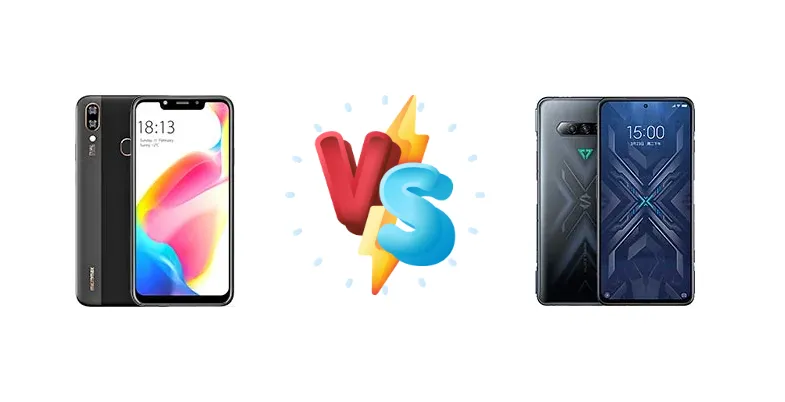
The smartphone market presents a stark contrast between raw power and affordability. We pit the Xiaomi Black Shark 4 Pro, a gaming-focused device boasting a flagship Snapdragon 888 chipset and blazing-fast 120W charging, against the Micromax Infinity N11, a budget-oriented option powered by a Mediatek Helio P22. This comparison dissects their capabilities to determine which device delivers the best experience for different user profiles.
🏆 Quick Verdict
For users prioritizing gaming and demanding performance, the Xiaomi Black Shark 4 Pro is the clear winner. Its Snapdragon 888 chipset and 120W charging are in a different league. However, the Micromax Infinity N11 provides a functional smartphone experience at a significantly lower price point, making it suitable for basic users.
| Network |
|---|
| 2G bands | GSM 850 / 900 / 1800 / 1900 | GSM 850 / 900 / 1800 / 1900 |
| 3G bands | HSDPA 900 / 2100 | HSDPA 800 / 850 / 900 / 1700(AWS) / 1900 / 2100 |
| 4G bands | 1, 3, 5, 8, 40, 41 | 1, 2, 3, 4, 5, 7, 8, 18, 19, 20, 26, 28, 34, 38, 39, 40, 41 |
| 5G bands | - | 1, 3, 8, 28, 41, 77, 78, 79 SA/NSA |
| Speed | HSPA 42.2/11.5 Mbps, LTE Cat4 150/50 Mbps | HSPA, LTE, 5G |
| Technology | GSM / HSPA / LTE | GSM / CDMA / HSPA / EVDO / LTE / 5G |
| | - | CDMA2000 1xEV-DO |
| Launch |
|---|
| Announced | 2018, December. Released 2019, January | 2021, March 23 |
| Status | Discontinued | Available. Released 2021, March 30 |
| Body |
|---|
| Dimensions | 156 x 76.2 x 8.5 mm (6.14 x 3.00 x 0.33 in) | 163.8 x 76.4 x 9.9 mm (6.45 x 3.01 x 0.39 in) |
| SIM | Nano-SIM + Nano-SIM | Nano-SIM + Nano-SIM |
| Weight | 164 g (5.78 oz) | 220 g (7.76 oz) |
| | - | Physical pop-up gaming triggers |
| Display |
|---|
| Resolution | 720 x 1500 pixels (~269 ppi density) | 1080 x 2400 pixels, 20:9 ratio (~395 ppi density) |
| Size | 6.19 inches, 96.4 cm2 (~81.1% screen-to-body ratio) | 6.67 inches, 107.4 cm2 (~85.8% screen-to-body ratio) |
| Type | IPS LCD | Super AMOLED, 144Hz, HDR10+, 1300 nits (peak) |
| | - | Always-on display |
| Platform |
|---|
| CPU | Octa-core 2.0 GHz Cortex-A53 | Octa-core (1x2.84 GHz Cortex-X1 & 3x2.42 GHz Cortex-A78 & 4x1.80 GHz Cortex-A55) |
| Chipset | Mediatek MT6762V Helio P22 (12 nm) | Qualcomm SM8350 Snapdragon 888 5G (5 nm) |
| GPU | PowerVR GE8320 | Adreno 660 |
| OS | Android 8.1 (Oreo) | Android 11, Joy UI 12.5 |
| Memory |
|---|
| Card slot | microSDXC (dedicated slot) | No |
| Internal | 32GB 2GB RAM | 128GB 8GB RAM, 256GB 8GB RAM, 256GB 12GB RAM, 512GB 16GB RAM |
| | eMMC 5.1 | UFS 3.1 |
| Main Camera |
|---|
| Dual | 13 MP, PDAF
Auxiliary lens | - |
| Features | LED flash | LED flash, HDR, panorama |
| Single | - | 20 MP, f/2.5, (wide), 0.8µm |
| Triple | - | 64 MP, f/1.8, (wide), 1/1.97", 0.7µm, PDAF
8 MP, f/2.2, 120˚ (ultrawide), 1/4.0", 1.12µm
5 MP (macro), AF |
| Video | 1080p@24fps | 4K@30/60fps, 1080p@30/60/240fps, 1080p@960fps; HDR10+ |
| Selfie camera |
|---|
| Features | LED flash | HDR |
| Single | 8 MP | 20 MP, f/2.5, (wide), 0.8µm |
| Video | 1080p | 1080p@30fps |
| Sound |
|---|
| 3.5mm jack | Yes | Yes |
| 35mm jack | Yes | Yes |
| Loudspeaker | Yes | Yes, with stereo speakers |
| | - | 24-bit/192kHz audio |
| Comms |
|---|
| Bluetooth | 4.2, A2DP | 5.2 (China), 5.0 (Global), A2DP, LE, aptX HD, aptX Adaptive |
| NFC | No | Yes |
| Positioning | GPS | GPS, GLONASS, GALILEO, QZSS, BDS |
| Radio | FM radio, recording | No |
| USB | microUSB 2.0, OTG | USB Type-C 2.0 |
| WLAN | Wi-Fi 802.11 a/b/g/n | Wi-Fi 802.11 a/b/g/n/ac/6, dual-band, Wi-Fi Direct |
| Features |
|---|
| Sensors | Fingerprint (rear-mounted), accelerometer, gyro, proximity | Fingerprint (side-mounted), accelerometer, gyro, proximity, compass, barometer (China only) |
| Battery |
|---|
| Charging | - | 120W wired, 50% in 5 min, 100% in 15 min |
| Type | Li-Po 4000 mAh, non-removable | Li-Po 4500 mAh |
| Misc |
|---|
| Colors | Black | Shadow Black, Misty Grey, Cosmos Black, Dark Blue, Silver |
| Models | - | SHARK PAR-H0 |
| Price | About 9000 INR | About 500 EUR |
Micromax Infinity N11
- Extremely Affordable
- Functional for Basic Tasks
- Potentially Longer Battery Life (due to less power-hungry chipset)
- Significantly Lower Performance
- Basic Camera Capabilities
- Outdated Chipset
Xiaomi Black Shark 4 Pro
- Flagship Snapdragon 888 Performance
- Ultra-Fast 120W Charging
- Optimized for Gaming
- Higher Price Point
- Potentially Shorter Battery Life (due to power-hungry chipset)
- Gaming Aesthetic May Not Appeal to Everyone
Display Comparison
While display specifications for the Micromax Infinity N11 are unavailable, it's reasonable to assume it features a standard LCD panel. The Black Shark 4 Pro, however, is built for immersion. Though the exact panel type isn't specified, its focus on gaming suggests a high refresh rate (likely 120Hz or 144Hz) and good color accuracy. The difference in processing power directly impacts the smoothness of animations and responsiveness, favoring the Black Shark 4 Pro. The absence of details on the N11's display suggests a cost-cutting measure, likely resulting in lower brightness and less vibrant colors.
Camera Comparison
Camera details for the Micromax Infinity N11 are limited, suggesting a basic camera setup. The Xiaomi Black Shark 4 Pro, while primarily a gaming phone, likely features a more capable camera system, though details are missing. The Snapdragon 888’s image signal processor (ISP) offers advanced image processing capabilities, potentially resulting in better dynamic range and low-light performance. Without specific sensor information for either device, it’s difficult to make a precise comparison, but the Black Shark 4 Pro’s chipset advantage suggests superior image quality.
Performance
The performance gap between these devices is substantial. The Xiaomi Black Shark 4 Pro’s Qualcomm Snapdragon 888 5G (5nm) is a flagship-tier chipset featuring an octa-core configuration with a prime Cortex-X1 core clocked at 2.84 GHz. This architecture delivers significantly higher CPU and GPU performance compared to the Micromax Infinity N11’s Mediatek MT6762V Helio P22 (12nm) and its octa-core 2.0 GHz Cortex-A53 CPUs. The 5nm fabrication process of the Snapdragon 888 also contributes to better thermal efficiency, reducing throttling during sustained workloads. The Black Shark 4 Pro is designed for demanding games and applications, while the Infinity N11 is geared towards basic tasks.
Battery Life
The Xiaomi Black Shark 4 Pro’s standout feature is its 120W wired charging, capable of charging the battery from 0% to 50% in just 5 minutes and fully charging it in 15 minutes. While the Infinity N11’s battery capacity is unknown, its slower processor and less demanding display likely translate to longer battery life per charge. However, the Black Shark 4 Pro’s rapid charging capability significantly reduces downtime, making it ideal for users who need to quickly top up their battery. The charging speed difference is a major differentiator, catering to different usage patterns.
Buying Guide
Buy the Micromax Infinity N11 if you need a reliable, basic smartphone for everyday tasks like calling, texting, and light social media use, and your budget is extremely limited. Buy the Xiaomi Black Shark 4 Pro if you are a mobile gamer, content creator, or power user who demands the fastest performance, rapid charging, and a feature-rich experience, and are willing to pay a premium.
Frequently Asked Questions
❓ Is the Mediatek Helio P22 in the Micromax Infinity N11 sufficient for playing modern mobile games?
The Helio P22 is a budget-oriented chipset and will struggle with demanding modern games. While it can handle less graphically intensive titles, expect low frame rates and significant lag in popular games like PUBG or Genshin Impact. It's best suited for casual gaming or older titles.
❓ How does the 120W charging on the Black Shark 4 Pro affect battery health over the long term?
While 120W charging is incredibly fast, concerns about long-term battery health are valid. Xiaomi likely employs sophisticated charging algorithms and thermal management to mitigate potential degradation. However, consistently using ultra-fast charging *may* slightly accelerate battery aging compared to slower charging methods. The convenience often outweighs this concern for most users.
❓ Does the Black Shark 4 Pro get excessively hot during prolonged gaming sessions?
The Snapdragon 888 is known to generate heat under sustained load. The Black Shark 4 Pro incorporates cooling solutions (details are missing in the provided data) to manage thermal throttling. While some heat is expected during intense gaming, the phone is designed to maintain performance for extended periods. Reviewers have noted that it can get warm, but not uncomfortably so.