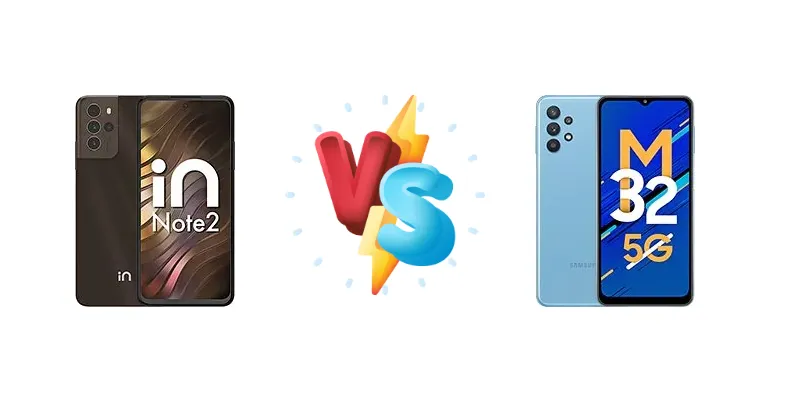
The Micromax In Note 2 and Samsung Galaxy M32 5G represent compelling options in the competitive budget 5G smartphone space. While both aim to deliver 5G connectivity at an accessible price point, they diverge significantly in their core hardware, particularly in their chipsets and charging capabilities. This comparison dissects these differences to determine which device offers the best value for your money.
🏆 Quick Verdict
For users prioritizing raw performance and faster charging, the Micromax In Note 2 emerges as the stronger contender. Its Helio G95 chipset, built on a 12nm process, offers a slight edge in CPU performance, and the 30W charging significantly reduces downtime. However, the Samsung Galaxy M32 5G’s Dimensity 720 offers a more efficient 7nm process.
| Network |
|---|
| 2G bands | GSM 850 / 900 / 1800 / 1900 | GSM 850 / 900 / 1800 / 1900 |
| 3G bands | HSDPA 850 / 900 / 2100 | HSDPA 850 / 900 / 1700(AWS) / 1900 / 2100 |
| 4G bands | 1, 3, 5, 8, 40, 41 | 1, 2, 3, 4, 5, 7, 8, 12, 17, 20, 26, 28, 38, 40, 41, 66 |
| 5G bands | - | 1, 3, 5, 7, 8, 20, 28, 38, 40, 41, 66, 78 SA/NSA/Sub6 |
| Speed | HSPA, LTE | HSPA, LTE, 5G |
| Technology | GSM / HSPA / LTE | GSM / HSPA / LTE / 5G |
| Launch |
|---|
| Announced | 2022, January 25 | 2021, August 25 |
| Status | Available. Released 2022, January 30 | Available. Released 2021, September 02 |
| Body |
|---|
| Dimensions | 159.9 x 74.3 x 8.3 mm (6.30 x 2.93 x 0.33 in) | 164.2 x 76.1 x 9.1 mm (6.46 x 3.00 x 0.36 in) |
| SIM | Nano-SIM + Nano-SIM | Nano-SIM + Nano-SIM |
| Weight | 205 g (7.23 oz) | 205 g (7.23 oz) |
| Display |
|---|
| Protection | Corning Gorilla Glass | - |
| Resolution | 1080 x 2400 pixels, 20:9 ratio (~409 ppi density) | 720 x 1600 pixels, 20:9 ratio (~270 ppi density) |
| Size | 6.43 inches, 99.8 cm2 (~84.0% screen-to-body ratio) | 6.5 inches, 102.0 cm2 (~81.6% screen-to-body ratio) |
| Type | AMOLED, 550 nits (typ) | TFT LCD |
| Platform |
|---|
| CPU | Octa-core (2x2.05 GHz Cortex-A76 & 6x2.0 GHz Cortex-A55) | Octa-core (2x2.0 GHz Cortex-A76 & 6x2.0 GHz Cortex-A55) |
| Chipset | Mediatek MT6785V/CD Helio G95 (12 nm) | Mediatek Dimensity 720 (7 nm) |
| GPU | Mali-G76 MC4 | Mali-G57 MC3 |
| OS | Android 11 | Android 11, upgradable to Android 13, One UI 5 |
| Memory |
|---|
| Card slot | microSDXC (dedicated slot) | microSDXC (uses shared SIM slot) |
| Internal | 64GB 4GB RAM | 128GB 6GB RAM, 128GB 8GB RAM |
| | UFS 2.1 | eMMC 5.1 |
| Main Camera |
|---|
| Features | Dual-LED dual-tone flash, HDR, panorama | LED flash, panorama, HDR |
| Quad | 48 MP, f/1.8, 26mm (wide), 1/2.0", 0.8µm, PDAF
5 MP, f/2.2, 115˚ (ultrawide), 1/5.0", 1.12µm
2 MP (macro)
Auxiliary lens | 48 MP, f/1.8, 26mm (wide), PDAF
8 MP, f/2.2, 123˚ (ultrawide)
5 MP (macro)
Auxiliary lens |
| Single | 16 MP, f/2.0, 27mm (wide), 1/3.06", 1.0µm | - |
| Video | 1080p@30fps | 4K@30fps, 1080p@30fps |
| Selfie camera |
|---|
| Single | 16 MP, f/2.0, 27mm (wide), 1/3.06", 1.0µm | 13 MP, f/2.2, (wide) |
| Video | 1080p@30fps | 1080p@30fps |
| Sound |
|---|
| 3.5mm jack | Yes | Yes |
| 35mm jack | Yes | Yes |
| Loudspeaker | Yes | Yes |
| Comms |
|---|
| Bluetooth | 5.0, A2DP, LE | 5.0, A2DP, LE, aptX |
| NFC | No | Yes |
| Positioning | GPS, GLONASS, GALILEO, BDS | GPS, GLONASS, BDS, GALILEO |
| Radio | FM radio | Unspecified |
| USB | USB Type-C 2.0, OTG | USB Type-C 2.0, OTG |
| WLAN | Wi-Fi 802.11 a/b/g/n/ac, dual-band, Wi-Fi Direct | Wi-Fi 802.11 a/b/g/n/ac, dual-band, Wi-Fi Direct |
| Features |
|---|
| Sensors | Fingerprint (side-mounted), accelerometer, gyro, proximity, compass | Fingerprint (side-mounted), accelerometer, gyro, compass |
| | - | Virtual proximity sensing |
| Battery |
|---|
| Charging | 30W wired, 50% in 25 min
Reverse wired | 15W wired |
| Type | Li-Po 5000 mAh | Li-Ion 5000 mAh |
| Misc |
|---|
| Colors | Black, Oak | Slate Black, Sky Blue |
| Models | E7446 | SM-M326B, SM-M326B/DS |
| Price | About 150 EUR | About 220 EUR |
| SAR | 1.01 W/kg (head) 0.77 W/kg (body) | 0.48 W/kg (head) |
Micromax In note 2
- Faster 30W charging for quicker top-ups
- Potentially better gaming performance due to the Helio G95's GPU
- Reverse wired charging offers added versatility
- 12nm process may lead to higher power consumption
- Software support from Micromax may be less consistent than Samsung
Samsung Galaxy M32 5G
- More power-efficient 7nm Dimensity 720 chipset
- Samsung's established brand reputation and software support
- Potentially better thermal management under sustained load
- Slower 15W charging
- Slightly less powerful GPU compared to the Helio G95
Display Comparison
Neither device boasts a standout display. While specific display specs (resolution, panel type) are absent, both likely utilize LCD panels common in this price bracket. The focus here shifts to internal performance, as display differences are likely minimal. Bezels are expected to be comparable, and color accuracy will likely be standard for the segment.
Camera Comparison
Without detailed camera specs, a direct comparison is difficult. Both phones likely feature a multi-camera setup with a primary sensor, ultrawide, and depth sensor. The absence of information regarding sensor size and aperture makes it impossible to determine which phone captures better images in low light. The inclusion of a 2MP macro camera on either device is largely a marketing tactic, offering limited practical benefit. Image processing style will likely differ, with Samsung typically favoring more saturated colors.
Performance
The core difference lies in the chipsets. The Micromax In Note 2 features the Mediatek Helio G95 (12nm), while the Samsung Galaxy M32 5G uses the Dimensity 720 (7nm). Both CPUs share the same core configuration – 2x2.05/2.0 GHz Cortex-A76 and 6x2.0 GHz Cortex-A55. However, the 7nm process of the Dimensity 720 *should* translate to better power efficiency and potentially less thermal throttling under sustained load, despite the G95’s slightly higher clock speeds. The G95’s Mali-G76 MC4 GPU versus the Dimensity 720’s Mali-G57 MC2 suggests a slight graphical advantage for the Micromax device, but real-world gains will depend on software optimization. RAM speed is not specified, but both likely utilize LPDDR4X to keep costs down.
Battery Life
The battery capacity isn't specified for either device, but the charging wattage is a key differentiator. The Micromax In Note 2’s 30W wired charging is a significant advantage, promising a 50% charge in just 25 minutes. The Samsung Galaxy M32 5G’s 15W charging is considerably slower. Even if the Samsung device has a slightly larger battery capacity, the faster charging of the Micromax In Note 2 will likely result in less downtime.
Buying Guide
Buy the Micromax In Note 2 if you need a phone that can handle moderately demanding games and applications with a bit more responsiveness, and if minimizing charging time is a priority. Buy the Samsung Galaxy M32 5G if you prioritize power efficiency and a potentially more stable software experience, and are less concerned with achieving peak performance or rapid charging.
Frequently Asked Questions
❓ Will the Helio G95 in the Micromax In Note 2 overheat during prolonged gaming sessions?
The 12nm process of the Helio G95 is less efficient than the 7nm Dimensity 720. While the G95 offers a slight performance edge, it's more prone to thermal throttling during extended gaming. However, the Micromax In Note 2's thermal design and software optimization will play a crucial role in mitigating this issue.
❓ Does the Samsung Galaxy M32 5G support carrier aggregation for faster 5G speeds?
The Dimensity 720 chipset *generally* supports carrier aggregation, but the specific bands supported depend on the software implementation and carrier compatibility. It's crucial to check with your mobile carrier to confirm whether the Samsung Galaxy M32 5G will fully utilize their 5G network capabilities in your region.
❓ Is the 30W charging on the Micromax In Note 2 compatible with Power Delivery (PD) chargers?
While the Micromax In Note 2 supports 30W charging, it's unlikely to fully support the Power Delivery (PD) protocol. It will likely utilize a proprietary fast-charging standard. Using a PD charger may still work, but it might not deliver the full 30W charging speed.