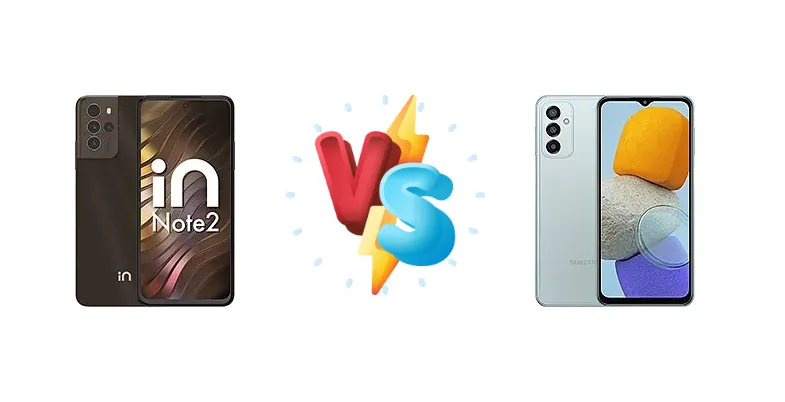
The Micromax In Note 2 and Samsung Galaxy F23 represent compelling options in the competitive budget smartphone segment. While both aim to deliver a feature-rich experience without breaking the bank, they take different approaches to achieving this. The In Note 2 prioritizes fast charging and a potentially higher peak CPU performance, while the Galaxy F23 leverages Qualcomm's 5G capabilities and a more efficient chipset.
🏆 Quick Verdict
For the average user prioritizing 5G connectivity and sustained performance, the Samsung Galaxy F23 emerges as the better choice. Its Snapdragon 750G, built on an 8nm process, offers superior efficiency and 5G support, outweighing the In Note 2's faster charging and slightly higher clocked CPU cores.
| Network |
|---|
| 2G bands | GSM 850 / 900 / 1800 / 1900 | GSM 850 / 900 / 1800 / 1900 |
| 3G bands | HSDPA 850 / 900 / 2100 | HSDPA 850 / 900 / 1700(AWS) / 1900 / 2100 |
| 4G bands | 1, 3, 5, 8, 40, 41 | 1, 2, 3, 4, 5, 7, 8, 12, 17, 20, 26, 28, 38, 40, 41, 66 |
| 5G bands | - | 1, 3, 5, 7, 8, 20, 28, 38, 40, 41, 66, 78 SA/NSA/Sub6 |
| Speed | HSPA, LTE | HSPA, LTE, 5G |
| Technology | GSM / HSPA / LTE | GSM / HSPA / LTE / 5G |
| Launch |
|---|
| Announced | 2022, January 25 | 2022, March 08 |
| Status | Available. Released 2022, January 30 | Available. Released 2022, March 16 |
| Body |
|---|
| Build | - | Glass front (Gorilla Glass 5), plastic frame, plastic back |
| Dimensions | 159.9 x 74.3 x 8.3 mm (6.30 x 2.93 x 0.33 in) | 165.5 x 77 x 8.4 mm (6.52 x 3.03 x 0.33 in) |
| SIM | Nano-SIM + Nano-SIM | Nano-SIM + Nano-SIM |
| Weight | 205 g (7.23 oz) | 198 g (6.98 oz) |
| Display |
|---|
| Protection | Corning Gorilla Glass | Corning Gorilla Glass 5 |
| Resolution | 1080 x 2400 pixels, 20:9 ratio (~409 ppi density) | 1080 x 2408 pixels, 20:9 ratio (~400 ppi density) |
| Size | 6.43 inches, 99.8 cm2 (~84.0% screen-to-body ratio) | 6.6 inches, 104.9 cm2 (~82.3% screen-to-body ratio) |
| Type | AMOLED, 550 nits (typ) | TFT LCD, 120Hz |
| Platform |
|---|
| CPU | Octa-core (2x2.05 GHz Cortex-A76 & 6x2.0 GHz Cortex-A55) | Octa-core (2x2.2 GHz Kryo 570 & 6x1.8 GHz Kryo 570) |
| Chipset | Mediatek MT6785V/CD Helio G95 (12 nm) | Qualcomm SM7225 Snapdragon 750G 5G (8 nm) |
| GPU | Mali-G76 MC4 | Adreno 619 |
| OS | Android 11 | Android 12, upgradable to Android 14, One UI 6 |
| Memory |
|---|
| Card slot | microSDXC (dedicated slot) | microSDXC (dedicated slot) |
| Internal | 64GB 4GB RAM | 128GB 4GB RAM, 128GB 6GB RAM |
| | UFS 2.1 | - |
| Main Camera |
|---|
| Features | Dual-LED dual-tone flash, HDR, panorama | LED flash, panorama, HDR |
| Quad | 48 MP, f/1.8, 26mm (wide), 1/2.0", 0.8µm, PDAF
5 MP, f/2.2, 115˚ (ultrawide), 1/5.0", 1.12µm
2 MP (macro)
Auxiliary lens | - |
| Single | 16 MP, f/2.0, 27mm (wide), 1/3.06", 1.0µm | 8 MP, f/2.2, (wide) |
| Triple | - | 50 MP, f/1.8, (wide), PDAF
8 MP, f/2.2, 123˚ (ultrawide), 1/4.0", 1.12µm
2 MP (macro) |
| Video | 1080p@30fps | 4K@30fps, 1080p@30fps, 720p@480fps |
| Selfie camera |
|---|
| Single | 16 MP, f/2.0, 27mm (wide), 1/3.06", 1.0µm | 8 MP, f/2.2, (wide) |
| Video | 1080p@30fps | 1080p@30fps |
| Sound |
|---|
| 3.5mm jack | Yes | Yes |
| 35mm jack | Yes | Yes |
| Loudspeaker | Yes | Yes |
| Comms |
|---|
| Bluetooth | 5.0, A2DP, LE | 5.0, A2DP, LE |
| NFC | No | Yes |
| Positioning | GPS, GLONASS, GALILEO, BDS | GPS, GLONASS, GALILEO, BDS, QZSS |
| Radio | FM radio | FM radio, recording |
| USB | USB Type-C 2.0, OTG | USB Type-C 2.0, OTG |
| WLAN | Wi-Fi 802.11 a/b/g/n/ac, dual-band, Wi-Fi Direct | Wi-Fi 802.11 a/b/g/n/ac, dual-band, Wi-Fi Direct |
| Features |
|---|
| Sensors | Fingerprint (side-mounted), accelerometer, gyro, proximity, compass | Fingerprint (side-mounted), accelerometer, gyro, compass |
| | - | Virtual Proximity Sensing |
| Battery |
|---|
| Charging | 30W wired, 50% in 25 min
Reverse wired | 25W wired |
| Type | Li-Po 5000 mAh | Li-Po 5000 mAh |
| Misc |
|---|
| Colors | Black, Oak | Aqua Blue, Forest Green |
| Models | E7446 | SM-E236B, SM-E236B/DS |
| Price | About 150 EUR | About 190 EUR |
| SAR | 1.01 W/kg (head) 0.77 W/kg (body) | 1.24 W/kg (head) |
Micromax In note 2
- Faster 30W charging
- Potentially higher peak CPU performance
- Reverse wired charging capability
- Less power-efficient chipset (12nm)
- Lacks 5G connectivity
- Potential for thermal throttling
Samsung Galaxy F23
- Integrated 5G modem
- More power-efficient chipset (8nm)
- Better sustained performance
- Slower 25W charging
- Potentially lower peak CPU performance
- Samsung's software can be bloated
Display Comparison
Neither device boasts a standout display. While specific display specs (resolution, panel type) are missing, both likely utilize LCD panels common in this price bracket. The key difference lies under the hood of the chipsets, impacting how efficiently the displays are driven. We can assume similar brightness levels, but the Snapdragon 750G's ISP may offer slightly better image processing for display output.
Camera Comparison
Without detailed camera specs, a direct comparison is difficult. However, the Snapdragon 750G’s image signal processor (ISP) generally offers superior image processing capabilities compared to the ISP found in the Helio G95. This translates to better dynamic range, noise reduction, and overall image quality, particularly in challenging lighting conditions. The absence of information regarding sensor sizes makes a definitive statement impossible, but Samsung’s history suggests a focus on camera quality even in budget devices.
Performance
The core battleground is the chipset. The Micromax In Note 2's MediaTek Helio G95 (12nm) features a dual-cluster CPU configuration with 2x2.05 GHz Cortex-A76 cores and 6x2.0 GHz Cortex-A55 cores. The Samsung Galaxy F23 counters with the Qualcomm Snapdragon 750G (8nm), utilizing 2x2.2 GHz Kryo 570 cores and 6x1.8 GHz Kryo 570 cores. The Snapdragon 750G’s 8nm process gives it a significant advantage in thermal efficiency. While the In Note 2 may show slightly higher benchmark scores in short bursts due to the higher clock speeds, the F23 will maintain performance for longer periods without throttling. The Snapdragon 750G also includes an integrated 5G modem, a feature absent in the In Note 2.
Battery Life
The Micromax In Note 2 features 30W wired charging, claiming 50% charge in 25 minutes, while the Samsung Galaxy F23 offers 25W wired charging. This gives the In Note 2 a clear advantage in charging speed. However, the Snapdragon 750G’s 8nm process is more power-efficient than the Helio G95’s 12nm process. This means the F23 will likely deliver longer battery life despite having a potentially smaller battery capacity (spec not provided). The faster charging of the In Note 2 is beneficial for quick top-ups, but the F23’s efficiency provides a more sustainable experience.
Buying Guide
Buy the Micromax In Note 2 if you absolutely need the fastest possible charging speeds and frequently engage in short bursts of demanding tasks where peak CPU performance is critical. Buy the Samsung Galaxy F23 if you value 5G connectivity, longer sustained performance during gaming or video editing, and a more refined software experience backed by Samsung's ecosystem.
Frequently Asked Questions
❓ Will the Snapdragon 750G in the Galaxy F23 struggle with demanding games like PUBG or Call of Duty?
The Snapdragon 750G is a capable chipset for gaming at medium to high settings. While it won't deliver flagship-level performance, its efficient thermal design allows for sustained gameplay without significant throttling, providing a smoother experience than the Helio G95 in the In Note 2 during extended gaming sessions.
❓ How much faster is the 30W charging on the Micromax In Note 2 compared to the 25W charging on the Samsung Galaxy F23 in real-world use?
The In Note 2's 30W charging will noticeably reduce charging times, especially for quick top-ups. Expect a roughly 15-20% faster charge from 0-100%, but the F23's efficiency means it won't be significantly behind, and the difference will be less noticeable for overnight charging.
❓ Does the Samsung Galaxy F23 support carrier aggregation for improved 5G speeds?
Yes, the Snapdragon 750G supports carrier aggregation, allowing it to combine multiple 5G channels for faster and more reliable data speeds, provided your carrier supports it. This is a key advantage over the In Note 2, which lacks 5G entirely.