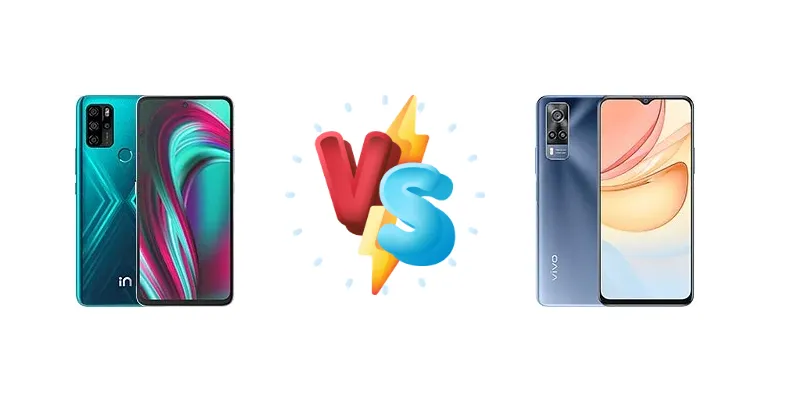
The Micromax In Note 1 and vivo Y53s 4G represent compelling options in the crowded budget smartphone market. Both devices leverage MediaTek’s Helio series of chipsets, aiming to deliver a balance of performance and affordability. However, key differences in charging technology and subtle chipset variations create a distinct user experience. This comparison dives deep into these nuances to determine which phone offers the best value.
🏆 Quick Verdict
For the average user prioritizing quick top-ups, the vivo Y53s 4G is the better choice thanks to its significantly faster 33W charging. However, the Micromax In Note 1 remains a strong contender for those who value a slightly more efficient chipset and don't mind slower charging speeds.
| Network |
|---|
| 2G bands | GSM 850 / 900 / 1800 / 1900 | GSM 850 / 900 / 1800 / 1900 |
| 3G bands | HSDPA 850 / 900 / 2100 | HSDPA 850 / 900 / 1700(AWS) / 2100 |
| 4G bands | 1, 3, 5, 8, 40, 41 | 1, 3, 5, 7, 8, 20, 38, 40, 41 |
| Speed | HSPA 42.2/11.5 Mbps, LTE (2CA) Cat7 300/150 Mbps | HSPA, LTE |
| Technology | GSM / HSPA / LTE | GSM / HSPA / LTE |
| Launch |
|---|
| Announced | 2020, November 03. Released 2020, November 24 | 2021, July 09 |
| Status | Discontinued | Available. Released 2021, July 09 |
| Body |
|---|
| Build | - | Glass front, plastic frame, plastic back |
| Dimensions | 165.2 x 77 x 9 mm (6.50 x 3.03 x 0.35 in) | 164 x 75.5 x 8.4 mm (6.46 x 2.97 x 0.33 in) |
| SIM | Nano-SIM + Nano-SIM | Nano-SIM + Nano-SIM |
| Weight | 196 g (6.91 oz) | 190 g (6.70 oz) |
| Display |
|---|
| Protection | Oleophobic coating | - |
| Resolution | 1080 x 2400 pixels, 20:9 ratio (~395 ppi density) | 1080 x 2408 pixels, 20:9 ratio (~401 ppi density) |
| Size | 6.67 inches, 107.4 cm2 (~84.4% screen-to-body ratio) | 6.58 inches, 104.3 cm2 (~84.2% screen-to-body ratio) |
| Type | IPS LCD, 450 nits (peak) | IPS LCD |
| Platform |
|---|
| CPU | Octa-core (2x2.0 GHz Cortex-A75 & 6x1.8 GHz Cortex-A55) | Octa-core (2x2.0 GHz Cortex-A75 & 6x1.8 GHz Cortex-A55) |
| Chipset | Mediatek MT6769Z Helio G85 (12 nm) | Mediatek MT6769V/CU Helio G80 (12 nm) |
| GPU | Mali-G52 MC2 | Mali-G52 MC2 |
| OS | Android 10 | Android 11, Funtouch 11.1 |
| Memory |
|---|
| Card slot | microSDXC (dedicated slot) | microSDXC (dedicated slot) |
| Internal | 64GB 4GB RAM, 128GB 4GB RAM | 128GB 6GB RAM, 128GB 8GB RAM |
| | eMMC 5.1 | - |
| Main Camera |
|---|
| Features | LED flash, HDR | LED flash, HDR, panorama |
| Quad | 48 MP, f/1.8, 26mm (wide), 1/2.0", 0.8µm, PDAF
5 MP, f/2.2, 115˚ (ultrawide), 1/5.0", 1.12µm
2 MP (macro)
Auxiliary lens | - |
| Single | - | 16 MP, f/2.0, (wide) |
| Triple | - | 64 MP, f/1.8, 26mm (wide), 1/1.97", 0.7µm, PDAF
2 MP (macro)
Auxiliary lens |
| Video | 1080p@30fps | 1080p@30fps, gyro-EIS |
| Selfie camera |
|---|
| Single | 16 MP, f/2.0, 27mm (wide), 1/3.06", 1.0µm | 16 MP, f/2.0, (wide) |
| Video | 1080p@30fps | 1080p@30fps |
| Sound |
|---|
| 3.5mm jack | Yes | Yes |
| 35mm jack | Yes | Yes |
| Loudspeaker | Yes | Yes |
| Comms |
|---|
| Bluetooth | 5.0, A2DP, LE | 5.1, A2DP, LE |
| NFC | No | No |
| Positioning | GPS, GLONASS, GALILEO, BDS | GPS |
| Radio | FM radio | Unspecified |
| USB | USB Type-C 2.0, OTG | USB Type-C 2.0, OTG |
| WLAN | Wi-Fi 802.11 a/b/g/n/ac, dual-band, Wi-Fi Direct | Wi-Fi 802.11 a/b/g/n/ac, dual-band, Wi-Fi Direct |
| Features |
|---|
| Sensors | Fingerprint (rear-mounted), accelerometer, gyro, proximity, compass | Fingerprint (side-mounted), accelerometer, gyro, proximity, compass |
| Battery |
|---|
| Charging | 18W wired
2.5W reverse wired | 33W wired |
| Type | Li-Po 5000 mAh | 5000 mAh |
| Misc |
|---|
| Colors | Green, White | Blue Purple, Black Green |
| Models | E7746 | - |
| Price | About 130 EUR | About 260 EUR |
| SAR | 0.57 W/kg (head) 0.96 W/kg (body) | - |
Micromax In note 1
- Slightly more powerful chipset (Helio G85)
- Reverse wired charging capability
- Potentially better sustained performance due to chipset efficiency
- Slower charging speed (18W)
- Likely less refined software experience
vivo Y53s 4G
- Significantly faster charging (33W)
- Potentially better software optimization (vivo's Funtouch OS)
- Wider availability and brand recognition
- Slightly less powerful chipset (Helio G80)
- Potentially more heat generation under load
Display Comparison
Neither device boasts a standout display. Both likely utilize LCD panels, common in this price bracket. Detailed display specs (resolution, brightness, color gamut) are unavailable, but the focus here is on internal components. Bezels are expected to be moderate on both, prioritizing affordability over an immersive edge-to-edge experience. Color accuracy will likely be standard for the segment, suitable for everyday use but not ideal for color-critical work.
Camera Comparison
Camera performance is difficult to assess without detailed sensor information. Both phones likely feature a multi-camera setup, but the emphasis will be on the primary sensor. The absence of Optical Image Stabilization (OIS) on either device suggests reliance on software processing for image stabilization. The inclusion of a 2MP macro camera on either device is largely a marketing tactic, offering limited practical benefit due to the low resolution and fixed focus. Image processing style will likely differ between the two brands, with vivo often favoring more saturated and vibrant colors.
Performance
The core of the performance difference lies in the chipsets: the Micromax In Note 1 features the MediaTek Helio G85, while the vivo Y53s 4G uses the Helio G80. Both are 12nm chips with an identical CPU configuration – a dual-core Cortex-A75 setup at 2.0 GHz paired with a hexa-core Cortex-A55 cluster at 1.8 GHz. The G85 offers a slightly higher GPU clock speed, potentially translating to marginally better graphics performance in games. However, the real-world difference will be minimal for most users. Both phones will likely be paired with similar amounts of RAM, impacting multitasking more significantly than the chipset difference. Thermal management will be crucial; the G85's slightly higher clock speeds could lead to more heat generation under sustained load, potentially causing throttling.
Battery Life
The battery capacity is not specified, but both phones likely feature batteries in the 5000mAh range, typical for this segment. The crucial difference is charging speed. The vivo Y53s 4G’s 33W wired charging is a significant advantage over the Micromax In Note 1’s 18W charging. This translates to a substantially faster 0-100% charge time – potentially under an hour for the vivo, compared to over 2 hours for the Micromax. The 2.5W reverse wired charging on the In Note 1 is a niche feature, useful for topping up accessories but not a primary selling point.
Buying Guide
Buy the Micromax In Note 1 if you prioritize sustained performance during extended gaming sessions or heavy multitasking, and are comfortable with slower charging. Its Helio G85 chipset, while not dramatically different, offers a slight edge in raw processing power. Buy the vivo Y53s 4G if you frequently find yourself needing to quickly recharge your phone and value the convenience of 33W fast charging, even if it means a potentially slightly warmer device under sustained load.
Frequently Asked Questions
❓ Will the Helio G80 in the vivo Y53s 4G struggle with demanding games like PUBG or Call of Duty?
The Helio G80 is capable of running PUBG and Call of Duty, but you'll likely need to use medium graphics settings for a smooth experience. The chipset isn't designed for ultra settings, and prolonged gaming may lead to some thermal throttling. The Micromax In Note 1's G85 offers a marginal improvement, but the difference won't be game-changing.
❓ How much faster is the 33W charging on the vivo Y53s 4G compared to the 18W charging on the Micromax In Note 1?
The 33W charging on the vivo Y53s 4G can realistically cut charging times by 40-50%. Expect a full charge in under an hour, whereas the Micromax In Note 1 will likely take over two hours. This is a significant difference for users who frequently need to top up their battery quickly.
❓ Does the Micromax In Note 1's reverse charging feature work with all devices?
The 2.5W reverse charging on the Micromax In Note 1 is compatible with most devices that charge via USB-C or Micro-USB, but the charging speed is very slow. It's best suited for accessories like wireless earbuds or smartwatches, not for quickly charging another phone.