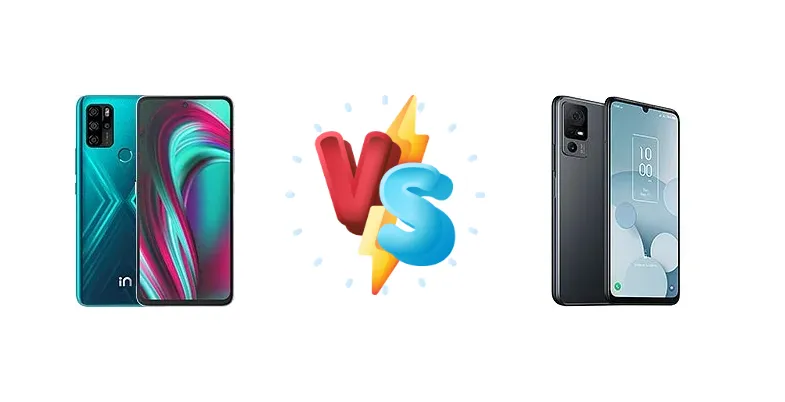
The Micromax In Note 1 and TCL 40 XL represent compelling options in the crowded budget smartphone market. Both aim to deliver essential features at an accessible price point, but they take different approaches to achieving this. This comparison dissects their core specifications to determine which device offers the best overall experience for the price-conscious consumer.
🏆 Quick Verdict
For users prioritizing consistent performance in everyday tasks and light gaming, the Micromax In Note 1 emerges as the stronger choice. Its Helio G85 chipset, featuring more powerful Cortex-A75 cores, provides a noticeable advantage over the TCL 40 XL’s Helio G37, despite both supporting 18W charging.
| Network |
|---|
| 2G bands | GSM 850 / 900 / 1800 / 1900 | GSM 850 / 900 / 1800 / 1900 |
| 3G bands | HSDPA 850 / 900 / 2100 | HSDPA 850 / 1700(AWS) / 1900 - USA |
| 4G bands | 1, 3, 5, 8, 40, 41 | 2, 4, 5, 12, 13, 25, 26, 41, 66, 71 - USA |
| Speed | HSPA 42.2/11.5 Mbps, LTE (2CA) Cat7 300/150 Mbps | HSPA, LTE |
| Technology | GSM / HSPA / LTE | GSM / HSPA / LTE |
| Launch |
|---|
| Announced | 2020, November 03. Released 2020, November 24 | 2023, February 26 |
| Status | Discontinued | Available. Released 2023, May |
| Body |
|---|
| Build | - | Glass front, plastic frame, plastic back |
| Dimensions | 165.2 x 77 x 9 mm (6.50 x 3.03 x 0.35 in) | 167.9 x 76.5 x 8.8 mm (6.61 x 3.01 x 0.35 in) |
| SIM | Nano-SIM + Nano-SIM | · Nano-SIM + eSIM· Nano-SIM + Nano-SIM |
| Weight | 196 g (6.91 oz) | 195 g (6.88 oz) |
| Display |
|---|
| Protection | Oleophobic coating | - |
| Resolution | 1080 x 2400 pixels, 20:9 ratio (~395 ppi density) | 720 x 1600 pixels, 20:9 ratio (~260 ppi density) |
| Size | 6.67 inches, 107.4 cm2 (~84.4% screen-to-body ratio) | 6.75 inches, 110.0 cm2 (~85.6% screen-to-body ratio) |
| Type | IPS LCD, 450 nits (peak) | IPS LCD, 90Hz |
| Platform |
|---|
| CPU | Octa-core (2x2.0 GHz Cortex-A75 & 6x1.8 GHz Cortex-A55) | Octa-core (4x2.3 GHz Cortex-A53 & 4x1.8 GHz Cortex-A53) |
| Chipset | Mediatek MT6769Z Helio G85 (12 nm) | Mediatek MT6765 Helio G37 (12 nm) |
| GPU | Mali-G52 MC2 | PowerVR GE8320 |
| OS | Android 10 | Android 13, TCL UI |
| Memory |
|---|
| Card slot | microSDXC (dedicated slot) | microSDXC |
| Internal | 64GB 4GB RAM, 128GB 4GB RAM | 128GB 4GB RAM, 256GB 6GB RAM |
| | eMMC 5.1 | - |
| Main Camera |
|---|
| Features | LED flash, HDR | LED flash, HDR, panorama |
| Quad | 48 MP, f/1.8, 26mm (wide), 1/2.0", 0.8µm, PDAF
5 MP, f/2.2, 115˚ (ultrawide), 1/5.0", 1.12µm
2 MP (macro)
Auxiliary lens | - |
| Single | - | 8 MP, (wide) |
| Triple | - | 50 MP, (wide), PDAF
2 MP (macro)
Auxiliary lens |
| Video | 1080p@30fps | 1080p@30fps |
| Selfie camera |
|---|
| Single | 16 MP, f/2.0, 27mm (wide), 1/3.06", 1.0µm | 8 MP, (wide) |
| Video | 1080p@30fps | 1080p@30fps |
| Sound |
|---|
| 3.5mm jack | Yes | Yes |
| 35mm jack | Yes | Yes |
| Loudspeaker | Yes | Yes, with dual speakers |
| Comms |
|---|
| Bluetooth | 5.0, A2DP, LE | 5.1, A2DP, LE |
| NFC | No | No |
| Positioning | GPS, GLONASS, GALILEO, BDS | GPS |
| Radio | FM radio | FM radio |
| USB | USB Type-C 2.0, OTG | USB Type-C 2.0 |
| WLAN | Wi-Fi 802.11 a/b/g/n/ac, dual-band, Wi-Fi Direct | Wi-Fi 802.11 a/b/g/n/ac, dual-band, Wi-Fi Direct |
| Features |
|---|
| Sensors | Fingerprint (rear-mounted), accelerometer, gyro, proximity, compass | Fingerprint (side-mounted), accelerometer, gyro, proximity, compass, barometer |
| Battery |
|---|
| Charging | 18W wired
2.5W reverse wired | 18W wired |
| Type | Li-Po 5000 mAh | Li-Ion 5000 mAh |
| Misc |
|---|
| Colors | Green, White | Dark Gray |
| Models | E7746 | T608M |
| Price | About 130 EUR | About 140 EUR |
| SAR | 0.57 W/kg (head) 0.96 W/kg (body) | - |
Micromax In note 1
- More powerful CPU for smoother performance
- Reverse wired charging for accessory top-ups
- Potentially better gaming experience
- Older device, potentially less software support
- Display specs are unknown, potentially average quality
TCL 40 XL
- Newer device, potentially longer software support
- Potentially improved image processing (speculative)
- May have a more refined software experience
- Less powerful CPU, slower performance
- Likely similar display quality to the Micromax
Display Comparison
Neither device boasts a standout display. Both likely utilize LCD panels, common in this price bracket. Without specific display specs (resolution, brightness), the comparison hinges on panel quality, which is difficult to ascertain. However, the TCL 40 XL, being a newer device, *may* benefit from slight improvements in color calibration, though this is speculative. Bezels are expected to be substantial on both, impacting the overall immersive experience.
Camera Comparison
Without detailed camera specifications, a direct comparison is limited. Both phones likely feature a primary camera and potentially depth/macro sensors. However, the image processing capabilities and sensor quality are crucial. Given the price point, expect image quality to be adequate in good lighting conditions, but struggle in low light. The absence of Optical Image Stabilization (OIS) on either device will exacerbate low-light issues. The TCL 40 XL, being newer, *might* have slightly improved image processing algorithms, but this is uncertain.
Performance
The core difference lies in the chipsets. The Micromax In Note 1’s Mediatek Helio G85 utilizes a combination of 2x 2.0 GHz Cortex-A75 and 6x 1.8 GHz Cortex-A55 cores. This configuration provides a significant performance boost over the TCL 40 XL’s Helio G37, which employs 4x 2.3 GHz Cortex-A53 and 4x 1.8 GHz Cortex-A53 cores. The Cortex-A75 cores in the G85 are architecturally superior to the A53 cores in the G37, resulting in faster single-core and multi-core performance. While the G37’s higher clock speed on the A53 cores offers some benefit, it doesn’t compensate for the architectural advantage of the G85. This translates to snappier app launches, smoother multitasking, and a more enjoyable gaming experience on the Micromax.
Battery Life
Both devices support 18W wired charging, suggesting similar charging speeds. The actual 0-100% charge time will depend on the charger used and battery optimization. Without knowing the battery capacity of the TCL 40 XL, it’s difficult to assess battery life. However, the Micromax In Note 1’s battery capacity, combined with the more efficient Helio G85 chipset, could potentially offer slightly longer screen-on time, especially during moderate usage. The 2.5W reverse wired charging on the Micromax In Note 1 is a niche feature, useful for topping up accessories but not a primary selling point.
Buying Guide
Buy the Micromax In Note 1 if you need a phone capable of handling multitasking and occasional gaming without significant slowdowns. Its CPU architecture is geared towards responsiveness. Buy the TCL 40 XL if you prioritize a potentially more streamlined software experience (depending on TCL’s skin) and are primarily focused on basic communication and media consumption, accepting a trade-off in processing power.
Frequently Asked Questions
❓ Will the Micromax In Note 1 struggle with demanding games like PUBG Mobile?
While the Helio G85 can run PUBG Mobile, you'll likely need to lower the graphics settings to medium or low to achieve a consistently smooth frame rate. The TCL 40 XL’s Helio G37 will likely require even more aggressive settings adjustments, potentially impacting visual fidelity significantly.
❓ How does the software experience differ between the Micromax In Note 1 and TCL 40 XL?
The Micromax In Note 1 likely runs a near-stock version of Android, potentially with minimal bloatware. TCL typically includes its own custom UI skin, which may offer additional features but could also introduce bloatware and impact performance. Software updates are also a consideration; TCL, as a larger brand, *may* offer more consistent updates.
❓ Is the 18W charging on either phone considered fast charging in 2024?
18W charging is relatively standard for budget smartphones. While not exceptionally fast, it's sufficient for topping up the battery overnight or providing a reasonable charge during a short break. Expect a full charge to take around 2-3 hours.