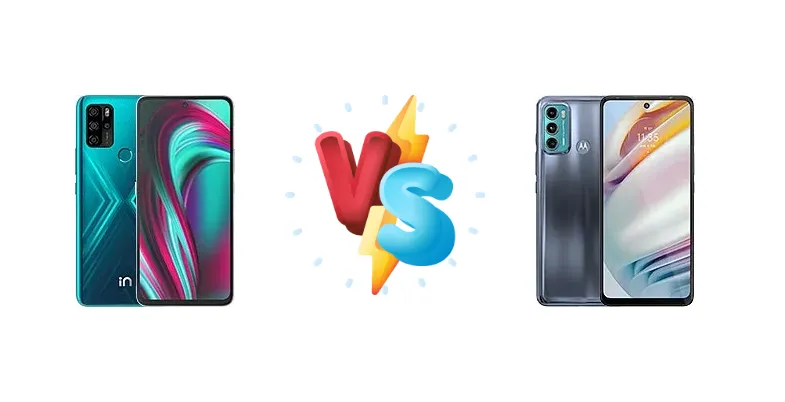
The sub-$200 smartphone market is fiercely competitive. The Micromax In Note 1 and Motorola Moto G40 Fusion both aim to deliver a compelling experience without breaking the bank. However, they take different approaches – the In Note 1 focuses on a balanced feature set, while the Moto G40 Fusion prioritizes processing power with a more modern chipset. This comparison dives deep into the specifics to determine which device offers the best value.
🏆 Quick Verdict
For most users, the Motorola Moto G40 Fusion is the superior choice. Its Snapdragon 732G chipset, built on an 8nm process, provides a noticeable performance advantage over the Micromax In Note 1’s Helio G85, translating to smoother multitasking and better gaming. While the In Note 1 offers reverse wired charging, the G40 Fusion’s faster 20W charging and overall efficiency make it the more practical option.
| Network |
|---|
| 2G bands | GSM 850 / 900 / 1800 / 1900 | GSM 850 / 900 / 1800 / 1900 |
| 3G bands | HSDPA 850 / 900 / 2100 | HSDPA 850 / 900 / 1700(AWS) / 1900 / 2100 |
| 4G bands | 1, 3, 5, 8, 40, 41 | 1, 2, 3, 4, 5, 7, 8, 18, 19, 20, 26, 28, 38, 40, 41 |
| Speed | HSPA 42.2/11.5 Mbps, LTE (2CA) Cat7 300/150 Mbps | HSPA, LTE |
| Technology | GSM / HSPA / LTE | GSM / HSPA / LTE |
| Launch |
|---|
| Announced | 2020, November 03. Released 2020, November 24 | 2021, April 20 |
| Status | Discontinued | Available. Released 2021, May 01 |
| Body |
|---|
| Build | - | Glass front, plastic frame, plastic back |
| Dimensions | 165.2 x 77 x 9 mm (6.50 x 3.03 x 0.35 in) | 169.6 x 75.9 x 9.7 mm (6.68 x 2.99 x 0.38 in) |
| SIM | Nano-SIM + Nano-SIM | Nano-SIM + Nano-SIM |
| Weight | 196 g (6.91 oz) | 225 g (7.94 oz) |
| | - | Water repellent design |
| Display |
|---|
| Protection | Oleophobic coating | - |
| Resolution | 1080 x 2400 pixels, 20:9 ratio (~395 ppi density) | 1080 x 2460 pixels (~395 ppi density) |
| Size | 6.67 inches, 107.4 cm2 (~84.4% screen-to-body ratio) | 6.8 inches, 109.8 cm2 (~85.3% screen-to-body ratio) |
| Type | IPS LCD, 450 nits (peak) | IPS LCD, 120Hz, HDR10 |
| Platform |
|---|
| CPU | Octa-core (2x2.0 GHz Cortex-A75 & 6x1.8 GHz Cortex-A55) | Octa-core (2x2.3 GHz Kryo 470 Gold & 6x1.8 GHz Kryo 470 Silver) |
| Chipset | Mediatek MT6769Z Helio G85 (12 nm) | Qualcomm SM7150 Snapdragon 732G (8 nm) |
| GPU | Mali-G52 MC2 | Adreno 618 |
| OS | Android 10 | Android 11, upgradable to Android 12 |
| Memory |
|---|
| Card slot | microSDXC (dedicated slot) | microSDXC (uses shared SIM slot) |
| Internal | 64GB 4GB RAM, 128GB 4GB RAM | 64GB 4GB RAM, 128GB 6GB RAM |
| | eMMC 5.1 | UFS 2.1 |
| Main Camera |
|---|
| Features | LED flash, HDR | LED flash, HDR, panorama |
| Quad | 48 MP, f/1.8, 26mm (wide), 1/2.0", 0.8µm, PDAF
5 MP, f/2.2, 115˚ (ultrawide), 1/5.0", 1.12µm
2 MP (macro)
Auxiliary lens | - |
| Triple | - | 64 MP, f/1.7 (wide), 0.7µm, PDAF
8 MP, f/2.2, 118˚ (ultrawide), 1/4.0", 1.12µm
Auxiliary lens |
| Video | 1080p@30fps | 4K@30/120fps, 1080p@30/60/240fps |
| Selfie camera |
|---|
| Features | - | HDR |
| Single | 16 MP, f/2.0, 27mm (wide), 1/3.06", 1.0µm | 16 MP, f/2.2, (wide), 1.0µm |
| Video | 1080p@30fps | 4K@30fps, 1080p@30/60/240fps |
| Sound |
|---|
| 3.5mm jack | Yes | Yes |
| 35mm jack | Yes | Yes |
| Loudspeaker | Yes | Yes |
| Comms |
|---|
| Bluetooth | 5.0, A2DP, LE | 5.0, A2DP, LE |
| NFC | No | Yes |
| Positioning | GPS, GLONASS, GALILEO, BDS | GPS, GLONASS, GALILEO |
| Radio | FM radio | FM radio |
| USB | USB Type-C 2.0, OTG | USB Type-C 2.0, OTG |
| WLAN | Wi-Fi 802.11 a/b/g/n/ac, dual-band, Wi-Fi Direct | Wi-Fi 802.11 a/b/g/n/ac, dual-band, Wi-Fi Direct |
| Features |
|---|
| Sensors | Fingerprint (rear-mounted), accelerometer, gyro, proximity, compass | Fingerprint (rear-mounted), accelerometer, gyro, proximity |
| Battery |
|---|
| Charging | 18W wired
2.5W reverse wired | 20W wired, QC4 |
| Type | Li-Po 5000 mAh | Li-Po 6000 mAh |
| Misc |
|---|
| Colors | Green, White | Dynamic Gray, Frosted Champagne |
| Models | E7746 | PANV0001IN, PANV0005IN, PANV0009IN |
| Price | About 130 EUR | About 180 EUR |
| SAR | 0.57 W/kg (head) 0.96 W/kg (body) | 0.85 W/kg (head) 1.20 W/kg (body) |
Micromax In note 1
- Reverse wired charging for accessories
- Potentially lower price point
- Balanced feature set for basic users
- Less powerful Helio G85 chipset
- Slower 18W charging
- Likely inferior image processing
Motorola Moto G40 Fusion
- More powerful Snapdragon 732G chipset
- Faster 20W charging with QC4
- Better power efficiency and thermal management
- Lacks reverse wired charging
- Potentially slightly higher price
- Software updates may be less frequent
Display Comparison
Neither device boasts a standout display. Both likely utilize IPS LCD panels, a common choice in this price bracket. However, the lack of detailed display specs (resolution, peak brightness, color gamut) makes a direct comparison difficult. The Moto G40 Fusion’s potential for a slightly higher peak brightness, given its more premium chipset, could offer better outdoor visibility. Bezels are likely comparable, and color accuracy will depend heavily on software calibration, an area where Motorola generally performs adequately.
Camera Comparison
Without detailed camera specs beyond the chipsets, a precise comparison is challenging. However, the Snapdragon 732G’s image signal processor (ISP) is generally more advanced than the Helio G85’s, offering better noise reduction, dynamic range, and image processing capabilities. This doesn’t guarantee better photos, as lens quality and sensor size play crucial roles, but the G40 Fusion has a clear advantage in computational photography. The prevalence of 2MP macro/depth sensors on both devices suggests these are largely marketing features and won’t significantly impact image quality.
Performance
The core difference lies in the chipsets. The Motorola Moto G40 Fusion’s Qualcomm Snapdragon 732G (8nm) is a significant upgrade over the Micromax In Note 1’s MediaTek Helio G85 (12nm). The 8nm process inherently offers better power efficiency and thermal management. While both CPUs feature a similar core configuration (2x performance cores + 6x efficiency cores), the Snapdragon 732G’s Kryo 470 Gold cores operate at a higher clock speed (2.3 GHz vs 2.0 GHz), resulting in faster single-core and multi-core performance. This translates to snappier app launches, smoother multitasking, and a more enjoyable gaming experience, particularly in demanding titles. The G40 Fusion will exhibit less throttling under sustained load.
Battery Life
Both phones offer adequate battery capacity for all-day use, but the charging speeds differ. The Moto G40 Fusion’s 20W charging with Quick Charge 4 (QC4) support is faster and more versatile than the Micromax In Note 1’s 18W charging. QC4 allows for optimized charging with compatible adapters, potentially reducing charging times and improving battery health. The In Note 1’s 2.5W reverse wired charging is a niche feature, useful for topping up accessories but unlikely to be a primary reason for purchase. The Snapdragon 732G’s superior power efficiency also contributes to potentially longer battery life in real-world usage.
Buying Guide
Buy the Micromax In Note 1 if you prioritize reverse charging functionality and are on a very tight budget, accepting a trade-off in processing power. It’s a reasonable option for basic daily tasks. Buy the Motorola Moto G40 Fusion if you value performance, smoother gaming, and faster charging, even if it means sacrificing the reverse charging feature. It’s the better choice for users who demand a more responsive and future-proof experience.
Frequently Asked Questions
❓ Will the Moto G40 Fusion handle demanding games like PUBG Mobile smoothly?
Yes, the Snapdragon 732G is capable of running PUBG Mobile at medium to high settings with stable frame rates. The 8nm process and improved GPU performance compared to the Helio G85 will minimize frame drops and provide a more consistent gaming experience.
❓ Is the reverse charging feature on the Micromax In Note 1 actually useful?
The 2.5W reverse charging is primarily useful for topping up small accessories like Bluetooth earbuds or smartwatches. It's a slow charging method and won't significantly charge a smartphone. Consider it a convenience feature rather than a core selling point.
❓ How much faster is the charging on the Moto G40 Fusion compared to the In Note 1?
The Moto G40 Fusion's 20W charging with QC4 will likely charge from 0-100% in around 1 hour 30 minutes to 2 hours, depending on the adapter used. The In Note 1's 18W charging will likely take closer to 2.5 to 3 hours for a full charge.
❓ Which phone is likely to receive more software updates?
Motorola generally provides at least one major Android update and a few security patches for its devices. Micromax's update track record is less consistent. Therefore, the Moto G40 Fusion is likely to receive more timely and frequent software updates.