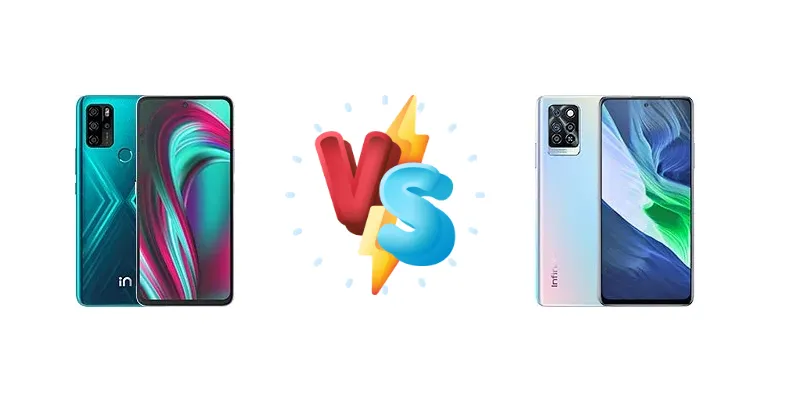
Both the Micromax In Note 1 and the Infinix Note 10 Pro NFC target the competitive budget smartphone market, but they approach it with different strengths. The In Note 1 focuses on providing a solid all-around experience at a very accessible price, while the Note 10 Pro NFC aims to deliver a more premium feel with faster charging and a slightly more powerful chipset. This comparison will dissect the key differences to help you determine which device best suits your needs.
🏆 Quick Verdict
For the average user prioritizing fast charging and a slightly smoother experience, the Infinix Note 10 Pro NFC is the better choice. Its Helio G95 chipset and 33W charging offer a noticeable advantage. However, the Micromax In Note 1 remains a compelling option for those on a tighter budget who don't need the absolute fastest performance.
| Network |
|---|
| 2G bands | GSM 850 / 900 / 1800 / 1900 | GSM 850 / 900 / 1800 / 1900 |
| 3G bands | HSDPA 850 / 900 / 2100 | HSDPA 850 / 900 / 1700(AWS) / 1900 / 2100 |
| 4G bands | 1, 3, 5, 8, 40, 41 | 1, 2, 3, 4, 5, 7, 8, 20, 28, 38, 41, 40, 66 |
| Speed | HSPA 42.2/11.5 Mbps, LTE (2CA) Cat7 300/150 Mbps | HSPA, LTE |
| Technology | GSM / HSPA / LTE | GSM / HSPA / LTE |
| | - | 1, 3, 7, 8, 20, 28 |
| Launch |
|---|
| Announced | 2020, November 03. Released 2020, November 24 | 2021, May 12 |
| Status | Discontinued | Available. Released 2021, June 07 |
| Body |
|---|
| Dimensions | 165.2 x 77 x 9 mm (6.50 x 3.03 x 0.35 in) | 172.8 x 78.3 x 7.8 mm (6.80 x 3.08 x 0.31 in) |
| SIM | Nano-SIM + Nano-SIM | Nano-SIM + Nano-SIM |
| Weight | 196 g (6.91 oz) | - |
| Display |
|---|
| Protection | Oleophobic coating | - |
| Resolution | 1080 x 2400 pixels, 20:9 ratio (~395 ppi density) | 1080 x 2460 pixels (~387 ppi density) |
| Size | 6.67 inches, 107.4 cm2 (~84.4% screen-to-body ratio) | 6.95 inches, 114.7 cm2 (~84.8% screen-to-body ratio) |
| Type | IPS LCD, 450 nits (peak) | IPS LCD, 90Hz |
| Platform |
|---|
| CPU | Octa-core (2x2.0 GHz Cortex-A75 & 6x1.8 GHz Cortex-A55) | Octa-core (2x2.05 GHz Cortex-A76 & 6x2.0 GHz Cortex-A55) |
| Chipset | Mediatek MT6769Z Helio G85 (12 nm) | Mediatek MT6785V/CD Helio G95 (12 nm) |
| GPU | Mali-G52 MC2 | Mali-G76 MC4 |
| OS | Android 10 | Android 11, XOS 7.6 |
| Memory |
|---|
| Card slot | microSDXC (dedicated slot) | microSDXC (dedicated slot) |
| Internal | 64GB 4GB RAM, 128GB 4GB RAM | 128GB 6GB RAM, 256GB 8GB RAM |
| | eMMC 5.1 | UFS 2.2 |
| Main Camera |
|---|
| Features | LED flash, HDR | Quad-LED flash, HDR, panorama |
| Quad | 48 MP, f/1.8, 26mm (wide), 1/2.0", 0.8µm, PDAF
5 MP, f/2.2, 115˚ (ultrawide), 1/5.0", 1.12µm
2 MP (macro)
Auxiliary lens | 64 MP, f/1.9, (wide), 1/1.72", 0.8µm, PDAF
8 MP, f/2.3, 120˚ (ultrawide)
2 MP, f/2.4, (monochrome)
Auxiliary lens |
| Single | - | 16 MP, (wide) |
| Video | 1080p@30fps | 4K@30fps, 1080p@30fps |
| Selfie camera |
|---|
| Single | 16 MP, f/2.0, 27mm (wide), 1/3.06", 1.0µm | 16 MP, f/2.0, (wide), 1/3.09" |
| Video | 1080p@30fps | 1080p@30fps |
| Sound |
|---|
| 3.5mm jack | Yes | Yes |
| 35mm jack | Yes | Yes |
| Loudspeaker | Yes | Yes, with dual speakers |
| Comms |
|---|
| Bluetooth | 5.0, A2DP, LE | 5.0, A2DP, LE |
| NFC | No | Yes |
| Positioning | GPS, GLONASS, GALILEO, BDS | GPS |
| Radio | FM radio | FM radio |
| USB | USB Type-C 2.0, OTG | USB Type-C 2.0, OTG |
| WLAN | Wi-Fi 802.11 a/b/g/n/ac, dual-band, Wi-Fi Direct | Wi-Fi 802.11 a/b/g/n/ac, dual-band, Wi-Fi Direct |
| Features |
|---|
| Sensors | Fingerprint (rear-mounted), accelerometer, gyro, proximity, compass | Fingerprint (side-mounted), accelerometer, gyro, proximity, compass |
| Battery |
|---|
| Charging | 18W wired
2.5W reverse wired | 33W wired |
| Type | Li-Po 5000 mAh | 5000 mAh |
| Misc |
|---|
| Colors | Green, White | Black, Purple, Nordic Secret |
| Models | E7746 | X695C |
| Price | About 130 EUR | - |
| SAR | 0.57 W/kg (head) 0.96 W/kg (body) | - |
Micromax In note 1
- More affordable price point
- Decent performance for everyday tasks
- Reverse wired charging capability
- Slower charging speed (18W)
- Less powerful chipset compared to the Infinix
Infinix Note 10 Pro NFC
- Faster charging speed (33W)
- More powerful Helio G95 chipset
- NFC support for contactless payments
- Higher price compared to the Micromax
- Potentially less battery life due to more powerful processor
Display Comparison
Neither device boasts a particularly standout display. Both likely utilize IPS LCD panels, common in this price bracket. The key difference lies in processing power, not panel quality. While specific display specs (resolution, brightness) are missing, the focus here is on the chipset's ability to drive the display smoothly. The Infinix, with its more powerful G95, will likely handle graphically intensive tasks and animations with slightly less strain.
Camera Comparison
Without detailed camera specifications, a direct comparison is difficult. However, the chipset plays a role in image processing speed. The G95 in the Infinix Note 10 Pro NFC will likely process images faster and potentially offer better noise reduction. The presence of NFC in the Infinix suggests a slightly more feature-rich overall package, potentially extending to camera features. It's reasonable to assume the Infinix will offer a more refined camera experience, though sensor size and lens quality are crucial factors not provided in the context data.
Performance
The core difference between these phones is the chipset. The Infinix Note 10 Pro NFC’s MediaTek Helio G95 (12nm) represents a step up from the Micromax In Note 1’s Helio G85 (12nm). The G95 utilizes two Cortex-A76 cores clocked at 2.05 GHz, compared to the G85’s Cortex-A75 cores at 2.0 GHz. While both are octa-core designs, the A76 architecture in the G95 offers improved single-core performance, translating to snappier app launches and a more responsive user interface. The G95 also has a slightly faster GPU, benefiting gaming performance. The In Note 1 will handle everyday tasks adequately, but the Note 10 Pro NFC will provide a smoother experience, especially during demanding games.
Battery Life
The Infinix Note 10 Pro NFC’s 33W wired charging is a significant advantage over the Micromax In Note 1’s 18W charging. This translates to substantially faster charging times – likely reducing a full charge from over 2 hours on the In Note 1 to around an hour or less on the Note 10 Pro NFC. While battery capacity isn't specified, the faster charging speed is a major benefit for users who frequently need to top up their phones. The 2.5W reverse wired charging on the Micromax is a niche feature, useful for charging accessories, but unlikely to be a deciding factor for most buyers.
Buying Guide
Buy the Micromax In Note 1 if you need a reliable, functional smartphone for everyday tasks and light gaming, and your budget is the primary concern. You'll appreciate its affordability and decent performance for basic use. Buy the Infinix Note 10 Pro NFC if you prioritize faster charging speeds, a slightly more powerful processor for gaming, and NFC functionality for mobile payments, and are willing to spend a bit more.
Frequently Asked Questions
❓ Will the Infinix Note 10 Pro NFC get noticeably hotter during extended gaming sessions compared to the Micromax In Note 1?
The Helio G95 in the Infinix Note 10 Pro NFC is more powerful, and therefore generates more heat under load. While MediaTek's thermal management is generally good, it's likely the Infinix will get warmer during prolonged gaming. However, the increased performance may justify the slightly higher temperatures for gamers.
❓ Is the NFC functionality on the Infinix Note 10 Pro NFC compatible with all payment systems in India?
NFC compatibility with payment systems varies. The Infinix Note 10 Pro NFC supports NFC, allowing for contactless payments. However, compatibility with specific services like Paytm, PhonePe, and Google Pay depends on their individual support for NFC-based transactions on different devices. It's best to check with each service provider for confirmation.
❓ Can the Micromax In Note 1 handle popular games like PUBG Mobile and Call of Duty Mobile at reasonable settings?
The Micromax In Note 1, with its Helio G85 chipset, can run PUBG Mobile and Call of Duty Mobile, but you'll likely need to lower the graphics settings to medium or low to achieve a smooth frame rate. Expect some occasional stuttering during intense firefights. The Infinix Note 10 Pro NFC will offer a more consistent and smoother gaming experience at higher settings.