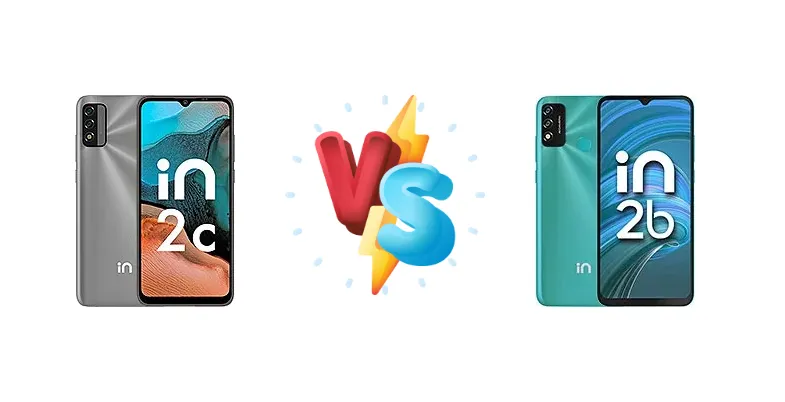
Micromax has consistently aimed to deliver affordable smartphones, and the In 2c and In 2b are prime examples. Both devices share a similar core, but subtle differences might sway your decision. This comprehensive comparison will help you determine which phone best suits your needs and budget.
🏆 Quick Verdict
The Micromax In 2c and In 2b are remarkably similar, sharing the same Unisoc T610 chipset and 10W charging. The In 2c generally offers slightly better camera performance and potentially a more refined software experience, making it the marginally better choice for most users, assuming similar pricing.
| Network |
|---|
| 2G bands | GSM 850 / 900 / 1800 / 1900 | GSM 850 / 900 / 1800 / 1900 |
| 3G bands | HSDPA 850 / 2100 | HSDPA 850 / 2100 |
| 4G bands | 1, 3, 5, 8, 38, 40, 41 | 1, 3, 5, 8, 38, 40, 41 |
| Speed | HSPA, LTE | HSPA, LTE |
| Technology | GSM / HSPA / LTE | GSM / HSPA / LTE |
| Launch |
|---|
| Announced | 2022, April 26 | 2021, July 30. Released 2021, August 06 |
| Status | Available. Released 2022, May 01 | Discontinued |
| Body |
|---|
| Dimensions | 164.3 x 75.7 x 8.6 mm (6.47 x 2.98 x 0.34 in) | 164.3 x 75.7 x 8.6 mm (6.47 x 2.98 x 0.34 in) |
| SIM | Nano-SIM + Nano-SIM | Nano-SIM + Nano-SIM |
| Weight | 198 g (6.98 oz) | 190 g (6.70 oz) |
| Display |
|---|
| Resolution | 720 x 1600 pixels, 20:9 ratio (~269 ppi density) | 720 x 1600 pixels, 20:9 ratio (~269 ppi density) |
| Size | 6.52 inches, 102.6 cm2 (~82.5% screen-to-body ratio) | 6.52 inches, 102.6 cm2 (~82.5% screen-to-body ratio) |
| Type | IPS LCD, 420 nits | IPS LCD, 400 nits (typ) |
| Platform |
|---|
| CPU | Octa-core (2x1.8 GHz Cortex-A75 & 6x1.8 GHz Cortex-A55) | Octa-core (2x1.8 GHz Cortex-A75 & 6x1.8 GHz Cortex-A55) |
| Chipset | Unisoc T610 (12 nm) | Unisoc T610 (12 nm) |
| GPU | Mali-G52 MP2 | Mali-G52 MP2 |
| OS | Android 11 | Android 11 |
| Memory |
|---|
| Card slot | microSDXC (dedicated slot) | microSDXC (dedicated slot) |
| Internal | 32GB 3GB RAM | 64GB 4GB RAM, 64GB 6GB RAM |
| | eMMC 5.1 | eMMC 5.1 |
| Main Camera |
|---|
| Dual | 8 MP, (wide), AF
Auxiliary lens | 13 MP, f/1.8, 27mm (wide), 1/3.0", 1.12µm, PDAF
Auxiliary lens |
| Features | LED flash, HDR, panorama | LED flash, HDR, panorama |
| Single | 5 MP, AF | 5 MP, f/2.2 |
| Video | 1080p@30fps | 1080p@30fps |
| Selfie camera |
|---|
| Features | - | HDR |
| Single | 5 MP, AF | 5 MP, f/2.2 |
| Video | Unspecified | Unspecified |
| Sound |
|---|
| 3.5mm jack | Yes | Yes |
| 35mm jack | Yes | Yes |
| Loudspeaker | Yes | Yes |
| Comms |
|---|
| Bluetooth | 5.0, A2DP, LE | 5.0, A2DP, LE |
| NFC | No | No |
| Positioning | GPS | GPS, GLONASS, GALILEO, BDS |
| Radio | No | Unspecified |
| USB | USB Type-C 2.0, OTG | USB Type-C 2.0, OTG |
| WLAN | Wi-Fi 802.11 a/b/g/n/ac, Wi-Fi Direct | Wi-Fi 802.11 a/b/g/n/ac, Wi-Fi Direct |
| Features |
|---|
| Sensors | Accelerometer, proximity | Fingerprint (rear-mounted), accelerometer, proximity |
| Battery |
|---|
| Charging | 10W wired | 10W wired |
| Type | Li-Po 5000 mAh | Li-Po 5000 mAh |
| Misc |
|---|
| Colors | Brown, Silver | Blue, Black, Green |
| Models | E6533 | E7544 |
| Price | About 100 EUR | About 90 EUR |
| SAR | - | 0.85 W/kg (head) 1.13 W/kg (body) |
Micromax In 2c
- Potentially better camera performance
- Slightly more refined software (potentially)
- Decent battery life
- Affordable price
- Slow 10W charging
- HD+ display quality
- Unisoc T610 chipset performance limitations
Micromax In 2b
- Affordable price
- Decent battery life
- Reliable for basic tasks
- Large display
- Slow 10W charging
- HD+ display quality
- Unisoc T610 chipset performance limitations
- Potentially less polished software
Display Comparison
Both phones likely feature a 6.53-inch HD+ display with a similar resolution (720 x 1600 pixels). Expect decent viewing angles and color reproduction for everyday use, but don't anticipate flagship-level quality. Differences in panel type (IPS vs. TFT) could exist, potentially impacting color accuracy and brightness, but this information is often not readily available.
Camera Comparison
While both phones likely feature a triple-camera setup (13MP main + 2MP macro + 2MP depth), the In 2c might have slightly improved image processing algorithms or a better main sensor, resulting in marginally better photo quality, especially in low-light conditions. Video recording capabilities are likely similar, offering 1080p at 30fps.
Performance
Powered by the Unisoc T610, both devices offer adequate performance for basic tasks like browsing, social media, and light gaming. Don't expect to run demanding games smoothly. Multitasking will be manageable, but heavy app usage might lead to some slowdowns. RAM configuration (likely 4GB or 6GB) will significantly impact performance.
Battery Life
Both phones are expected to house a 5000mAh battery, providing all-day battery life for moderate users. The 10W charging speed is relatively slow, so expect a longer charging time (around 3-4 hours) to fully replenish the battery.
Buying Guide
The Micromax In 2c is ideal for users prioritizing a slightly better camera and potentially a more polished software experience within a tight budget. The Micromax In 2b is a solid choice for those seeking a reliable, no-frills smartphone with a focus on essential features and a potentially lower price point.
Frequently Asked Questions
❓ Are the Micromax In 2c and In 2b the same phone?
No, while they share many similarities like the chipset and battery, there might be subtle differences in camera performance, software, and design.
❓ Which phone is better for gaming?
Neither phone is ideal for demanding games. Both will struggle with high graphics settings. Stick to lighter games for a smoother experience.
❓ How long does it take to fully charge each phone?
With the 10W charger, expect around 3-4 hours to fully charge either the In 2c or In 2b.