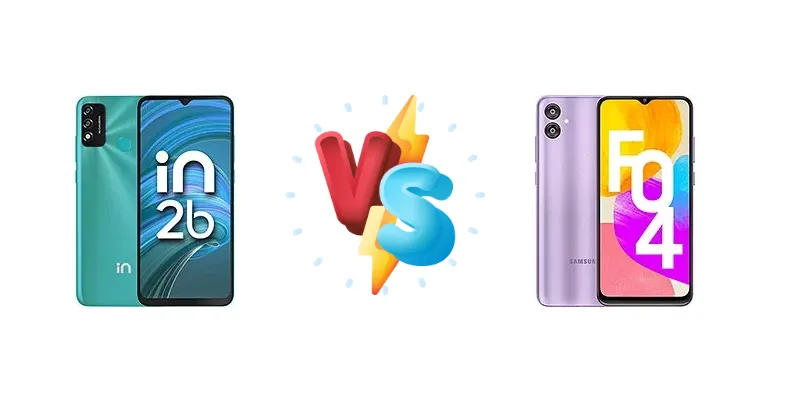
The budget smartphone market is fiercely competitive, with new contenders constantly vying for your attention. Today, we're pitting two popular options against each other: the Micromax In 2b and the Samsung Galaxy F04. Both promise affordability, but which one delivers the best overall experience?
🏆 Quick Verdict
The Samsung Galaxy F04 edges out the Micromax In 2b thanks to its slightly faster processor, faster charging, and the Samsung brand reputation. While the In 2b offers decent value, the F04 provides a more polished and reliable experience for most users.
| Network |
|---|
| 2G bands | GSM 850 / 900 / 1800 / 1900 | GSM 850 / 900 / 1800 / 1900 |
| 3G bands | HSDPA 850 / 2100 | HSDPA 850 / 900 / 2100 |
| 4G bands | 1, 3, 5, 8, 38, 40, 41 | 1, 3, 5, 7, 8, 20, 28, 38, 40, 41 |
| Speed | HSPA, LTE | HSPA, LTE |
| Technology | GSM / HSPA / LTE | GSM / HSPA / LTE |
| Launch |
|---|
| Announced | 2021, July 30. Released 2021, August 06 | 2023, January 04 |
| Status | Discontinued | Available. Released 2023, January 12 |
| Body |
|---|
| Build | - | Glass front, plastic back, plastic frame |
| Dimensions | 164.3 x 75.7 x 8.6 mm (6.47 x 2.98 x 0.34 in) | 164.2 x 75.9 x 9.1 mm (6.46 x 2.99 x 0.36 in) |
| SIM | Nano-SIM + Nano-SIM | Nano-SIM + Nano-SIM |
| Weight | 190 g (6.70 oz) | 188 g (6.63 oz) |
| Display |
|---|
| Resolution | 720 x 1600 pixels, 20:9 ratio (~269 ppi density) | 720 x 1600 pixels, 20:9 ratio (~270 ppi density) |
| Size | 6.52 inches, 102.6 cm2 (~82.5% screen-to-body ratio) | 6.5 inches, 102.0 cm2 (~81.8% screen-to-body ratio) |
| Type | IPS LCD, 400 nits (typ) | PLS LCD |
| Platform |
|---|
| CPU | Octa-core (2x1.8 GHz Cortex-A75 & 6x1.8 GHz Cortex-A55) | Octa-core (4x2.35 GHz Cortex-A53 & 4x1.8 GHz Cortex-A53) |
| Chipset | Unisoc T610 (12 nm) | Mediatek MT6765 Helio P35 (12 nm) |
| GPU | Mali-G52 MP2 | PowerVR GE8320 |
| OS | Android 11 | Android 12, One UI |
| Memory |
|---|
| Card slot | microSDXC (dedicated slot) | microSDXC (dedicated slot) |
| Internal | 64GB 4GB RAM, 64GB 6GB RAM | 64GB 4GB RAM |
| | eMMC 5.1 | - |
| Main Camera |
|---|
| Dual | 13 MP, f/1.8, 27mm (wide), 1/3.0", 1.12µm, PDAF
Auxiliary lens | 13 MP, f/2.2, (wide), AF
Auxiliary lens |
| Features | LED flash, HDR, panorama | LED flash |
| Single | 5 MP, f/2.2 | - |
| Video | 1080p@30fps | 1080p@30fps |
| Selfie camera |
|---|
| Features | HDR | - |
| Single | 5 MP, f/2.2 | 5 MP, f/2.2 |
| Video | Unspecified | Yes |
| Sound |
|---|
| 3.5mm jack | Yes | Yes |
| 35mm jack | Yes | Yes |
| Loudspeaker | Yes | Yes |
| Comms |
|---|
| Bluetooth | 5.0, A2DP, LE | 5.0, A2DP, LE |
| NFC | No | No |
| Positioning | GPS, GLONASS, GALILEO, BDS | GPS, GLONASS, GALILEO, BDS |
| Radio | Unspecified | Unspecified |
| USB | USB Type-C 2.0, OTG | USB Type-C 2.0 |
| WLAN | Wi-Fi 802.11 a/b/g/n/ac, Wi-Fi Direct | Wi-Fi 802.11 b/g/n, Wi-Fi Direct |
| Features |
|---|
| Sensors | Fingerprint (rear-mounted), accelerometer, proximity | Accelerometer, proximity |
| Battery |
|---|
| Charging | 10W wired | 15W wired |
| Type | Li-Po 5000 mAh | Li-Po 5000 mAh |
| Misc |
|---|
| Colors | Blue, Black, Green | Jade Purple, Opal Green |
| Models | E7544 | SM-E045F, SM-E045F/DS |
| Price | About 90 EUR | About 90 EUR |
| SAR | 0.85 W/kg (head) 1.13 W/kg (body) | 0.38 W/kg (head) |
Micromax In 2b
- Potentially more affordable
- Larger screen (likely)
- Decent battery life
- Slower processor
- Slower charging
- Less brand recognition
- Potentially lower camera quality
Samsung Galaxy F04
- Faster processor
- Faster charging (15W)
- Samsung brand reputation
- Likely better camera quality
- Smoother user experience
- Slightly more expensive
- Smaller screen (potentially)
Display Comparison
Both phones feature similar display technology (likely LCD) and resolution, but the Samsung Galaxy F04 might offer slightly better color accuracy and brightness due to Samsung's display expertise. The In 2b likely has a slightly larger screen, which could be beneficial for media consumption.
Camera Comparison
Camera performance is often a weak point in budget phones. The Samsung Galaxy F04 likely has a slight edge in image processing and overall camera quality, thanks to Samsung's software optimization. Both phones will likely struggle in low-light conditions. Expect similar camera features like portrait mode and HDR.
Performance
The Samsung Galaxy F04's Helio P35 chipset generally outperforms the Unisoc T610 in real-world usage. While both are entry-level processors, the F04's higher clock speeds and slightly more efficient architecture provide a noticeable difference in responsiveness and multitasking capabilities. Expect smoother app loading and less lag on the F04.
Battery Life
The Samsung Galaxy F04's 15W charging is a significant advantage over the In 2b's 10W charging. This means faster charging times and less time tethered to a wall outlet. Battery capacity is likely similar between the two devices, so real-world battery life should be comparable, but the F04's faster charging makes it more convenient.
Buying Guide
The Micromax In 2b is a good choice for users prioritizing a larger screen and a slightly more affordable price point, especially if brand recognition isn't a major factor. The Samsung Galaxy F04 is ideal for those seeking a reliable, well-supported device with a smoother user experience and faster charging, even if it costs a bit more.
Frequently Asked Questions
❓ Which phone has better performance?
The Samsung Galaxy F04 generally offers better performance due to its Helio P35 chipset, which is slightly faster and more efficient than the Unisoc T610 in the Micromax In 2b.
❓ Is the Samsung Galaxy F04 worth the extra money?
For most users, yes. The faster charging, smoother performance, and Samsung's brand reputation make the Galaxy F04 a more compelling choice, even if it costs a bit more.