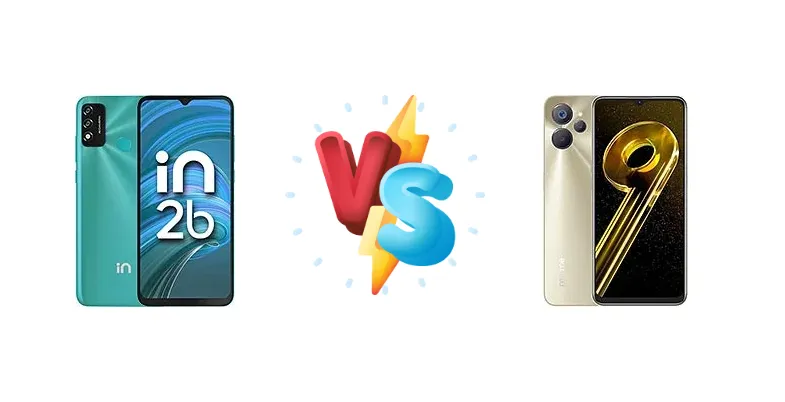
The budget smartphone market is fiercely competitive, offering incredible value for money. Today, we're pitting two contenders against each other: the Micromax In 2b and the Realme 9i 5G. Both promise a lot, but which one delivers the best overall experience?
🏆 Quick Verdict
The Realme 9i 5G takes the crown. Its superior chipset, faster charging, and 5G connectivity offer a significant upgrade over the Micromax In 2b, despite both targeting the budget segment. While the In 2b might appeal to those prioritizing a very basic experience, the Realme 9i 5G provides better future-proofing and performance.
| Network |
|---|
| 2G bands | GSM 850 / 900 / 1800 / 1900 | GSM 850 / 900 / 1800 / 1900 |
| 3G bands | HSDPA 850 / 2100 | HSDPA 850 / 900 / 1700(AWS) / 1900 / 2100 |
| 4G bands | 1, 3, 5, 8, 38, 40, 41 | 1, 2, 3, 4, 5, 7, 8, 19, 20, 28, 34, 38, 39, 40, 41 |
| 5G bands | - | 1, 5, 7, 8, 28, 41, 77, 78 SA/NSA |
| Speed | HSPA, LTE | HSPA, LTE, 5G |
| Technology | GSM / HSPA / LTE | GSM / HSPA / LTE / 5G |
| Launch |
|---|
| Announced | 2021, July 30. Released 2021, August 06 | 2022, August 18 |
| Status | Discontinued | Available. Released 2022, August 24 |
| Body |
|---|
| Dimensions | 164.3 x 75.7 x 8.6 mm (6.47 x 2.98 x 0.34 in) | 164.4 x 75.1 x 8.1 mm (6.47 x 2.96 x 0.32 in) |
| SIM | Nano-SIM + Nano-SIM | Nano-SIM + Nano-SIM |
| Weight | 190 g (6.70 oz) | 187 g (6.60 oz) |
| Display |
|---|
| Protection | - | Panda Glass |
| Resolution | 720 x 1600 pixels, 20:9 ratio (~269 ppi density) | 1080 x 2408 pixels, 20:9 ratio (~400 ppi density) |
| Size | 6.52 inches, 102.6 cm2 (~82.5% screen-to-body ratio) | 6.6 inches, 104.9 cm2 (~85.0% screen-to-body ratio) |
| Type | IPS LCD, 400 nits (typ) | IPS LCD, 90Hz, 400 nits (typ) |
| Platform |
|---|
| CPU | Octa-core (2x1.8 GHz Cortex-A75 & 6x1.8 GHz Cortex-A55) | Octa-core (2x2.4 GHz Cortex-A76 & 6x2.0 GHz Cortex-A55) |
| Chipset | Unisoc T610 (12 nm) | Mediatek Dimensity 810 (6 nm) |
| GPU | Mali-G52 MP2 | Mali-G57 MC2 |
| OS | Android 11 | Android 12, upgradable to Android 13, Realme UI 4.0 |
| Memory |
|---|
| Card slot | microSDXC (dedicated slot) | microSDXC (dedicated slot) |
| Internal | 64GB 4GB RAM, 64GB 6GB RAM | 64GB 4GB RAM, 128GB 4GB RAM, 128GB 6GB RAM |
| | eMMC 5.1 | UFS 2.2 |
| Main Camera |
|---|
| Dual | 13 MP, f/1.8, 27mm (wide), 1/3.0", 1.12µm, PDAF
Auxiliary lens | - |
| Features | LED flash, HDR, panorama | LED flash, HDR, panorama |
| Single | 5 MP, f/2.2 | 8 MP, f/2.0, 27mm (wide) |
| Triple | - | 50 MP, f/1.8, 26mm (wide), 1/2.76", 0.64µm, PDAF
Unspecified MP, 46mm (telephoto)
2 MP (macro) |
| Video | 1080p@30fps | 1080p@30fps |
| Selfie camera |
|---|
| Features | HDR | HDR, panorama |
| Single | 5 MP, f/2.2 | 8 MP, f/2.0, 27mm (wide) |
| Video | Unspecified | 1080p@30fps |
| Sound |
|---|
| 3.5mm jack | Yes | Yes |
| 35mm jack | Yes | Yes |
| Loudspeaker | Yes | Yes |
| Comms |
|---|
| Bluetooth | 5.0, A2DP, LE | 5.2, A2DP, LE |
| NFC | No | No |
| Positioning | GPS, GLONASS, GALILEO, BDS | GPS, GLONASS, GALILEO, BDS |
| Radio | Unspecified | No |
| USB | USB Type-C 2.0, OTG | USB Type-C 2.0, OTG |
| WLAN | Wi-Fi 802.11 a/b/g/n/ac, Wi-Fi Direct | Wi-Fi 802.11 a/b/g/n/ac, dual-band |
| Features |
|---|
| Sensors | Fingerprint (rear-mounted), accelerometer, proximity | Fingerprint (side-mounted), accelerometer, proximity, compass |
| Battery |
|---|
| Charging | 10W wired | 18W wired |
| Type | Li-Po 5000 mAh | 5000 mAh |
| Misc |
|---|
| Colors | Blue, Black, Green | Soulful Blue, Rocking Black, Gold |
| Models | E7544 | RMX3612 |
| Price | About 90 EUR | About 180 EUR |
| SAR | 0.85 W/kg (head) 1.13 W/kg (body) | - |
Micromax In 2b
- Very affordable
- Decent battery life
- Reliable for basic tasks
- Underpowered chipset
- Slow charging
- Basic camera
- Limited features
Realme 9i 5G
- Powerful Dimensity 810 chipset
- 5G connectivity
- Faster charging (18W)
- Better camera
- Smoother performance
- Slightly more expensive than In 2b
- May lack some niche features
Display Comparison
Both phones feature similar display sizes (around 6.5 inches) and resolutions (likely FHD+). However, Realme often utilizes slightly better display technology, potentially offering slightly better color accuracy and brightness. The In 2b's display is likely adequate but may lack the vibrancy of the Realme 9i 5G.
Camera Comparison
The Realme 9i 5G likely boasts a more versatile camera system, potentially including a higher resolution main sensor and improved image processing. While both phones likely have a similar megapixel count on their primary sensors (around 50MP), the Realme's image quality should be noticeably better, especially in low light. The Realme also likely has better video recording capabilities.
Performance
This is where the Realme 9i 5G shines. The Dimensity 810 chipset is significantly more powerful than the Unisoc T610. Expect smoother multitasking, faster app loading times, and better gaming performance on the Realme. The In 2b will handle basic tasks, but will struggle with demanding applications.
Battery Life
Both phones likely have a battery capacity around 5000mAh, offering all-day battery life. However, the Realme 9i 5G's 18W fast charging is a significant advantage over the In 2b's 10W charging, allowing for quicker top-ups.
Buying Guide
The Micromax In 2b is ideal for users who need a basic smartphone for calls, texts, and light social media use, and are extremely budget-conscious. The Realme 9i 5G is a better choice for those who want a smoother experience, faster performance for gaming and multitasking, and the benefits of 5G connectivity, even on a budget.
Frequently Asked Questions
❓ Is the Micromax In 2b good for gaming?
The Micromax In 2b is not ideal for gaming. Its chipset struggles with demanding games, resulting in lag and low frame rates. The Realme 9i 5G offers a much better gaming experience.
❓ Which phone has better 5G support?
The Realme 9i 5G is a 5G phone, offering significantly faster download and upload speeds where 5G networks are available. The Micromax In 2b does not support 5G.