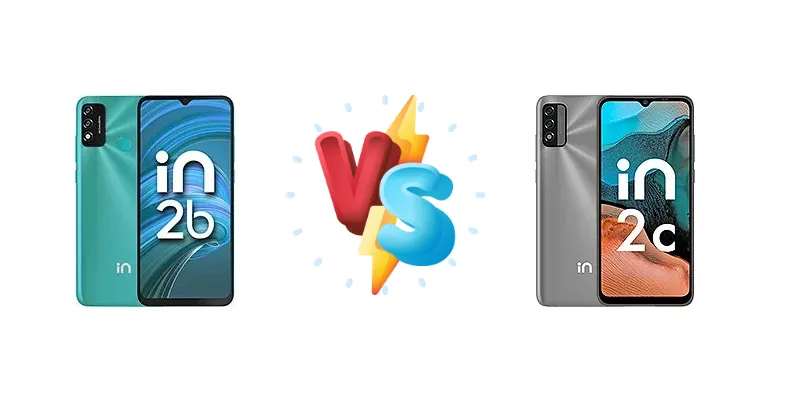
Micromax has been making a comeback in the budget smartphone space, and the In 2b and In 2c are key contenders. Both offer compelling features at an affordable price, but subtle differences might make one a better choice for you. Let's dive into a head-to-head comparison to help you decide.
🏆 Quick Verdict
The Micromax In 2b and In 2c are remarkably similar, sharing the same Unisoc T610 chipset and 10W charging. The In 2b generally offers slightly better value due to its often lower price and potentially improved software experience, making it the preferred choice for most budget-conscious buyers.
| Network |
|---|
| 2G bands | GSM 850 / 900 / 1800 / 1900 | GSM 850 / 900 / 1800 / 1900 |
| 3G bands | HSDPA 850 / 2100 | HSDPA 850 / 2100 |
| 4G bands | 1, 3, 5, 8, 38, 40, 41 | 1, 3, 5, 8, 38, 40, 41 |
| Speed | HSPA, LTE | HSPA, LTE |
| Technology | GSM / HSPA / LTE | GSM / HSPA / LTE |
| Launch |
|---|
| Announced | 2021, July 30. Released 2021, August 06 | 2022, April 26 |
| Status | Discontinued | Available. Released 2022, May 01 |
| Body |
|---|
| Dimensions | 164.3 x 75.7 x 8.6 mm (6.47 x 2.98 x 0.34 in) | 164.3 x 75.7 x 8.6 mm (6.47 x 2.98 x 0.34 in) |
| SIM | Nano-SIM + Nano-SIM | Nano-SIM + Nano-SIM |
| Weight | 190 g (6.70 oz) | 198 g (6.98 oz) |
| Display |
|---|
| Resolution | 720 x 1600 pixels, 20:9 ratio (~269 ppi density) | 720 x 1600 pixels, 20:9 ratio (~269 ppi density) |
| Size | 6.52 inches, 102.6 cm2 (~82.5% screen-to-body ratio) | 6.52 inches, 102.6 cm2 (~82.5% screen-to-body ratio) |
| Type | IPS LCD, 400 nits (typ) | IPS LCD, 420 nits |
| Platform |
|---|
| CPU | Octa-core (2x1.8 GHz Cortex-A75 & 6x1.8 GHz Cortex-A55) | Octa-core (2x1.8 GHz Cortex-A75 & 6x1.8 GHz Cortex-A55) |
| Chipset | Unisoc T610 (12 nm) | Unisoc T610 (12 nm) |
| GPU | Mali-G52 MP2 | Mali-G52 MP2 |
| OS | Android 11 | Android 11 |
| Memory |
|---|
| Card slot | microSDXC (dedicated slot) | microSDXC (dedicated slot) |
| Internal | 64GB 4GB RAM, 64GB 6GB RAM | 32GB 3GB RAM |
| | eMMC 5.1 | eMMC 5.1 |
| Main Camera |
|---|
| Dual | 13 MP, f/1.8, 27mm (wide), 1/3.0", 1.12µm, PDAF
Auxiliary lens | 8 MP, (wide), AF
Auxiliary lens |
| Features | LED flash, HDR, panorama | LED flash, HDR, panorama |
| Single | 5 MP, f/2.2 | 5 MP, AF |
| Video | 1080p@30fps | 1080p@30fps |
| Selfie camera |
|---|
| Features | HDR | - |
| Single | 5 MP, f/2.2 | 5 MP, AF |
| Video | Unspecified | Unspecified |
| Sound |
|---|
| 3.5mm jack | Yes | Yes |
| 35mm jack | Yes | Yes |
| Loudspeaker | Yes | Yes |
| Comms |
|---|
| Bluetooth | 5.0, A2DP, LE | 5.0, A2DP, LE |
| NFC | No | No |
| Positioning | GPS, GLONASS, GALILEO, BDS | GPS |
| Radio | Unspecified | No |
| USB | USB Type-C 2.0, OTG | USB Type-C 2.0, OTG |
| WLAN | Wi-Fi 802.11 a/b/g/n/ac, Wi-Fi Direct | Wi-Fi 802.11 a/b/g/n/ac, Wi-Fi Direct |
| Features |
|---|
| Sensors | Fingerprint (rear-mounted), accelerometer, proximity | Accelerometer, proximity |
| Battery |
|---|
| Charging | 10W wired | 10W wired |
| Type | Li-Po 5000 mAh | Li-Po 5000 mAh |
| Misc |
|---|
| Colors | Blue, Black, Green | Brown, Silver |
| Models | E7544 | E6533 |
| Price | About 90 EUR | About 100 EUR |
| SAR | 0.85 W/kg (head) 1.13 W/kg (body) | - |
Micromax In 2b
- Potentially better value for money
- Slightly more modern design (likely)
- Potentially cleaner software experience
- Slow 10W charging
- Unisoc T610 chipset isn't a powerhouse
- HD+ display resolution
Micromax In 2c
- Affordable price (if discounted)
- Decent battery life
- Large display for media consumption
- Slow 10W charging
- Unisoc T610 chipset isn't a powerhouse
- HD+ display resolution
Display Comparison
Both phones likely feature a 6.53-inch HD+ display with a similar resolution (720 x 1600 pixels). Expect decent viewing angles and color reproduction for everyday use, but don't expect flagship-level quality. Differences in panel type (IPS vs. TFT) and brightness levels might exist, but are often not explicitly stated by Micromax. The In 2b might have a slightly more modern design.
Camera Comparison
While both phones likely have a similar rear camera setup (typically a 13MP main sensor and a depth sensor), the In 2b might have a slightly better primary sensor or image processing algorithms. Expect decent image quality in good lighting conditions, but low-light performance will be average. Front-facing camera resolution and features may also differ slightly.
Performance
Powered by the Unisoc T610, both phones offer adequate performance for basic tasks like browsing, social media, and light gaming. Don't expect to run demanding games smoothly. The chipset's efficiency is decent, but thermal management could be a concern under sustained load. Software optimization will play a crucial role in the overall user experience.
Battery Life
Both devices are expected to have a 5000mAh battery, providing all-day battery life for moderate users. However, the 10W charging is slow, so expect long charging times. Battery optimization in the software will significantly impact real-world battery performance.
Buying Guide
The Micromax In 2b is ideal for users prioritizing a slightly better price-to-performance ratio and potentially a cleaner software experience. The Micromax In 2c is a good option if you find it at a significantly lower price or if specific design preferences sway you.
Frequently Asked Questions
❓ Are the Micromax In 2b and In 2c the same phone?
They are very similar, sharing the same chipset and battery capacity. Differences lie in design, software optimization, and potentially camera performance.
❓ Which phone has better performance?
Performance is largely identical due to the same chipset. Software optimization will be the deciding factor.