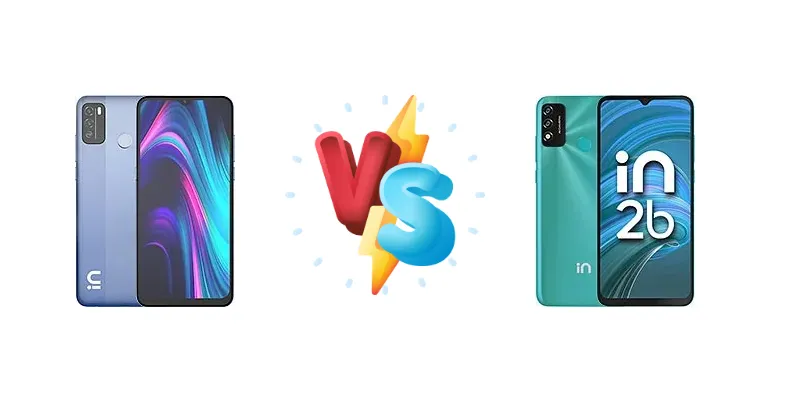
Micromax re-entered the Indian smartphone market with the In 1b and In 2b, aiming to disrupt the budget segment. While both phones target affordability, they differ significantly in their core hardware. This comparison dissects the key distinctions – particularly the chipset choices – to determine which device delivers the best experience for your money.
🏆 Quick Verdict
For most users, the Micromax In 2b emerges as the better choice. Its Unisoc T610 chipset, featuring Cortex-A75 cores, provides a noticeable performance uplift over the In 1b’s Helio G35, translating to smoother multitasking and a more responsive user experience. While both offer 10W charging, the In 2b’s CPU architecture provides a more future-proof foundation.
| Network |
|---|
| 2G bands | GSM 850 / 900 / 1800 / 1900 | GSM 850 / 900 / 1800 / 1900 |
| 3G bands | HSDPA 850 / 2100 | HSDPA 850 / 2100 |
| 4G bands | 1, 3, 5, 8, 40, 41 | 1, 3, 5, 8, 38, 40, 41 |
| Speed | HSPA, LTE | HSPA, LTE |
| Technology | GSM / HSPA / LTE | GSM / HSPA / LTE |
| Launch |
|---|
| Announced | 2020, November 03. Released 2020, November 26 | 2021, July 30. Released 2021, August 06 |
| Status | Discontinued | Discontinued |
| Body |
|---|
| Dimensions | 164.5 x 75.8 x 8.9 mm (6.48 x 2.98 x 0.35 in) | 164.3 x 75.7 x 8.6 mm (6.47 x 2.98 x 0.34 in) |
| SIM | Nano-SIM + Nano-SIM | Nano-SIM + Nano-SIM |
| Weight | 188 g (6.63 oz) | 190 g (6.70 oz) |
| Display |
|---|
| Resolution | 720 x 1600 pixels, 20:9 ratio (~269 ppi density) | 720 x 1600 pixels, 20:9 ratio (~269 ppi density) |
| Size | 6.52 inches, 102.6 cm2 (~82.3% screen-to-body ratio) | 6.52 inches, 102.6 cm2 (~82.5% screen-to-body ratio) |
| Type | IPS LCD, 400 nits (typ) | IPS LCD, 400 nits (typ) |
| Platform |
|---|
| CPU | Octa-core (4x2.3 GHz Cortex-A53 & 4x1.8 GHz Cortex-A53) | Octa-core (2x1.8 GHz Cortex-A75 & 6x1.8 GHz Cortex-A55) |
| Chipset | Mediatek MT6765G Helio G35 (12 nm) | Unisoc T610 (12 nm) |
| GPU | PowerVR GE8320 | Mali-G52 MP2 |
| OS | Android 10 (Go edition) | Android 11 |
| Memory |
|---|
| Card slot | microSDXC (dedicated slot) | microSDXC (dedicated slot) |
| Internal | 32GB 2GB RAM, 64GB 4GB RAM | 64GB 4GB RAM, 64GB 6GB RAM |
| | eMMC 5.1 | eMMC 5.1 |
| Main Camera |
|---|
| Dual | 13 MP, f/1.9, 26mm (wide), PDAF
Auxiliary lens | 13 MP, f/1.8, 27mm (wide), 1/3.0", 1.12µm, PDAF
Auxiliary lens |
| Features | LED flash, panorama | LED flash, HDR, panorama |
| Single | - | 5 MP, f/2.2 |
| Video | 1080p@30fps | 1080p@30fps |
| Selfie camera |
|---|
| Features | - | HDR |
| Single | 8 MP, f/2.0 | 5 MP, f/2.2 |
| Video | 1080p@30fps | Unspecified |
| Sound |
|---|
| 3.5mm jack | Yes | Yes |
| 35mm jack | Yes | Yes |
| Loudspeaker | Yes | Yes |
| Comms |
|---|
| Bluetooth | 5.0, A2DP, LE | 5.0, A2DP, LE |
| NFC | No | No |
| Positioning | GPS, GLONASS, GALILEO | GPS, GLONASS, GALILEO, BDS |
| Radio | Unspecified | Unspecified |
| USB | USB Type-C 2.0, OTG | USB Type-C 2.0, OTG |
| WLAN | Wi-Fi 802.11 a/b/g/n/ac, Wi-Fi Direct | Wi-Fi 802.11 a/b/g/n/ac, Wi-Fi Direct |
| Features |
|---|
| Sensors | Fingerprint (rear-mounted), accelerometer, gyro, proximity | Fingerprint (rear-mounted), accelerometer, proximity |
| Battery |
|---|
| Charging | 10W wired
Reverse wired | 10W wired |
| Type | Li-Po 5000 mAh | Li-Po 5000 mAh |
| Misc |
|---|
| Colors | Blue, Purple, Green | Blue, Black, Green |
| Models | E6523, E7533 | E7544 |
| Price | About 80 EUR | About 90 EUR |
| SAR | 0.57 W/kg (head) 0.90 W/kg (body) | 0.85 W/kg (head) 1.13 W/kg (body) |
Micromax In 1b
- Proven Mediatek chipset
- Potentially lower price (depending on retailer)
- Reliable for basic tasks
- Older CPU architecture
- Less responsive multitasking
- Inferior gaming performance
Micromax In 2b
- More modern Unisoc T610 chipset
- Improved CPU performance with Cortex-A75 cores
- Smoother multitasking experience
- Unisoc chipset may have less software support
- 10W charging is slow
- Camera performance likely similar to In 1b
Display Comparison
Both the Micromax In 1b and In 2b likely feature similar LCD panels, given their price points. Specific details like resolution and peak brightness are not provided, but we can assume they are optimized for power efficiency. The absence of high refresh rates is expected in this segment. The user experience will likely be comparable in terms of visual fidelity, with the display quality being a secondary consideration compared to the chipset.
Camera Comparison
Without detailed camera specifications beyond the presence of cameras, a direct comparison is difficult. However, the chipset’s image signal processor (ISP) plays a crucial role. The Unisoc T610 likely has a more capable ISP than the Helio G35, potentially leading to better image processing, especially in low-light conditions. Users should manage expectations, as both phones are likely to deliver adequate, but not exceptional, camera performance.
Performance
The core difference lies in the chipsets. The Micromax In 1b utilizes the Mediatek Helio G35, an octa-core processor with four Cortex-A53 cores clocked at 2.3 GHz and another four at 1.8 GHz. The In 2b, however, features the Unisoc T610, employing a more modern architecture with two Cortex-A75 cores at 1.8 GHz and six Cortex-A55 cores also at 1.8 GHz. The A75 cores in the T610 represent a significant architectural improvement over the A53 cores in the G35, offering better single-core performance and improved efficiency. This translates to snappier app launches and smoother multitasking. While both are 12nm chips, the T610’s architecture provides a clear advantage in real-world usage.
Battery Life
Both devices are equipped with 10W wired charging, indicating a similar charging experience – expect around 2-3 hours for a full charge. Battery capacity isn't specified, but given the focus on affordability, it's likely to be in the 4000-5000 mAh range for both. The Unisoc T610’s improved efficiency *could* translate to slightly better battery life in the In 2b, but the difference is unlikely to be dramatic. The slow charging speed is a limitation for both devices.
Buying Guide
Buy the Micromax In 1b if you prioritize a proven, if older, chipset and are primarily focused on basic smartphone tasks like calling, texting, and light social media use. Buy the Micromax In 2b if you value a more responsive experience for multitasking, occasional gaming, and want a device with a slightly more modern CPU architecture that may receive software updates for a longer period.
Frequently Asked Questions
❓ Will the Unisoc T610 in the In 2b struggle with demanding games like PUBG Mobile?
While the Unisoc T610 is an improvement over the Helio G35, it's still an entry-level chipset. PUBG Mobile will likely be playable at lower graphics settings and frame rates. Expect some frame drops during intense action. It's not designed for high-end gaming.
❓ Is the 10W charging speed on either phone a significant drawback?
Yes, 10W charging is quite slow by today's standards. Expect a full charge to take over two hours. This is a compromise made to keep the price down, but it requires planning ahead and overnight charging.
❓ Does the Micromax In 2b receive regular software updates?
Micromax's software update track record is not well-established. While the Unisoc T610 is a capable chipset, the longevity of software support remains a question mark. Users should temper expectations regarding future Android version updates.
❓ Which phone is better for someone who primarily uses WhatsApp, YouTube, and Facebook?
The Micromax In 2b is the better choice. The Cortex-A75 cores in the Unisoc T610 will provide a smoother and more responsive experience when switching between these apps and scrolling through social media feeds.