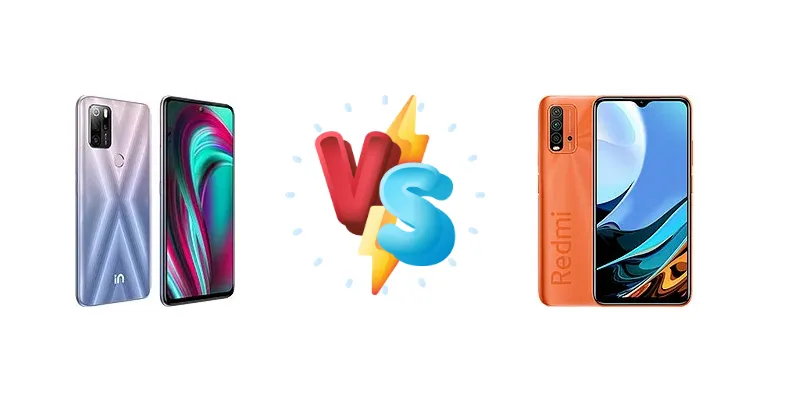
The Micromax In 1 and Xiaomi Redmi 9 Power represent a resurgence of competitive pricing in the budget smartphone segment. Both aim to deliver a solid experience without breaking the bank, but they achieve this through different approaches to chipset selection and overall design. This comparison dissects their key specifications to determine which device offers the best value for your money.
🏆 Quick Verdict
For the average user, the Xiaomi Redmi 9 Power is the stronger choice. While both phones offer 18W charging and reverse wired charging, the Snapdragon 662’s more efficient 11nm process and optimized CPU architecture provide a smoother, more consistent experience, particularly in sustained workloads and multitasking.
| Network |
|---|
| 2G bands | GSM 850 / 900 / 1800 / 1900 | GSM 850 / 900 / 1800 / 1900 |
| 3G bands | HSDPA 850 / 900 / 2100 | HSDPA 850 / 900 / 2100 |
| 4G bands | 1, 3, 5, 8, 40, 41 | 1, 3, 5, 8, 40, 41 |
| Speed | HSPA, LTE | HSPA, LTE |
| Technology | GSM / HSPA / LTE | GSM / HSPA / LTE |
| Launch |
|---|
| Announced | 2021, March 19. Released 2021, March 26 | 2020, December 17 |
| Status | Discontinued | Available. Released 2020, December 22 |
| Body |
|---|
| Build | - | Glass front (Gorilla Glass 3), plastic frame, plastic back |
| Dimensions | 165.2 x 77 x 9 mm (6.50 x 3.03 x 0.35 in) | 162.3 x 77.3 x 9.6 mm (6.39 x 3.04 x 0.38 in) |
| SIM | Nano-SIM + Nano-SIM | Nano-SIM + Nano-SIM |
| Weight | 195 g (6.88 oz) | 198 g (6.98 oz) |
| Display |
|---|
| Protection | - | Corning Gorilla Glass 3 |
| Resolution | 1080 x 2400 pixels, 20:9 ratio (~395 ppi density) | 1080 x 2340 pixels, 19.5:9 ratio (~395 ppi density) |
| Size | 6.67 inches, 107.4 cm2 (~84.4% screen-to-body ratio) | 6.53 inches, 104.7 cm2 (~83.4% screen-to-body ratio) |
| Type | IPS LCD, 440 nits (peak) | IPS LCD, 400 nits (typ) |
| Platform |
|---|
| CPU | Octa-core (2x2.0 GHz Cortex-A75 & 6x1.8 GHz Cortex-A55) | Octa-core (4x2.0 GHz Kryo 260 Gold & 4x1.8 GHz Kryo 260 Silver) |
| Chipset | Mediatek MT6769V/CU Helio G80 (12 nm) | Qualcomm SM6115 Snapdragon 662 (11 nm) |
| GPU | Mali-G52 MC2 | Adreno 610 |
| OS | Android 10 | Android 10, MIUI 12 |
| Memory |
|---|
| Card slot | microSDXC (dedicated slot) | microSDXC (dedicated slot) |
| Internal | 64GB 4GB RAM, 128GB 6GB RAM | 64GB 4GB RAM, 128GB 4GB RAM, 128GB 6GB RAM |
| | eMMC 5.1 | eMMC 4.5 |
| Main Camera |
|---|
| Features | LED flash, HDR | LED flash, HDR, panorama |
| Quad | 48 MP, f/1.8, 26mm (wide), 1/2.0", 0.8µm, PDAF
2 MP (macro)
Auxiliary lens | 48 MP, f/1.8, 26mm (wide), 1/2.0", 0.8µm, PDAF
8 MP, f/2.2, 120˚ (ultrawide), 1/4.0", 1.12µm
2 MP (macro)
Auxiliary lens |
| Single | - | 5 MP, AF |
| Video | 1080p@30fps | 1080p@30fps |
| Selfie camera |
|---|
| Single | 8 MP, f/2.0, (wide), 1/4.0", 1.12µm | 8 MP, f/2.0, 27mm (wide), 1/4.0", 1.12µm |
| Video | 1080p@30fps | 1080p@30fps |
| Sound |
|---|
| 3.5mm jack | Yes | Yes |
| 35mm jack | Yes | Yes |
| Loudspeaker | Yes | Yes, with stereo speakers |
| Comms |
|---|
| Bluetooth | 5.0, A2DP, LE | 5.0, A2DP, LE |
| Infrared port | - | Yes |
| NFC | No | No |
| Positioning | GPS, GLONASS, GALILEO, BDS | GPS, GLONASS, BDS |
| Radio | FM radio | FM radio |
| USB | USB Type-C 2.0, OTG | USB Type-C 2.0, OTG |
| WLAN | Wi-Fi 802.11 a/b/g/n/ac, dual-band, Wi-Fi Direct | Wi-Fi 802.11 a/b/g/n/ac, dual-band, Wi-Fi Direct |
| Features |
|---|
| Sensors | Fingerprint (rear-mounted), accelerometer, gyro, proximity, compass | Fingerprint (side-mounted), accelerometer, proximity, compass |
| Battery |
|---|
| Charging | 18W wired
2.5W reverse wired | 18W wired
2.5W reverse wired |
| Stand-by | - | Up to 350 h (3G) |
| Talk time | - | Up to 8 h (3G) |
| Type | Li-Po 5000 mAh | Li-Po 6000 mAh |
| Misc |
|---|
| Colors | Blue, Purple | Mighty Black, Fiery Red, Electric Green, Blazing Blue |
| Models | E6746 | M2010J19SI, M2010J19SL |
| Price | About 120 EUR | About 120 EUR |
| SAR | 0.96 W/kg (head) | 0.87 W/kg (head) 0.86 W/kg (body) |
Micromax In 1
- Potentially lower price point
- MediaTek Helio G80 offers decent performance for basic tasks
- 18W fast charging with reverse wired charging
- Less efficient 12nm process
- Helio G80 may throttle under sustained load
- Potentially inferior ISP compared to Snapdragon 662
Xiaomi Redmi 9 Power
- More efficient Snapdragon 662 chipset
- 11nm process for better thermal management and battery life
- Superior ISP for improved image processing
- May be slightly more expensive than the Micromax In 1
- Similar charging speed to the Micromax In 1
- Performance gains may not be noticeable for very light users
Display Comparison
Both devices likely feature LCD panels, common in this price bracket. However, detailed display specs like resolution, brightness, and color gamut are missing. The focus here is on the internal hardware. The absence of high refresh rate panels is expected, but the quality of the LCD itself will be a key differentiator, something we can't assess with the provided data. Bezels are likely comparable, given the similar target price points.
Camera Comparison
Without detailed camera sensor information, a direct comparison is difficult. Both phones likely feature a primary camera alongside supporting lenses (depth, macro). However, the image signal processor (ISP) within the Snapdragon 662 is generally considered superior, offering better image processing capabilities, particularly in low-light conditions. The Helio G80’s ISP is capable, but the Snapdragon 662 has a slight edge in computational photography. We can assume both phones will offer acceptable image quality for social media sharing, but the Redmi 9 Power is likely to produce more detailed and vibrant photos.
Performance
The core difference lies in the chipsets. The Redmi 9 Power’s Qualcomm Snapdragon 662, built on an 11nm process, offers a more efficient architecture than the Micromax In 1’s MediaTek Helio G80 (12nm). While both are octa-core CPUs with similar clock speeds (2.0 GHz for the Cortex-A75/Kryo 260 Gold and 1.8 GHz for the Cortex-A55/Kryo 260 Silver), the Snapdragon 662’s Kryo cores are generally more power-efficient and deliver better sustained performance. This translates to less throttling during extended gaming sessions or demanding applications. The 11nm process node is a significant advantage for the Redmi 9 Power.
Battery Life
Both devices feature 18W wired charging and 2.5W reverse wired charging, providing similar charging speeds. Battery capacity is not specified, but given the target market, both are likely in the 5000mAh range. The Snapdragon 662’s superior power efficiency will likely translate to slightly better battery life on the Redmi 9 Power, allowing for longer screen-on time and reduced standby drain. The 11nm process contributes to this efficiency.
Buying Guide
Buy the Micromax In 1 if you prioritize a potentially lower price point and are primarily focused on basic smartphone tasks like calling, texting, and light social media use. Buy the Xiaomi Redmi 9 Power if you value consistent performance, smoother multitasking, and a slightly more refined user experience, even if it means spending a little extra.
Frequently Asked Questions
❓ Will the Micromax In 1 struggle with graphically demanding games like PUBG Mobile?
The Helio G80 can run PUBG Mobile, but you'll likely need to lower the graphics settings to achieve a smooth frame rate. The 12nm process and potential for thermal throttling may lead to performance drops during extended gaming sessions. The Redmi 9 Power, with its Snapdragon 662, will offer a more consistent and playable experience at higher settings.
❓ Does the Snapdragon 662 in the Redmi 9 Power offer noticeable improvements in multitasking compared to the Helio G80?
Yes, the Snapdragon 662’s more efficient architecture and optimized CPU cores provide a noticeable improvement in multitasking. Switching between apps will be smoother and faster, and the phone is less likely to experience lag when running multiple applications simultaneously. The 11nm process contributes to this improved responsiveness.
❓ Is the 2.5W reverse wired charging on either phone useful for anything beyond emergencies?
The 2.5W reverse wired charging is primarily for emergency situations, such as topping up a wireless earbud case or a smartwatch. It's too slow to significantly charge a larger device like another smartphone. Consider it a convenience feature rather than a primary charging method.