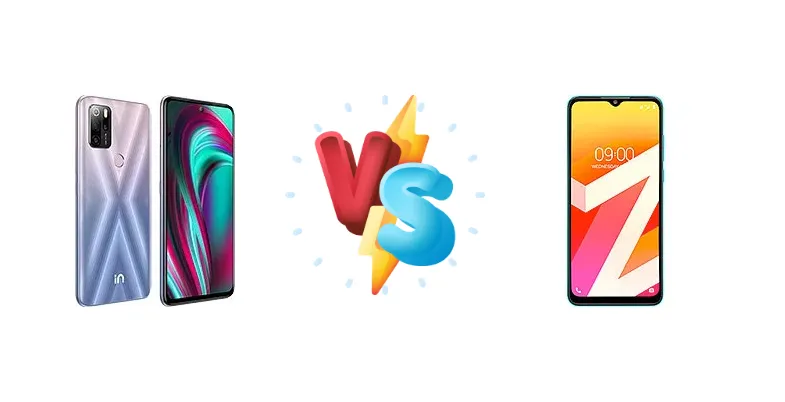
The Micromax In 1 and Lava Z6 represent a resurgence of Indian smartphone brands aiming for the budget segment. Both phones target users seeking affordable gaming capabilities, but they employ different Mediatek Helio chipsets. This comparison dissects their strengths and weaknesses to determine which device offers the best value for gamers and everyday users.
🏆 Quick Verdict
For most users, the Micromax In 1 emerges as the stronger choice. Its Helio G80 chipset, featuring more powerful Cortex-A75 cores, provides a noticeable performance advantage in gaming and demanding applications, justifying its slightly higher price point. However, the Lava Z6 remains a viable option for basic users.
| Network |
|---|
| 2G bands | GSM 850 / 900 / 1800 / 1900 | GSM 900 / 1800 |
| 3G bands | HSDPA 850 / 900 / 2100 | HSDPA 900 / 2100 |
| 4G bands | 1, 3, 5, 8, 40, 41 | 1, 3, 5, 8, 40, 41 |
| Speed | HSPA, LTE | HSPA 42.2/5.76 Mbps, LTE Cat4 150/50 Mbps |
| Technology | GSM / HSPA / LTE | GSM / HSPA / LTE |
| Launch |
|---|
| Announced | 2021, March 19. Released 2021, March 26 | 2021, January 07 |
| Status | Discontinued | Available. Released 2021, January 11 |
| Body |
|---|
| Build | - | Glass front, plastic back, plastic frame |
| Dimensions | 165.2 x 77 x 9 mm (6.50 x 3.03 x 0.35 in) | 164.5 x 75.8 x 9 mm (6.48 x 2.98 x 0.35 in) |
| SIM | Nano-SIM + Nano-SIM | Nano-SIM + Nano-SIM |
| Weight | 195 g (6.88 oz) | 190 g (6.70 oz) |
| Display |
|---|
| Protection | - | Corning Gorilla Glass 3 |
| Resolution | 1080 x 2400 pixels, 20:9 ratio (~395 ppi density) | 720 x 1600 pixels, 20:9 ratio (~270 ppi density) |
| Size | 6.67 inches, 107.4 cm2 (~84.4% screen-to-body ratio) | 6.51 inches, 102.3 cm2 (~82.1% screen-to-body ratio) |
| Type | IPS LCD, 440 nits (peak) | IPS LCD |
| Platform |
|---|
| CPU | Octa-core (2x2.0 GHz Cortex-A75 & 6x1.8 GHz Cortex-A55) | Octa-core (4x2.3 GHz Cortex-A53 & 4x1.8 GHz Cortex-A53) |
| Chipset | Mediatek MT6769V/CU Helio G80 (12 nm) | Mediatek MT6765G Helio G35 (12 nm) |
| GPU | Mali-G52 MC2 | PowerVR GE8320 |
| OS | Android 10 | Android 10 |
| Memory |
|---|
| Card slot | microSDXC (dedicated slot) | microSDXC (dedicated slot) |
| Internal | 64GB 4GB RAM, 128GB 6GB RAM | 64GB 6GB RAM |
| | eMMC 5.1 | eMMC 5.1 |
| Main Camera |
|---|
| Features | LED flash, HDR | LED flash |
| Quad | 48 MP, f/1.8, 26mm (wide), 1/2.0", 0.8µm, PDAF
2 MP (macro)
Auxiliary lens | - |
| Triple | - | 13 MP, f/1.9, (wide), 1/3.0", 1.12µm, AF
5 MP, (ultrawide)
Auxiliary lens |
| Video | 1080p@30fps | 1080p@30fps |
| Selfie camera |
|---|
| Features | - | LED flash |
| Single | 8 MP, f/2.0, (wide), 1/4.0", 1.12µm | 16 MP, f/2.0, (wide), 1/3.06" 1.0µm |
| Video | 1080p@30fps | 1080p@30fps |
| Sound |
|---|
| 3.5mm jack | Yes | Yes |
| 35mm jack | Yes | Yes |
| Loudspeaker | Yes | Yes |
| Comms |
|---|
| Bluetooth | 5.0, A2DP, LE | 5.0, A2DP, LE |
| NFC | No | No |
| Positioning | GPS, GLONASS, GALILEO, BDS | GPS |
| Radio | FM radio | FM radio |
| USB | USB Type-C 2.0, OTG | USB Type-C |
| WLAN | Wi-Fi 802.11 a/b/g/n/ac, dual-band, Wi-Fi Direct | Wi-Fi 802.11 b/g/n, Wi-Fi Direct |
| Features |
|---|
| Sensors | Fingerprint (rear-mounted), accelerometer, gyro, proximity, compass | Fingerprint (rear-mounted), accelerometer, proximity |
| Battery |
|---|
| Charging | 18W wired
2.5W reverse wired | - |
| Type | Li-Po 5000 mAh | Li-Po 5000 mAh |
| Misc |
|---|
| Colors | Blue, Purple | Blue, Red |
| Models | E6746 | LMX06 |
| Price | About 120 EUR | About 110 EUR |
| SAR | 0.96 W/kg (head) | - |
Micromax In 1
- More powerful Helio G80 chipset for better gaming
- Faster CPU cores (Cortex-A75) for smoother multitasking
- 18W fast charging with reverse wired charging
- May be slightly more expensive than the Lava Z6
- Specific display details are unknown
Lava Z6
- Potentially lower price point
- Decent performance for basic tasks
- Acceptable for light usage
- Less powerful Helio G35 chipset
- Inferior CPU architecture (Cortex-A53)
- Likely slower charging speeds
Display Comparison
Neither device boasts a standout display. Both likely utilize LCD panels, common in this price bracket. The key difference lies under the hood. While specific display specs are unavailable, the focus here is on processing power, not pixel density. Bezels are expected to be substantial on both, and color accuracy will likely be standard for the segment.
Camera Comparison
Camera performance is likely to be similar, with both phones relying on budget sensors. Without specific sensor details, it's safe to assume both will struggle in low-light conditions. The inclusion of a 2MP macro camera on the Lava Z6 is a common, but often underwhelming, feature in this segment. Image processing will likely be basic on both, prioritizing speed over detail. The G80’s ISP (Image Signal Processor) *may* offer slightly better noise reduction, but this is speculative without detailed testing.
Performance
The core battleground is the chipset. The Micromax In 1’s Mediatek Helio G80 (12nm) utilizes a dual-cluster CPU configuration: 2x2.0 GHz Cortex-A75 cores for demanding tasks and 6x1.8 GHz Cortex-A55 cores for efficiency. This is a significant upgrade over the Lava Z6’s Helio G35 (12nm), which employs a homogenous octa-core setup of 4x2.3 GHz Cortex-A53 and 4x1.8 GHz Cortex-A53 cores. The A75 cores in the G80 offer substantially higher single-core performance, translating to snappier app launches and smoother multitasking. While the G35’s higher clock speed on the A53 cores might seem appealing, the architectural differences favor the G80 in sustained workloads like gaming. The G80 also benefits from a more capable GPU, further widening the performance gap.
Battery Life
Battery life will depend heavily on usage patterns. The Micromax In 1 features 18W wired charging and 2.5W reverse wired charging, offering a convenient, albeit slow, top-up option. The Lava Z6’s charging capabilities are not specified, but are likely to be similar or slightly slower. The actual battery capacity of both devices is not provided, but the G80’s more efficient architecture could potentially offset a slightly smaller battery size, resulting in comparable real-world battery endurance.
Buying Guide
Buy the Micromax In 1 if you prioritize gaming performance and responsiveness for apps. Its Helio G80 chipset will handle PUBG Mobile and Call of Duty Mobile at medium settings with greater stability. Buy the Lava Z6 if your primary needs are basic communication, social media, and light web browsing, and you're looking for the absolute lowest price point.
Frequently Asked Questions
❓ Will the Micromax In 1 handle demanding games like Genshin Impact?
While the Helio G80 can run Genshin Impact, expect to play at the lowest settings with significant frame rate drops. It's best suited for less graphically intensive titles like PUBG Mobile and Call of Duty Mobile at medium settings.
❓ Is the Lava Z6 suitable for video streaming and social media?
Yes, the Lava Z6 is perfectly adequate for video streaming (YouTube, Netflix) and social media browsing. However, expect some lag when switching between multiple apps due to the less powerful Helio G35 chipset.
❓ Does the Micromax In 1 support VoWiFi (WiFi Calling)?
Support for VoWiFi depends on the carrier and software updates. It's not guaranteed on either device, but the Micromax In 1's more frequent software updates *may* increase the likelihood of future VoWiFi support.
❓ What type of storage does the Lava Z6 use – eMMC or UFS?
Given the price point, it's highly probable that the Lava Z6 utilizes eMMC storage, which is slower than UFS. This will impact app loading times and overall system responsiveness compared to a device with UFS storage.