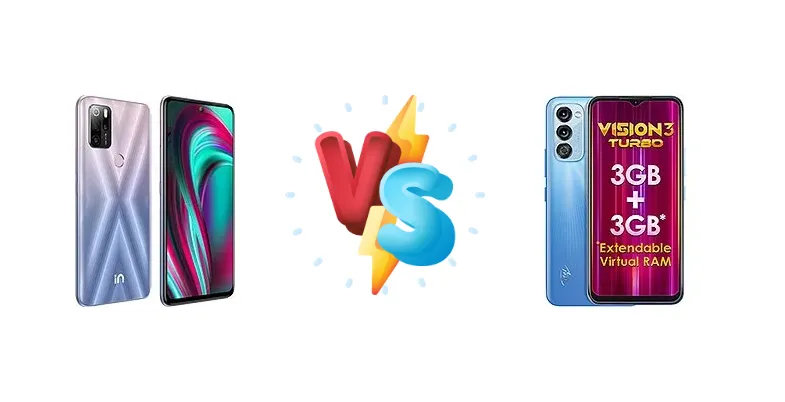
The sub-$150 smartphone market is fiercely competitive. Both the Micromax In 1 and the itel Vision 3 Turbo aim to deliver essential smartphone functionality at an incredibly affordable price. However, significant differences in their core hardware – specifically the chipset – dictate vastly different user experiences. This comparison dissects those differences to determine which phone offers the best value.
🏆 Quick Verdict
For users prioritizing responsiveness and a smoother overall experience, the Micromax In 1 is the clear winner. Its Mediatek Helio G80 chipset provides a substantial performance advantage over the itel Vision 3 Turbo’s Unisoc SC9863A, making it better suited for multitasking and light gaming. While both offer 18W charging, the In 1’s superior processing power justifies its slightly higher price.
| Network |
|---|
| 2G bands | GSM 850 / 900 / 1800 / 1900 | GSM 850 / 900 / 1800 / 1900 |
| 3G bands | HSDPA 850 / 900 / 2100 | HSDPA 850 / 900 / 2100 |
| 4G bands | 1, 3, 5, 8, 40, 41 | LTE |
| Speed | HSPA, LTE | HSPA, LTE |
| Technology | GSM / HSPA / LTE | GSM / HSPA / LTE |
| Launch |
|---|
| Announced | 2021, March 19. Released 2021, March 26 | 2022 |
| Status | Discontinued | Available. Released 2022 |
| Body |
|---|
| Dimensions | 165.2 x 77 x 9 mm (6.50 x 3.03 x 0.35 in) | - |
| SIM | Nano-SIM + Nano-SIM | Dual SIM |
| Weight | 195 g (6.88 oz) | - |
| Display |
|---|
| Resolution | 1080 x 2400 pixels, 20:9 ratio (~395 ppi density) | 720 x 1600 pixels, 20:9 ratio (~266 ppi density) |
| Size | 6.67 inches, 107.4 cm2 (~84.4% screen-to-body ratio) | 6.6 inches, 105.2 cm2 |
| Type | IPS LCD, 440 nits (peak) | IPS LCD |
| Platform |
|---|
| CPU | Octa-core (2x2.0 GHz Cortex-A75 & 6x1.8 GHz Cortex-A55) | Octa-core (4x1.6 GHz Cortex-A55 & 4x1.2 GHz Cortex-A55) |
| Chipset | Mediatek MT6769V/CU Helio G80 (12 nm) | Unisoc SC9863A (28 nm) |
| GPU | Mali-G52 MC2 | IMG8322 |
| OS | Android 10 | Android 11 (Go edition) |
| Memory |
|---|
| Card slot | microSDXC (dedicated slot) | microSDXC |
| Internal | 64GB 4GB RAM, 128GB 6GB RAM | 64GB 3GB RAM |
| | eMMC 5.1 | - |
| Main Camera |
|---|
| Features | LED flash, HDR | LED flash |
| Quad | 48 MP, f/1.8, 26mm (wide), 1/2.0", 0.8µm, PDAF
2 MP (macro)
Auxiliary lens | - |
| Single | - | 8 MP (wide)
Auxiliary lens |
| Video | 1080p@30fps | 1080p@30fps |
| Selfie camera |
|---|
| Single | 8 MP, f/2.0, (wide), 1/4.0", 1.12µm | 5 MP |
| Video | 1080p@30fps | Yes |
| Sound |
|---|
| 3.5mm jack | Yes | - |
| 35mm jack | Yes | Yes |
| Loudspeaker | Yes | Yes |
| Comms |
|---|
| Bluetooth | 5.0, A2DP, LE | Yes |
| NFC | No | No |
| Positioning | GPS, GLONASS, GALILEO, BDS | GPS |
| Radio | FM radio | Unspecified |
| USB | USB Type-C 2.0, OTG | microUSB |
| WLAN | Wi-Fi 802.11 a/b/g/n/ac, dual-band, Wi-Fi Direct | Yes |
| Features |
|---|
| Sensors | Fingerprint (rear-mounted), accelerometer, gyro, proximity, compass | Fingerprint (rear-mounted), accelerometer |
| Battery |
|---|
| Charging | 18W wired
2.5W reverse wired | 18W wired |
| Type | Li-Po 5000 mAh | 5000 mAh |
| Misc |
|---|
| Colors | Blue, Purple | Blue |
| Models | E6746 | - |
| Price | About 120 EUR | - |
| SAR | 0.96 W/kg (head) | - |
Micromax In 1
- Significantly faster processor (Helio G80)
- More efficient chipset (12nm process)
- Better multitasking capabilities
- May be slightly more expensive
- Likely similar display quality to the itel Vision 3 Turbo
itel Vision 3 Turbo
- Extremely affordable price point
- Acceptable for basic communication tasks
- 18W fast charging support
- Slow processor (Unisoc SC9863A)
- Less efficient chipset (28nm process)
- Struggles with multitasking and gaming
Display Comparison
Neither device boasts a standout display. Given the context data focuses on processing, we can infer both likely utilize LCD panels, common in this price bracket. The absence of specifications like resolution or refresh rate suggests both are targeting the bare minimum for functionality. Bezels are likely substantial on both, prioritizing cost reduction. Color accuracy is expected to be standard for budget displays, leaning towards warmer tones.
Camera Comparison
Without detailed camera specifications, a direct comparison is difficult. However, given the price point, both phones likely feature basic camera setups. The absence of mentions of OIS or large sensors suggests image quality will be heavily reliant on software processing. It's reasonable to assume both will struggle in low-light conditions. Any 2MP macro or depth sensors included on either device are likely to offer minimal practical benefit, serving primarily as marketing features.
Performance
The core difference lies in the chipsets. The Micromax In 1’s Mediatek Helio G80, built on a 12nm process, features an octa-core configuration with two Cortex-A75 performance cores clocked at 2.0 GHz and six Cortex-A55 efficiency cores at 1.8 GHz. This architecture provides a significant boost in single-core and multi-core performance compared to the itel Vision 3 Turbo’s Unisoc SC9863A. The Unisoc chip, fabricated on a less efficient 28nm process, utilizes four Cortex-A55 cores at 1.6 GHz and another four at 1.2 GHz. This translates to noticeably slower app loading times, sluggish multitasking, and a less enjoyable gaming experience on the itel device. The Helio G80’s superior CPU architecture and more efficient manufacturing process give the In 1 a clear advantage.
Battery Life
Both devices support 18W wired charging, which is respectable for this price range. However, the actual 0-100% charging time will depend on the battery capacity, which isn't specified. The Unisoc SC9863A’s lower power consumption *could* translate to slightly better battery life in extremely light usage scenarios. However, the Helio G80’s efficiency gains and optimized power management are likely to offset this difference with typical usage, and the In 1’s faster processing will allow for quicker task completion, potentially reducing overall screen-on time.
Buying Guide
Buy the Micromax In 1 if you need a phone capable of handling everyday tasks with relative ease, enjoy occasional gaming, and value a more responsive user interface. Buy the itel Vision 3 Turbo if your primary needs are basic communication – calls, texts, and light social media – and you prioritize absolute affordability above all else. The Turbo is best for first-time smartphone users or as a reliable backup device.
Frequently Asked Questions
❓ Will the itel Vision 3 Turbo be able to run popular games like PUBG Mobile?
While the itel Vision 3 Turbo *can* technically run PUBG Mobile, the experience will likely be far from ideal. The Unisoc SC9863A chipset struggles with demanding games, resulting in low frame rates, significant lag, and frequent stutters. Expect to play at the lowest graphics settings, and even then, performance may be inconsistent.
❓ Is the Micromax In 1 a good choice for someone who frequently uses social media apps?
Yes, the Micromax In 1 is a much better choice for social media users. The Helio G80 chipset provides the processing power needed for smooth scrolling through feeds, quick app loading times, and responsive interactions within apps like Facebook, Instagram, and TikTok. The itel Vision 3 Turbo will likely feel sluggish and unresponsive when multitasking between social media apps.
❓ How much does the 18W charging actually improve the charging speed on either device?
18W charging is a welcome feature at this price point, but the actual improvement depends on the battery capacity (which isn't specified). It will likely reduce charging times compared to a standard 10W charger, but don't expect flagship-level fast charging. The In 1's more efficient chipset may allow it to reach full charge slightly faster, even with a similar battery size.