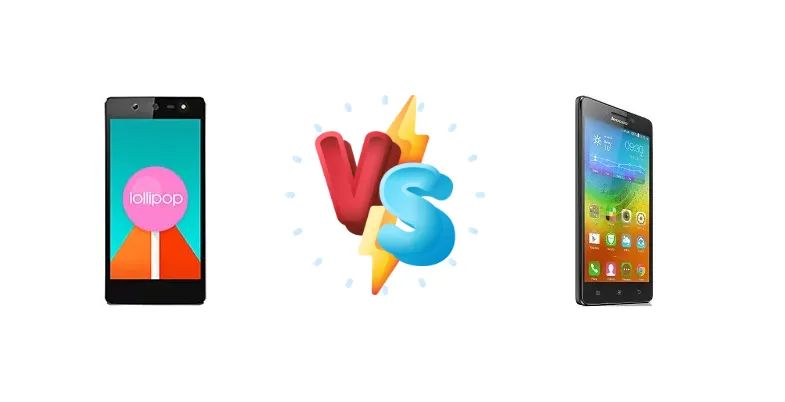
Released in a similar era of budget Android expansion, the Micromax Canvas Selfie 3 Q348 and Lenovo A6000 Plus represent competing strategies for capturing the entry-level smartphone market. While both aimed for affordability, they differed significantly in their core hardware, particularly in their choice of chipset. This comparison dissects those differences to determine which device offers the better experience for today’s user.
🏆 Quick Verdict
For the average user prioritizing responsiveness and future-proofing, the Lenovo A6000 Plus emerges as the better choice. Its Qualcomm Snapdragon 410 chipset, built on the Cortex-A53 architecture, provides a noticeable performance advantage over the Micromax’s older Cortex-A7 based Mediatek MT6582, despite a slightly lower clock speed.
| Network |
|---|
| 2G bands | GSM 850 / 900 / 1800 / 1900 - SIM 1 & SIM 2 | GSM 900 / 1800 / 1900 - SIM 1 & SIM 2 |
| 3G bands | HSDPA 900 / 2100 | HSDPA 2100 |
| 4G bands | - | 1, 3, 7, 20, 40 - Data only, no voice |
| Speed | HSPA 21.1/5.76 Mbps | HSPA, LTE Cat4 150/50 Mbps |
| Technology | GSM / HSPA | GSM / HSPA / LTE |
| Launch |
|---|
| Announced | 2015, August. Released 2015, August | 2015, April. Released 2015, April |
| Status | Discontinued | Discontinued |
| Body |
|---|
| Dimensions | 141 x 68.4 x 7.8 mm (5.55 x 2.69 x 0.31 in) | 141 x 70 x 8.2 mm (5.55 x 2.76 x 0.32 in) |
| SIM | Dual SIM | Dual SIM (Micro-SIM, dual stand-by) |
| Weight | 110 g (3.88 oz) | 128 g (4.52 oz) |
| Display |
|---|
| Protection | Corning Gorilla Glass 3 | - |
| Resolution | 720 x 1280 pixels, 16:9 ratio (~306 ppi density) | 720 x 1280 pixels, 16:9 ratio (~294 ppi density) |
| Size | 4.8 inches, 63.5 cm2 (~65.9% screen-to-body ratio) | 5.0 inches, 68.9 cm2 (~69.8% screen-to-body ratio) |
| Type | AMOLED | IPS LCD |
| Platform |
|---|
| CPU | Quad-core 1.3 GHz Cortex-A7 | Quad-core 1.2 GHz Cortex-A53 |
| Chipset | Mediatek MT6582 (28 nm) | Qualcomm MSM8916 Snapdragon 410 (28 nm) |
| GPU | Mali-400MP2 | Adreno 306 |
| OS | Android 5.0 (Lollipop) | Android 4.4.4 (KitKat), upgradable to 5.2 (Lollipop) |
| Memory |
|---|
| Card slot | microSDHC | microSDHC (dedicated slot) |
| Internal | 8GB 1GB RAM | 16GB 2GB RAM |
| | - | eMMC 4.5 |
| Main Camera |
|---|
| Features | LED flash | LED flash |
| Single | 8 MP, AF | 8 MP, f/2.2, AF |
| Video | 1080p@30fps | 720p@30fps |
| Selfie camera |
|---|
| Features | LED flash | - |
| Single | 8 MP | 2 MP |
| Sound |
|---|
| 3.5mm jack | Yes | Yes |
| 35mm jack | Yes | Yes |
| Loudspeaker | Yes | Yes, with stereo speakers |
| Comms |
|---|
| Bluetooth | 4.1, A2DP, LE | 4.0, A2DP |
| NFC | No | No |
| Positioning | GPS | GPS |
| Radio | FM radio | FM radio |
| USB | microUSB 2.0 | microUSB 2.0 |
| WLAN | Wi-Fi 802.11 b/g/n, hotspot | Wi-Fi 802.11 b/g/n, hotspot |
| Features |
|---|
| Sensors | Accelerometer, proximity | Accelerometer, proximity |
| Battery |
|---|
| Stand-by | Up to 275 h | Up to 264 h (2G) / Up to 264 h (3G) |
| Talk time | Up to 8 h 30 min | Up to 22 h (2G) / Up to 13 h (3G) |
| Type | Li-Ion 2300 mAh, non-removable | Li-Po 2300 mAh, removable |
| Misc |
|---|
| Colors | Black | Black, White, Yellow, Red |
| Price | - | About 110 EUR |
| SAR EU | 0.41 W/kg (head) 0.75 W/kg (body) | - |
Micromax Canvas Selfie 3 Q348
- Potentially lower price point (depending on current market)
- Focus on selfie camera (branding suggests)
- Simple and straightforward Android experience
- Older, less efficient processor (MT6582)
- Slower performance compared to Snapdragon 410
- Limited software update potential
Lenovo A6000 Plus
- More powerful and efficient Snapdragon 410 processor
- Better multitasking and app responsiveness
- Improved long-term software support
- May be slightly more expensive than the Micromax
- Camera performance likely similar to Micromax without detailed specs
- Basic display quality (typical of the price range)
Display Comparison
Neither device boasts a standout display. Given the context data focuses on the chipset, we can infer both likely utilized similar LCD panels common in this price bracket. The absence of information regarding resolution or brightness suggests neither phone aimed for visual fidelity. Bezels were likely substantial on both, typical of the era. Color accuracy would have been standard for budget displays, prioritizing cost over calibration.
Camera Comparison
Without detailed camera specifications, a direct comparison is difficult. However, given the target market, both phones likely featured basic camera sensors. The 'Selfie' branding of the Micromax suggests a focus on the front-facing camera, but image quality would have been heavily reliant on software processing. The Lenovo A6000 Plus, benefiting from Qualcomm’s image signal processor (ISP) within the Snapdragon 410, likely offered slightly better image processing capabilities, resulting in more detailed and accurate photos, even with similar sensor hardware. We can assume both phones would have struggled in low-light conditions.
Performance
The core difference lies in the chipsets. The Lenovo A6000 Plus’s Qualcomm MSM8916 Snapdragon 410, featuring quad-core Cortex-A53 processors, represents a significant architectural leap over the Micromax’s Mediatek MT6582 and its Cortex-A7 cores. Cortex-A53 cores offer improved instructions per clock (IPC) compared to A7, translating to better performance at the same clock speed. While the MT6582 has a slightly higher clock speed (1.3 GHz vs 1.2 GHz), the A53’s superior architecture provides a more fluid user experience, especially noticeable when multitasking or running more demanding apps. Both chipsets are fabricated on a 28nm process, meaning thermal efficiency is comparable, but the A53’s efficiency gains will still be present.
Battery Life
Battery life will depend heavily on usage patterns. Without knowing the battery capacity of either device, it’s difficult to make a definitive statement. However, the Snapdragon 410’s improved efficiency, stemming from the Cortex-A53 architecture, likely translates to slightly better battery life for the Lenovo A6000 Plus, even if the Micromax has a marginally larger battery. Charging speeds were likely similar – slow, by modern standards – given the lack of fast charging technology in this price segment.
Buying Guide
Buy the Micromax Canvas Selfie 3 Q348 if your primary need is a very basic smartphone for calls, texts, and light social media use, and you are on an extremely tight budget. Buy the Lenovo A6000 Plus if you prefer a smoother, more responsive experience for everyday tasks, occasional gaming, and a chipset that offers better long-term software compatibility and potential for custom ROM development.
Frequently Asked Questions
❓ Will the Lenovo A6000 Plus handle basic games like Candy Crush or Subway Surfers smoothly?
Yes, the Snapdragon 410 in the Lenovo A6000 Plus is capable of running less demanding games like Candy Crush and Subway Surfers without significant lag. While it won't handle graphically intensive titles, it provides a noticeably smoother experience than the Mediatek MT6582 in the Micromax Canvas Selfie 3 for casual gaming.
❓ Is the Micromax Canvas Selfie 3 a good option for someone who primarily uses WhatsApp and makes phone calls?
For basic communication tasks like WhatsApp and phone calls, the Micromax Canvas Selfie 3 is sufficient. However, be aware that the older processor may result in occasional slowdowns when switching between apps or opening multiple chats. The Lenovo A6000 Plus offers a more responsive experience even for these basic tasks.
❓ Can I expect to receive software updates on either of these phones?
Software update support for both devices is extremely limited at this point. However, the Lenovo A6000 Plus, benefiting from Qualcomm’s wider developer support, has a higher chance of receiving custom ROM updates from the Android developer community, extending its usable lifespan.