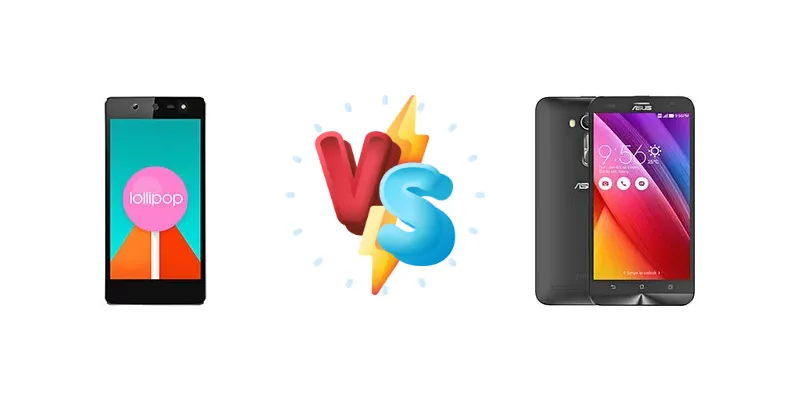
Released in a similar era of budget-focused Android devices, the Micromax Canvas Selfie 3 Q348 and the Asus Zenfone 2 Laser ZE550KL represent different approaches to delivering affordable smartphone experiences. The Canvas Selfie 3 prioritized a name-brand feature (selfie camera) while the Zenfone 2 Laser aimed for a more balanced package, including a potentially more powerful chipset. This comparison dissects their core components to determine which offers the best value today.
🏆 Quick Verdict
For the average user seeking a responsive and versatile experience, the Asus Zenfone 2 Laser ZE550KL is the superior choice. While the Canvas Selfie 3 might appeal to those solely focused on basic functionality, the Zenfone 2 Laser’s Snapdragon processor provides a noticeable performance boost and greater future-proofing.
| Network |
|---|
| 2G bands | GSM 850 / 900 / 1800 / 1900 - SIM 1 & SIM 2 | GSM 850 / 900 / 1800 / 1900 - SIM 1 & SIM 2 |
| 3G bands | HSDPA 900 / 2100 | HSDPA 850 / 900 / 1900 / 2100 - Global |
| 4G bands | - | 1, 2, 3, 5, 7, 8, 20 - Global |
| Speed | HSPA 21.1/5.76 Mbps | HSPA 42.2/5.76 Mbps, LTE Cat4 150/50 Mbps |
| Technology | GSM / HSPA | GSM / HSPA / LTE |
| | - | 1, 3, 38, 40, 41 - India |
| Launch |
|---|
| Announced | 2015, August. Released 2015, August | 2015, August. Released 2015, September |
| Status | Discontinued | Discontinued |
| Body |
|---|
| Dimensions | 141 x 68.4 x 7.8 mm (5.55 x 2.69 x 0.31 in) | 152.5 x 77.2 x 10.8 mm (6.00 x 3.04 x 0.43 in) |
| SIM | Dual SIM | Dual SIM (Micro-SIM, dual stand-by) |
| Weight | 110 g (3.88 oz) | 170 g (6.00 oz) |
| Display |
|---|
| Protection | Corning Gorilla Glass 3 | Corning Gorilla Glass 4 |
| Resolution | 720 x 1280 pixels, 16:9 ratio (~306 ppi density) | 720 x 1280 pixels, 16:9 ratio (~267 ppi density) |
| Size | 4.8 inches, 63.5 cm2 (~65.9% screen-to-body ratio) | 5.5 inches, 83.4 cm2 (~70.8% screen-to-body ratio) |
| Type | AMOLED | IPS LCD |
| Platform |
|---|
| CPU | Quad-core 1.3 GHz Cortex-A7 | Quad-core 1.2 GHz Cortex-A53Octa-core (4x1.5 GHz Cortex-A53 & 4x1.0 GHz Cortex-A53) |
| Chipset | Mediatek MT6582 (28 nm) | Qualcomm MSM8916 Snapdragon 410 (28 nm)Qualcomm MSM8939 Snapdragon 615 (28 nm) |
| GPU | Mali-400MP2 | Adreno 306Adreno 405 |
| OS | Android 5.0 (Lollipop) | Android 5.0 (Lollipop), upgradable to 6.0 (Marshmallow), ZenUI |
| Memory |
|---|
| Card slot | microSDHC | microSDXC (dedicated slot) |
| Internal | 8GB 1GB RAM | 16GB 2GB RAM, 32GB 3GB RAM |
| | - | eMMC 4.5 |
| Main Camera |
|---|
| Features | LED flash | Laser AF, Dual-LED dual-tone flash, panorama, HDR |
| Single | 8 MP, AF | 13 MP, f/2.0 |
| Video | 1080p@30fps | 1080p@30fps |
| Selfie camera |
|---|
| Features | LED flash | - |
| Single | 8 MP | 5 MP, f/2.0, AF |
| Sound |
|---|
| 3.5mm jack | Yes | Yes |
| 35mm jack | Yes | Yes |
| Loudspeaker | Yes | Yes |
| Comms |
|---|
| Bluetooth | 4.1, A2DP, LE | 4.0, A2DP, EDR |
| NFC | No | No |
| Positioning | GPS | GPS, GLONASS |
| Radio | FM radio | FM radio |
| USB | microUSB 2.0 | microUSB 2.0, OTG |
| WLAN | Wi-Fi 802.11 b/g/n, hotspot | Wi-Fi 802.11 b/g/n, Wi-Fi Direct, hotspot |
| Features |
|---|
| Sensors | Accelerometer, proximity | Accelerometer, gyro, proximity, compass |
| Battery |
|---|
| Stand-by | Up to 275 h | - |
| Talk time | Up to 8 h 30 min | - |
| Type | Li-Ion 2300 mAh, non-removable | Li-Po 3000 mAh, removable |
| Misc |
|---|
| Colors | Black | Black, White, Red, Silver, Gold |
| Models | - | Z00LD, Z00LDD |
| Price | - | About 220 EUR |
| SAR EU | 0.41 W/kg (head) 0.75 W/kg (body) | - |
Micromax Canvas Selfie 3 Q348
- Potentially lower price point
- Simple and straightforward user experience
- May have longer battery life due to less powerful processor (speculative)
- Significantly weaker performance
- Outdated chipset architecture
- Likely limited software support
Asus Zenfone 2 Laser ZE550KL
- More powerful Snapdragon processor options
- Laser autofocus for improved camera performance
- Better multitasking capabilities
- Potentially faster charging
- May be slightly more expensive
- Battery life could be shorter than Canvas Selfie 3 (depending on usage)
- Software updates may be limited due to age
Display Comparison
Neither device boasts a standout display. Both utilize a 28nm manufacturing process, suggesting similar power consumption profiles. Without specific display specs for the Canvas Selfie 3, it's difficult to make a direct comparison. However, the Zenfone 2 Laser’s availability with different chipset options (MSM8916 Snapdragon 410 or MSM8939 Snapdragon 615) suggests potential variations in display quality depending on the model. The Snapdragon 615 variant would likely have a more capable GPU for driving a higher resolution or refresh rate panel, if equipped. The Zenfone 2 Laser’s laser autofocus system, while primarily for the camera, hints at a focus on detail and clarity, potentially extending to the display panel.
Camera Comparison
The 'Selfie' in the Canvas Selfie 3’s name suggests a focus on the front-facing camera, but without specific details, it’s hard to assess its quality. The Zenfone 2 Laser, as the name implies, features laser autofocus, a technology designed to improve focusing speed and accuracy, particularly in low-light conditions. While sensor size and aperture are unknown for both devices, the laser autofocus system gives the Zenfone 2 Laser a clear advantage in capturing sharper, more detailed photos. The presence of a Snapdragon 615 variant in the Zenfone 2 Laser also suggests a more capable image signal processor (ISP) for better image processing.
Performance
The core difference lies in the chipsets. The Micromax Canvas Selfie 3’s Mediatek MT6582, with its quad-core 1.3 GHz Cortex-A7 CPU, is a significantly older and less powerful architecture than the Qualcomm Snapdragon options in the Zenfone 2 Laser. The Snapdragon 410 (quad-core 1.2 GHz Cortex-A53) offers improved CPU performance and a more modern architecture. Crucially, the Zenfone 2 Laser’s availability with the Snapdragon 615 (octa-core with Cortex-A53 cores clocked at 1.5 GHz and 1.0 GHz) provides a substantial leap in processing power, particularly for multi-tasking and more demanding applications. This architectural difference translates to a smoother user experience on the Zenfone 2 Laser, especially with the 615 variant.
Battery Life
Without battery capacity information for the Canvas Selfie 3, a direct comparison is challenging. Both chipsets are manufactured on a 28nm process, suggesting similar power efficiency. However, the Snapdragon 615, despite its higher performance, is known for its relatively efficient power management. The Zenfone 2 Laser’s potential for faster charging (depending on the included charger) could offset a slightly smaller battery capacity compared to the Canvas Selfie 3, offering quicker top-ups throughout the day.
Buying Guide
Buy the Micromax Canvas Selfie 3 Q348 if you need a very basic smartphone for essential tasks like calls, texts, and light social media, and are on an extremely tight budget. Buy the Asus Zenfone 2 Laser ZE550KL if you prioritize smoother multitasking, occasional gaming, and a more reliable overall experience, even if it means spending slightly more.
Frequently Asked Questions
❓ Is the Snapdragon 615 in the Zenfone 2 Laser prone to overheating during extended gaming sessions?
While the Snapdragon 615 is a capable processor, it was known to exhibit some thermal throttling under sustained heavy load. However, given the relatively low graphical demands of most mobile games at the time of release, and the phone's age, overheating is unlikely to be a major issue for casual gaming. The Zenfone 2 Laser's design likely incorporates basic thermal management to mitigate this.
❓ Does the Mediatek MT6582 in the Canvas Selfie 3 struggle with modern app performance?
Yes, the Mediatek MT6582 is a significantly outdated processor. Modern apps, even lightweight ones, are likely to exhibit noticeable lag and slowdowns on the Canvas Selfie 3. It's best suited for basic tasks like calls, texts, and simple web browsing.
❓ Which phone is more likely to receive software updates?
Neither phone is likely to receive significant software updates at this point, given their age. However, Asus generally provided slightly better software support than Micromax during the release period of these devices, so the Zenfone 2 Laser might have a marginally more up-to-date (though still likely outdated) Android version.