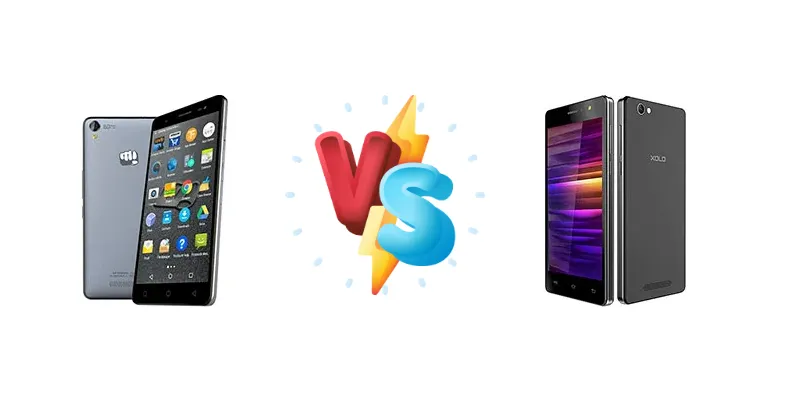
The Micromax Canvas Juice 3+ Q394 and XOLO Era 4G represent the ultra-budget end of the Android spectrum. Both devices aim to deliver essential smartphone functionality at the lowest possible price point, but they take different approaches to achieving this. This comparison dissects their core components to determine which offers the best value for users prioritizing affordability.
🏆 Quick Verdict
For the average user seeking a basic 4G smartphone, the XOLO Era 4G is the slightly better choice. Its Spreadtrum SC9830A chipset, clocked at 1.5 GHz, provides a noticeable performance advantage over the Micromax’s 1.3 GHz Mediatek MT6582M, translating to smoother app loading and multitasking, despite both being quad-core.
| Network |
|---|
| 2G bands | GSM 850 / 900 / 1800 / 1900 - SIM 1 & SIM 2 | GSM 900 / 1800 - SIM 1 & SIM 2 |
| 3G bands | HSDPA 900 / 2100 | HSDPA 900 / 2100 |
| 4G bands | - | 3, 5, 40 |
| Speed | HSPA | HSPA 21.1/5.76 Mbps |
| Technology | GSM / HSPA | GSM / HSPA / LTE |
| Launch |
|---|
| Announced | 2015, October. Released 2015, November | 2016, February. Released 2016, February |
| Status | Discontinued | Discontinued |
| Body |
|---|
| Dimensions | - | 145.5 x 72 x 8.5 mm (5.73 x 2.83 x 0.33 in) |
| SIM | Dual SIM (Micro-SIM, dual stand-by) | Dual SIM |
| Weight | 152 g (5.36 oz) | - |
| Display |
|---|
| Protection | Corning Gorilla Glass 3 | Corning Gorilla Glass |
| Resolution | 720 x 1280 pixels, 16:9 ratio (~267 ppi density) | 720 x 1280 pixels, 16:9 ratio (~294 ppi density) |
| Size | 5.5 inches, 83.4 cm2 | 5.0 inches, 68.9 cm2 (~65.8% screen-to-body ratio) |
| Type | IPS LCD | IPS LCD |
| Platform |
|---|
| CPU | Quad-core 1.3 GHz Cortex-A7 | Quad-core 1.5 GHz |
| Chipset | Mediatek MT6582M (28 nm) | Spreadtrum SC9830A |
| GPU | Mali-400MP2 | Mali-400MP2 |
| OS | Android 5.0 (Lollipop) | Android 5.1.1 (Lollipop), upgradable to 6.0 (Marshmallow) |
| Memory |
|---|
| Card slot | microSDHC | microSDHC |
| Internal | 16GB 2GB RAM | 8GB 1GB RAM |
| Main Camera |
|---|
| Features | LED flash | LED flash, panorama, HDR |
| Single | 8 MP, AF | 5 MP, AF |
| Video | 1080p@30fps | 1080p@30fps |
| Selfie camera |
|---|
| Features | - | LED flash |
| Single | 5 MP | 2 MP |
| Sound |
|---|
| 3.5mm jack | - | Yes |
| 35mm jack | Yes | Yes |
| Loudspeaker | Yes | Yes |
| Comms |
|---|
| Bluetooth | 3.0 | 4.0, A2DP |
| NFC | No | No |
| Positioning | GPS | GPS |
| Radio | FM radio | FM radio |
| USB | microUSB 2.0 | microUSB 2.0 |
| WLAN | Wi-Fi 802.11 b/g/n, hotspot | Wi-Fi 802.11 b/g/n, hotspot |
| Features |
|---|
| Sensors | Accelerometer, gyro, proximity, compass | Accelerometer, proximity |
| Battery |
|---|
| Stand-by | Up to 500 h | Up to 455 h (2G) / Up to 329 h (3G) |
| Talk time | Up to 12 h | Up to 13 h 30 min (2G) / Up to 10 h 45 min (3G) |
| Type | Li-Ion 4000 mAh, non-removable | Li-Po 2500 mAh, removable |
| Misc |
|---|
| Colors | Black | Black |
| SAR EU | - | 0.26 W/kg (head) 0.23 W/kg (body) |
Micromax Canvas Juice 3+ Q394
- Potentially better battery life due to chipset efficiency.
- Lower price point (likely).
- Reliable brand reputation in the Indian market.
- Slower processor performance.
- Likely less responsive user interface.
- Limited multitasking capabilities.
XOLO Era 4G
- Faster processor for smoother performance.
- More responsive user experience.
- Slightly better app loading times.
- Potentially shorter battery life.
- Spreadtrum chipsets sometimes have less software support.
- May be slightly more expensive.
Display Comparison
Neither device boasts a standout display. Given the context of these phones, we can assume both utilize basic IPS LCD panels with resolutions likely around 480x854. The lack of detailed display specs means a direct comparison is difficult, but the focus here is functionality over fidelity. Bezels are expected to be substantial on both, maximizing screen real estate within a compact form factor. Color accuracy and brightness are likely to be average, suitable for indoor use but potentially washed out in direct sunlight.
Camera Comparison
Camera performance on both devices will be limited. Without specific sensor details, it’s safe to assume both feature basic sensors, likely around 5MP or 8MP for the main camera. Image quality will be acceptable in good lighting conditions, but expect significant noise and lack of detail in low light. Any secondary cameras (likely a VGA front-facing camera) will be of very limited utility. The absence of Optical Image Stabilization (OIS) on either device means shaky hands will result in blurry photos.
Performance
The core difference lies in the chipsets. The XOLO Era 4G’s Spreadtrum SC9830A, with its 1.5 GHz quad-core CPU, offers a clear clock speed advantage over the Micromax Canvas Juice 3+’s Mediatek MT6582M (1.3 GHz). While both CPUs are based on the Cortex-A7 architecture, the higher clock speed of the Spreadtrum chip will result in faster processing of tasks. The Mediatek MT6582M, built on a 28nm process, is known for its power efficiency, potentially offsetting some of the performance gap. However, for everyday tasks like browsing, social media, and basic app usage, the XOLO will feel more responsive.
Battery Life
Battery life is a key consideration in this segment. While the exact battery capacities are unknown, the Mediatek MT6582M’s 28nm process is generally more power-efficient than the Spreadtrum SC9830A. This suggests the Micromax Canvas Juice 3+ Q394 might offer slightly longer battery life under similar usage conditions. However, the XOLO Era 4G’s faster processor could complete tasks quicker, potentially reducing overall screen-on time and mitigating the battery life difference. Charging speeds are likely to be slow on both devices, given the budget nature of the phones.
Buying Guide
Buy the Micromax Canvas Juice 3+ Q394 if you prioritize a potentially longer-lasting battery life due to the Mediatek chipset's known power efficiency, and are comfortable with a slightly slower overall experience. Buy the XOLO Era 4G if you prefer a more responsive user interface and slightly faster app performance, even if it means potentially sacrificing a small amount of battery endurance. Both are ideal for first-time smartphone users or those needing a reliable secondary device.
Frequently Asked Questions
❓ Will the XOLO Era 4G struggle with popular apps like WhatsApp and Facebook?
While the XOLO Era 4G won't offer a flagship-level experience, its 1.5 GHz quad-core processor should handle WhatsApp and Facebook reasonably well. Expect some loading times and occasional lag when multitasking, but it's sufficient for basic social media usage. The Micromax Juice 3+ will likely be slower.
❓ Is the Spreadtrum SC9830A chipset known for overheating?
The Spreadtrum SC9830A is a low-power chipset and generally doesn't suffer from significant overheating issues. It's designed for basic tasks and isn't likely to be pushed to its thermal limits. However, prolonged gaming or intensive multitasking could lead to some warmth.
❓ Can either of these phones handle basic mobile gaming?
Both phones can handle very basic 2D games. However, demanding 3D games will likely be unplayable or suffer from extremely low frame rates. The XOLO Era 4G's faster processor will provide a slightly better gaming experience, but don't expect anything beyond casual gaming.