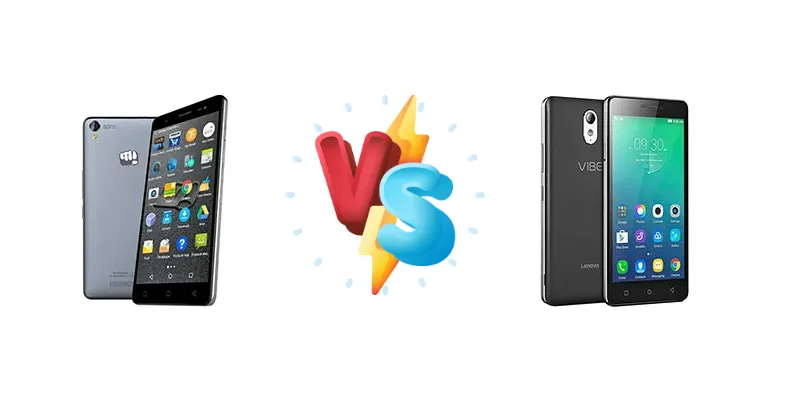
Both the Micromax Canvas Juice 3+ Q394 and the Lenovo Vibe P1m targeted the budget-conscious smartphone user, but with slightly different approaches. The Juice 3+ prioritized a large battery capacity, while the P1m focused on faster charging and a more modern chipset. This comparison dissects their key differences to determine which offers the best value in 2024.
🏆 Quick Verdict
For the average user prioritizing quick top-ups and a slightly smoother experience, the Lenovo Vibe P1m is the better choice. Its MT6735P chipset and 15W charging offer a noticeable advantage over the Micromax Canvas Juice 3+'s older MT6582M and slower charging, despite the Juice 3+'s potentially larger battery capacity.
| Network |
|---|
| 2G bands | GSM 850 / 900 / 1800 / 1900 - SIM 1 & SIM 2 | GSM 850 / 900 / 1800 / 1900 - SIM 1 & SIM 2 |
| 3G bands | HSDPA 900 / 2100 | HSDPA 900 / 2100 |
| 4G bands | - | 1, 3, 5, 7, 8, 20, 40 |
| Speed | HSPA | HSPA, LTE Cat4 150/50 Mbps |
| Technology | GSM / HSPA | GSM / HSPA / LTE |
| Launch |
|---|
| Announced | 2015, October. Released 2015, November | 2015, September. Released 2015, October |
| Status | Discontinued | Discontinued |
| Body |
|---|
| Dimensions | - | 141 x 71.8 x 9.3 mm (5.55 x 2.83 x 0.37 in) |
| SIM | Dual SIM (Micro-SIM, dual stand-by) | Dual SIM (Micro-SIM, dual stand-by) |
| Weight | 152 g (5.36 oz) | 148 g (5.22 oz) |
| Display |
|---|
| Protection | Corning Gorilla Glass 3 | - |
| Resolution | 720 x 1280 pixels, 16:9 ratio (~267 ppi density) | 720 x 1280 pixels, 16:9 ratio (~294 ppi density) |
| Size | 5.5 inches, 83.4 cm2 | 5.0 inches, 68.9 cm2 (~68.1% screen-to-body ratio) |
| Type | IPS LCD | IPS LCD |
| Platform |
|---|
| CPU | Quad-core 1.3 GHz Cortex-A7 | Quad-core 1.0 GHz Cortex-A53 |
| Chipset | Mediatek MT6582M (28 nm) | Mediatek MT6735P (28 nm) |
| GPU | Mali-400MP2 | Mali-T720MP2 |
| OS | Android 5.0 (Lollipop) | Android 5.1 (Lollipop) |
| Memory |
|---|
| Card slot | microSDHC | microSDHC (dedicated slot) |
| Internal | 16GB 2GB RAM | 16GB 2GB RAM |
| Main Camera |
|---|
| Features | LED flash | LED flash |
| Single | 8 MP, AF | 8 MP, f/2.2, AF |
| Video | 1080p@30fps | 720p@30fps |
| Selfie camera |
|---|
| Single | 5 MP | 5 MP |
| Video | - | 720p |
| Sound |
|---|
| 3.5mm jack | - | Yes |
| 35mm jack | Yes | Yes |
| Loudspeaker | Yes | Yes |
| Comms |
|---|
| Bluetooth | 3.0 | 4.1, A2DP, LE |
| NFC | No | No |
| Positioning | GPS | GPS |
| Radio | FM radio | FM radio |
| USB | microUSB 2.0 | microUSB 2.0, OTG |
| WLAN | Wi-Fi 802.11 b/g/n, hotspot | Wi-Fi 802.11 b/g/n, hotspot |
| Features |
|---|
| Sensors | Accelerometer, gyro, proximity, compass | Accelerometer, proximity |
| Battery |
|---|
| Charging | - | 15W wired |
| Stand-by | Up to 500 h | Up to 456 h (2G) / Up to 566 h (3G) |
| Talk time | Up to 12 h | Up to 36 h (2G) / Up to 16 h (3G) |
| Type | Li-Ion 4000 mAh, non-removable | Li-Po 4000 mAh, non-removable |
| Misc |
|---|
| Colors | Black | Onyx Black, Pearl White |
| Models | - | P1ma40 |
| Price | - | About 110 EUR |
Micromax Canvas Juice 3+ Q394
- Potentially longer battery life due to larger capacity (estimated)
- Lower price point (likely)
- Simple and straightforward user experience
- Outdated processor architecture (Cortex-A7)
- Slower charging speeds
- Limited performance for demanding apps
Lenovo Vibe P1m
- More modern processor (Cortex-A53)
- Faster 15W charging
- Better overall performance and responsiveness
- Potentially shorter battery life compared to Juice 3+
- May be slightly more expensive
- Basic camera capabilities
Display Comparison
Neither device is known for display prowess. Both likely feature basic IPS LCD panels, but specific details like resolution and brightness are unavailable. The focus here is clearly not on visual fidelity. The absence of information suggests both displays are adequate for basic tasks but won't impress users accustomed to higher-end screens.
Camera Comparison
Camera performance on both devices is expected to be basic. Without specific sensor details, it’s safe to assume both rely on low-resolution sensors. The focus is likely on capturing passable images in good lighting conditions. Any claims of advanced features like HDR or panorama should be viewed with skepticism. The absence of Optical Image Stabilization (OIS) on either device suggests image quality will suffer in low-light scenarios.
Performance
The Lenovo Vibe P1m’s Mediatek MT6735P represents a significant architectural leap over the Micromax Canvas Juice 3+’s MT6582M. While both are quad-core processors, the MT6735P utilizes the more efficient Cortex-A53 architecture, compared to the older Cortex-A7 in the Juice 3+. This translates to better performance per clock cycle and improved power efficiency. The MT6735P also supports 64-bit computing, offering compatibility with a wider range of apps and future software updates. The 1.0 GHz clock speed on the P1m is lower than the 1.3 GHz on the Juice 3+, but the architectural improvements more than compensate for this difference. Users will experience noticeably smoother multitasking and app loading times on the P1m.
Battery Life
While the Micromax Canvas Juice 3+ likely boasts a larger battery capacity (specific mAh is unavailable), the Lenovo Vibe P1m’s 15W wired charging is a game-changer. The MT6735P chipset is also more power-efficient, mitigating some of the potential battery life advantage of the Juice 3+. The P1m’s faster charging allows for quick top-ups, reducing downtime and making it more convenient for users on the go. A full charge on the Juice 3+ will likely take significantly longer, even with a larger battery.
Buying Guide
Buy the Micromax Canvas Juice 3+ Q394 if you absolutely need the longest possible runtime on a single charge and are willing to sacrifice performance and charging speed. It's ideal for users who frequently find themselves away from power outlets for extended periods. Buy the Lenovo Vibe P1m if you prefer a more responsive user experience, faster charging, and a chipset capable of handling slightly more demanding tasks, even if it means slightly less overall battery endurance.
Frequently Asked Questions
❓ Will the Lenovo Vibe P1m struggle with modern apps like WhatsApp and Facebook?
While the MT6735P isn't a powerhouse, it's capable of running essential apps like WhatsApp and Facebook smoothly. The Cortex-A53 architecture provides sufficient performance for these everyday tasks. However, expect some slowdowns with multiple apps open simultaneously.
❓ How long will it take to fully charge the Lenovo Vibe P1m with the 15W charger?
With the included 15W charger, the Lenovo Vibe P1m should fully charge from 0% to 100% in approximately 2.5 to 3 hours. This is significantly faster than the Micromax Canvas Juice 3+, which will likely take 4+ hours due to its slower charging capabilities.
❓ Is the Micromax Canvas Juice 3+ a good choice for gaming?
The Micromax Canvas Juice 3+ is not recommended for gaming. The MT6582M processor and limited GPU power will struggle with even basic games. Expect low frame rates and frequent lag. The Lenovo Vibe P1m offers a slightly better gaming experience, but it's still not ideal for demanding titles.
❓ Does the Lenovo Vibe P1m support 4G LTE connectivity?
Yes, the Mediatek MT6735P chipset in the Lenovo Vibe P1m supports 4G LTE connectivity, allowing for faster data speeds compared to the Micromax Canvas Juice 3+, which likely only supports 3G.