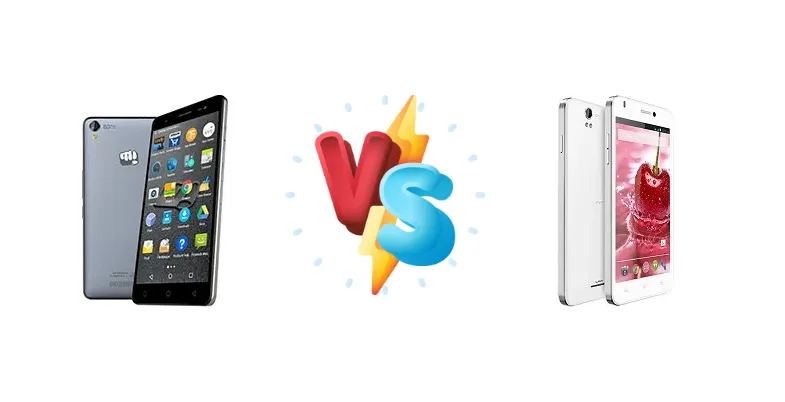
The Micromax Canvas Juice 3+ Q394 and Lava Iris X1 Grand represent a segment of the smartphone market increasingly focused on affordability. Both devices target first-time smartphone buyers or those seeking a reliable secondary device. With identical Mediatek MT6582M chipsets, the differences lie in potential software optimizations, battery capacity (assumed, given the 'Juice' branding of the Micromax), and overall user experience. This comparison aims to dissect these nuances.
🏆 Quick Verdict
For the average user prioritizing battery life and a potentially cleaner software experience, the Micromax Canvas Juice 3+ Q394 emerges as the slightly better choice. While performance is identical, Micromax's history with larger batteries in the 'Juice' line suggests a longer-lasting device, crucial for users in areas with limited charging access.
| Network |
|---|
| 2G bands | GSM 850 / 900 / 1800 / 1900 - SIM 1 & SIM 2 | GSM 900 / 1800 - SIM 1 & SIM 2 |
| 3G bands | HSDPA 900 / 2100 | HSDPA 2100 |
| Speed | HSPA | HSPA |
| Technology | GSM / HSPA | GSM / HSPA |
| Launch |
|---|
| Announced | 2015, October. Released 2015, November | 2015, January. Released 2015, January |
| Status | Discontinued | Discontinued |
| Body |
|---|
| Dimensions | - | 144 x 72 x 9.2 mm (5.67 x 2.83 x 0.36 in) |
| SIM | Dual SIM (Micro-SIM, dual stand-by) | Dual SIM |
| Weight | 152 g (5.36 oz) | 152 g (5.36 oz) |
| Display |
|---|
| Protection | Corning Gorilla Glass 3 | - |
| Resolution | 720 x 1280 pixels, 16:9 ratio (~267 ppi density) | 480 x 854 pixels, 16:9 ratio (~196 ppi density) |
| Size | 5.5 inches, 83.4 cm2 | 5.0 inches, 68.9 cm2 (~66.4% screen-to-body ratio) |
| Type | IPS LCD | IPS LCD |
| Platform |
|---|
| CPU | Quad-core 1.3 GHz Cortex-A7 | Quad-core 1.3 GHz Cortex-A7 |
| Chipset | Mediatek MT6582M (28 nm) | Mediatek MT6582M (28 nm) |
| GPU | Mali-400MP2 | Mali-400MP2 |
| OS | Android 5.0 (Lollipop) | Android 4.4.2 (KitKat), upgradable to 5.0 (Lollipop) |
| Memory |
|---|
| Card slot | microSDHC | microSDHC |
| Internal | 16GB 2GB RAM | 8GB 1GB RAM |
| Main Camera |
|---|
| Features | LED flash | Dual-LED flash |
| Single | 8 MP, AF | 8 MP, AF |
| Video | 1080p@30fps | 1080p@30fps |
| Selfie camera |
|---|
| Single | 5 MP | 2 MP |
| Sound |
|---|
| 3.5mm jack | - | Yes |
| 35mm jack | Yes | Yes |
| Loudspeaker | Yes | Yes, dual speakers |
| Comms |
|---|
| Bluetooth | 3.0 | 4.0, LE |
| NFC | No | No |
| Positioning | GPS | A-GPS |
| Radio | FM radio | FM radio, recording |
| USB | microUSB 2.0 | microUSB 2.0 |
| WLAN | Wi-Fi 802.11 b/g/n, hotspot | Wi-Fi 802.11 b/g/n |
| Features |
|---|
| Sensors | Accelerometer, gyro, proximity, compass | Accelerometer, proximity |
| Battery |
|---|
| Stand-by | Up to 500 h | Up to 200 h (3G) |
| Talk time | Up to 12 h | Up to 10 h (3G) |
| Type | Li-Ion 4000 mAh, non-removable | Li-Po 2200 mAh, removable |
| Misc |
|---|
| Colors | Black | Black-gold, White-silver, White-gold |
| Price | - | About 110 EUR |
Micromax Canvas Juice 3+ Q394
- Potentially larger battery capacity (based on 'Juice' branding)
- Likely optimized for longer battery life
- Affordable price point
- Limited processing power for demanding tasks
- Low-resolution camera sensors
Lava Iris X1 Grand
- Established brand presence in India
- Straightforward Android experience
- Affordable price point
- Likely smaller battery capacity
- Limited processing power for demanding tasks
Display Comparison
Both the Micromax Canvas Juice 3+ Q394 and Lava Iris X1 Grand likely feature similar LCD panels, given their price point. Expect resolutions around 480x854 pixels. Without specific nit brightness data, it's reasonable to assume both displays will struggle in direct sunlight. The 28nm chipset suggests limited graphical power, meaning neither phone is ideal for graphically intensive tasks on the display. Bezels are expected to be substantial on both devices, reflecting their budget nature.
Camera Comparison
Camera performance on both devices will be limited. While specifications aren't provided, budget phones in this segment typically feature low-resolution sensors (likely 5MP or 8MP main cameras). Image quality will be acceptable in good lighting conditions, but will suffer significantly in low light. Any secondary cameras (often 2MP or VGA) are primarily for adding features like depth sensing or macro photography, but their image quality will be poor. Expect limited image processing capabilities.
Performance
The core of both devices is the Mediatek MT6582M chipset, featuring a quad-core 1.3 GHz Cortex-A7 CPU. This chipset is designed for basic Android functionality and will handle tasks like calling, texting, and light app usage adequately. However, demanding games or multitasking will likely result in noticeable lag. The 28nm manufacturing process is relatively mature, but doesn't offer the efficiency of newer nodes. RAM capacity is a critical unknown; lower RAM (likely 512MB or 1GB) will severely impact multitasking performance on both devices.
Battery Life
The Micromax Canvas Juice 3+ Q394, with its 'Juice' branding, strongly suggests a larger battery capacity than the Lava Iris X1 Grand. While specific mAh figures are unavailable, Micromax has historically prioritized battery life in this series. The MT6582M chipset is relatively power-efficient, but a larger battery will translate to longer usage times. Charging speeds are likely to be slow on both devices, given the lack of fast charging support. Expect 0-100% charge times to be several hours.
Buying Guide
Buy the Micromax Canvas Juice 3+ Q394 if you need a phone that can reliably last through a full day of moderate use, and value a potentially larger battery capacity. Buy the Lava Iris X1 Grand if you prefer a brand with a more established presence in the Indian market and are looking for a straightforward, no-frills Android experience. Both are suitable for basic communication, social media, and light web browsing.
Frequently Asked Questions
❓ Will the Mediatek MT6582M chipset struggle with popular apps like WhatsApp and Facebook?
While the MT6582M can run WhatsApp and Facebook, expect some lag when scrolling through image-heavy feeds or switching between apps. These apps are optimized for low-end hardware, but the chipset's limitations will be noticeable with prolonged use.
❓ Is the camera quality sufficient for casual social media sharing?
The camera quality will be adequate for casual social media sharing in good lighting conditions. However, expect images to be soft and lack detail, especially in low light. Don't expect professional-quality photos.
❓ What Android version do these phones likely run, and will they receive updates?
These phones likely run Android Go Edition, a lightweight version of Android designed for devices with limited RAM. Updates are unlikely to be frequent or guaranteed, given the budget nature of these devices.