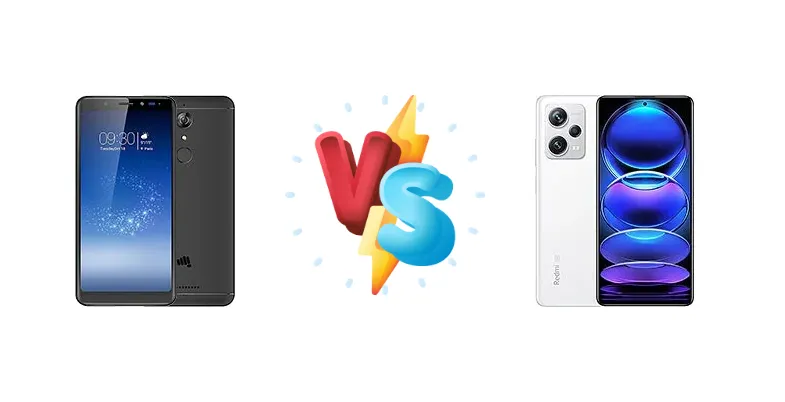
The smartphone landscape is crowded with options, especially in the budget segment. We're pitting the Micromax Canvas Infinity, a veteran of affordable Android, against the Xiaomi Redmi Note 12 Pro+, a newer contender boasting impressive specs like 120W charging and a high-resolution camera. This comparison aims to determine which device delivers the best value for your money.
🏆 Quick Verdict
For the average user prioritizing speed, camera quality, and future-proofing, the Xiaomi Redmi Note 12 Pro+ is the clear winner. Its Dimensity 1080 chipset and 120W charging offer a significantly improved experience, justifying the higher price tag. However, the Canvas Infinity remains a viable option for basic smartphone needs.
| Network |
|---|
| 2G bands | GSM 850 / 900 / 1800 / 1900 - SIM 1 & SIM 2 | GSM 850 / 900 / 1800 / 1900 - SIM 1 & SIM 2 |
| 3G bands | HSDPA 850 / 900 / 1900 / 2100 | HSDPA 800 / 850 / 900 / 1900 / 2100 |
| 4G bands | 3, 5, 40 | 1, 3, 5, 8, 19, 34, 38, 39, 40, 41 - International, China |
| 5G bands | - | 1, 3, 5, 8, 28, 38, 40, 41, 77, 78 SA/NSA - International |
| Speed | HSPA 42.2/5.76 Mbps, LTE Cat4 150/50 Mbps | HSPA, LTE-A (CA), 5G |
| Technology | GSM / HSPA / LTE | GSM / CDMA / HSPA / EVDO / LTE / 5G |
| | - | 1, 3, 5, 8, 28, 38, 41, 77, 78 SA/NSA - China |
| Launch |
|---|
| Announced | 2017, August. Released 2017, September | 2022, October 27 |
| Status | Discontinued | Available. Released 2022, November 01 |
| Body |
|---|
| Build | Glass front, aluminum back, aluminum frame | Glass front (Gorilla Glass 5), glass back |
| Dimensions | 152 x 73 x 9 mm (5.98 x 2.87 x 0.35 in) | 162.9 x 76 x 8.9 mm (6.41 x 2.99 x 0.35 in) |
| SIM | Dual SIM (Micro-SIM, dual stand-by) | Dual SIM (Nano-SIM, dual stand-by) |
| Weight | 160 g (5.64 oz) | 208.4 g (7.34 oz) |
| | - | IP53, dust and splash resistant |
| Display |
|---|
| Protection | - | Corning Gorilla Glass 5 |
| Resolution | 720 x 1440 pixels, 18:9 ratio (~279 ppi density) | 1080 x 2400 pixels, 20:9 ratio (~395 ppi density) |
| Size | 5.7 inches, 85.7 cm2 (~77.2% screen-to-body ratio) | 6.67 inches, 107.4 cm2 (~86.8% screen-to-body ratio) |
| Type | IPS LCD | OLED, 1B colors, 120Hz, Dolby Vision, HDR10+, 500 nits (typ), 900 nits (HBM) |
| Platform |
|---|
| CPU | Quad-core 1.4 GHz Cortex-A53 | Octa-core (2x2.6 GHz Cortex-A78 & 6x2.0 GHz Cortex-A55) |
| Chipset | Qualcomm MSM8917 Snapdragon 425 (28 nm) | Mediatek MT6877V Dimensity 1080 (6 nm) |
| GPU | Adreno 308 | Mali-G68 MC4 |
| OS | Android 7.1.2 (Nougat), upgradable to Android 8.0 (Oreo) | Android 12, MIUI 13 |
| Memory |
|---|
| Card slot | microSDXC (dedicated slot) | No |
| Internal | 32GB 3GB RAM | 256GB 8GB RAM, 256GB 12GB RAM |
| | eMMC 5.1 | UFS 2.2 |
| Main Camera |
|---|
| Features | LED flash, auto-HDR | Dual-LED dual-tone flash, HDR, panorama |
| Single | 13 MP, f/2.0, 1/3.1", 1.12µm, AF | - |
| Triple | - | 200 MP, f/1.7, 24mm (wide), 1/1.4", 0.56µm, PDAF, OIS
8 MP, f/2.2, 120˚ (ultrawide), 1/4", 1.12µm
2 MP, f/2.4, (macro) |
| Video | 1080p@30fps | 4K@30fps, 1080p@30/60/120fps, 720p@960fps |
| Selfie camera |
|---|
| Features | LED flash | HDR |
| Single | 16 MP, f/2.0, 26mm (wide), 1/3.06", 1.0µm, AF | 16 MP, f/2.5, (wide), 1/3.06", 1.0µm |
| Video | 1080p@30fps | 1080p@30/60fps |
| Sound |
|---|
| 3.5mm jack | Yes | Yes |
| 35mm jack | Yes | - |
| Loudspeaker | Yes | Yes, with stereo speakers |
| | - | 24-bit/192kHz audio |
| Comms |
|---|
| Bluetooth | 4.1, A2DP | 5.2, A2DP, LE |
| Infrared port | - | Yes |
| NFC | No | Yes (market/region dependent) |
| Positioning | GPS | GPS (L1), GLONASS (G1), BDS (B1I+B1c), GALILEO (E1), QZSS (L1) |
| Radio | FM radio | No |
| USB | microUSB 2.0, OTG | USB Type-C 2.0, OTG |
| WLAN | Wi-Fi 802.11 b/g/n | Wi-Fi 802.11 a/b/g/n/ac/6, dual-band, Wi-Fi Direct |
| Features |
|---|
| Sensors | Fingerprint (rear-mounted), accelerometer, proximity | Fingerprint (side-mounted), accelerometer, proximity, gyro, compass |
| Battery |
|---|
| Charging | - | 120W wired, PD3.0, 100% in 19 min (advertised) |
| Stand-by | Up to 420 h (3G) | - |
| Talk time | Up to 20 h (3G) | - |
| Type | Li-Ion 2980 mAh, removable | Li-Po 5000 mAh, non-removable |
| Misc |
|---|
| Colors | Black | Arctic White, Iceberg Blue, Obsidian Black, Trend edition |
| Models | HS2 | 22101316UCP, 22101316UG |
| Price | About 10000 INR | $ 348.00 / £ 439.00 / € 399.00 / ₹ 29,949 |
| Tests |
|---|
| Battery life | - |
Endurance rating 88h
|
| Camera | - |
Photo / Video |
| Display | - |
Contrast ratio: Infinite (nominal) |
| Loudspeaker | - |
-26.7 LUFS (Good)
|
| Performance | - |
AnTuTu: 498710 (v9)
GeekBench: 2208 (v5.1), 2372 (v6)
GFXBench: 22fps (ES 3.1 onscreen) |
Micromax Canvas Infinity
- Extremely affordable price point
- Functional for basic smartphone tasks
- Reliable for calls and texts
- Outdated processor and limited performance
- Likely poor camera quality
- Slow charging speeds (assumed)
Xiaomi Redmi Note 12 Pro+
- Fast 120W charging
- Powerful Dimensity 1080 processor
- Likely superior camera system
- Long battery endurance (88h)
- Higher price compared to Canvas Infinity
- May be overkill for basic users
- Software bloat (typical of Xiaomi)
Display Comparison
The Redmi Note 12 Pro+ boasts an 'Infinite' contrast ratio (nominal), suggesting a vibrant display, though specific brightness nits aren't provided. The Canvas Infinity's display specifications are absent, implying a standard LCD panel. The Redmi Note 12 Pro+'s likely AMOLED panel, combined with its higher contrast, will deliver superior color reproduction and deeper blacks, benefiting media consumption. The lack of information on the Canvas Infinity suggests a significantly less immersive viewing experience.
Camera Comparison
While the Redmi Note 12 Pro+ advertises a photo/video capability, specific sensor details are missing. However, the presence of a 'Pro+' designation suggests a more advanced camera system than the Canvas Infinity. The Canvas Infinity's camera specs are unavailable, but given its price point, it likely features a basic sensor. The Redmi Note 12 Pro+'s likely larger sensor and potentially OIS (Optical Image Stabilization) will result in better low-light performance and sharper images. The absence of detailed camera information for the Canvas Infinity suggests it won't compete in image quality.
Performance
The performance gap is substantial. The Micromax Canvas Infinity relies on the Qualcomm MSM8917 Snapdragon 425, a quad-core Cortex-A53 processor built on a 28nm node. This is a decidedly entry-level chipset. Conversely, the Xiaomi Redmi Note 12 Pro+ features the Mediatek MT6877V Dimensity 1080, an octa-core processor with a mix of Cortex-A78 and A55 cores fabricated on a more efficient 6nm process. The Dimensity 1080's architecture and smaller node translate to significantly faster processing speeds, smoother multitasking, and improved gaming performance. The Redmi Note 12 Pro+ will handle demanding apps and games with ease, while the Canvas Infinity will struggle with anything beyond basic tasks.
Battery Life
The Redmi Note 12 Pro+’s standout feature is its 120W wired charging, capable of a full charge in a claimed 19 minutes. This is a game-changer for users who need to quickly top up their battery. The Canvas Infinity’s battery capacity and charging speed are unknown, but it’s safe to assume it will be significantly slower. The Redmi Note 12 Pro+’s endurance rating of 88 hours suggests a well-optimized battery life, despite the power-hungry charging capabilities. The faster charging and potentially larger battery of the Redmi Note 12 Pro+ provide a significant convenience advantage.
Buying Guide
Buy the Micromax Canvas Infinity if you need a functional, extremely affordable smartphone for basic tasks like calls, texts, and light social media. It's ideal for first-time smartphone users or as a reliable backup device. Buy the Xiaomi Redmi Note 12 Pro+ if you prioritize performance for gaming and multitasking, demand fast charging, and want a versatile camera system capable of capturing detailed photos and videos. It's suited for users who actively use their phones throughout the day and value a premium experience.
Frequently Asked Questions
❓ Is the Dimensity 1080 in the Redmi Note 12 Pro+ powerful enough for demanding games like Genshin Impact?
Yes, the Dimensity 1080 is a capable mid-range processor that can handle Genshin Impact and other demanding games at medium to high settings. While it won't match the performance of flagship chips, it provides a smooth and enjoyable gaming experience.
❓ How does the 120W charging of the Redmi Note 12 Pro+ affect battery health over time?
While extremely fast charging can theoretically degrade battery health faster, Xiaomi implements charging management algorithms to mitigate this effect. The Redmi Note 12 Pro+ utilizes technologies to optimize charging speed and reduce heat, minimizing long-term battery degradation. However, some degradation is inevitable with any rechargeable battery.
❓ Given the Canvas Infinity's age, will it receive future Android updates?
It's highly unlikely the Micromax Canvas Infinity will receive any further Android updates. Its age and the manufacturer's update track record suggest it's stuck on its original Android version. This is a significant drawback compared to the Redmi Note 12 Pro+, which will likely receive at least one major Android update.