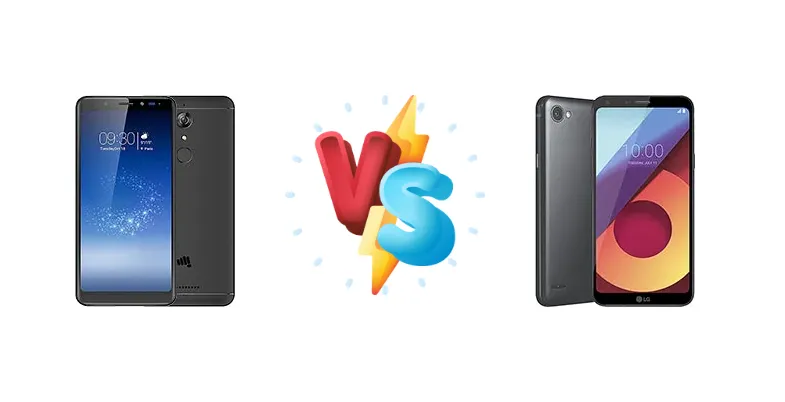
The Micromax Canvas Infinity and LG Q6 represent a segment of the market focused on delivering smartphone functionality at an extremely accessible price point. Both devices launched aiming to provide a solid experience without breaking the bank, but they take different approaches to achieving this. This comparison dives deep into their specifications to determine which offers the best value.
🏆 Quick Verdict
For the average user prioritizing responsiveness and a slightly smoother experience, the LG Q6 emerges as the better choice. Its octa-core Snapdragon 435 chipset provides a noticeable performance advantage over the Canvas Infinity’s quad-core Snapdragon 425, making everyday tasks and light multitasking more fluid.
| Network |
|---|
| 2G bands | GSM 850 / 900 / 1800 / 1900 - SIM 1 & SIM 2 | GSM 850 / 900 / 1800 / 1900 - SIM 1 & SIM 2 (dual-SIM model only) |
| 3G bands | HSDPA 850 / 900 / 1900 / 2100 | HSDPA 850 / 900 / 1900 / 2100 |
| 4G bands | 3, 5, 40 | 1, 3, 4, 5, 7, 8, 12, 17, 20, 28, 38 |
| Speed | HSPA 42.2/5.76 Mbps, LTE Cat4 150/50 Mbps | HSPA 42.2/5.76 Mbps, LTE (2CA) Cat7 300/100 Mbps |
| Technology | GSM / HSPA / LTE | GSM / HSPA / LTE |
| Launch |
|---|
| Announced | 2017, August. Released 2017, September | 2017, July. Released 2017, August |
| Status | Discontinued | Discontinued |
| Body |
|---|
| Build | Glass front, aluminum back, aluminum frame | Glass front (Gorilla Glass 3), plastic back, aluminum frame |
| Dimensions | 152 x 73 x 9 mm (5.98 x 2.87 x 0.35 in) | 142.5 x 69.3 x 8.1 mm (5.61 x 2.73 x 0.32 in) |
| SIM | Dual SIM (Micro-SIM, dual stand-by) | · Nano-SIM· Nano-SIM + Nano-SIM |
| Weight | 160 g (5.64 oz) | 149 g (5.26 oz) |
| | - | MIL-STD-810G compliant*
*does not guarantee ruggedness or use in extreme conditions |
| Display |
|---|
| Protection | - | Corning Gorilla Glass 3 |
| Resolution | 720 x 1440 pixels, 18:9 ratio (~279 ppi density) | 1080 x 2160 pixels, 18:9 ratio (~442 ppi density) |
| Size | 5.7 inches, 85.7 cm2 (~77.2% screen-to-body ratio) | 5.5 inches, 77.0 cm2 (~78.0% screen-to-body ratio) |
| Type | IPS LCD | IPS LCD |
| Platform |
|---|
| CPU | Quad-core 1.4 GHz Cortex-A53 | Octa-core 1.4 GHz Cortex-A53 |
| Chipset | Qualcomm MSM8917 Snapdragon 425 (28 nm) | Qualcomm MSM8940 Snapdragon 435 (28 nm) |
| GPU | Adreno 308 | Adreno 505 |
| OS | Android 7.1.2 (Nougat), upgradable to Android 8.0 (Oreo) | Android 7.1.1 (Nougat), upgradable to Android 8.0 (Oreo), LG UI 5.0 |
| Memory |
|---|
| Card slot | microSDXC (dedicated slot) | microSDXC (dedicated slot) |
| Internal | 32GB 3GB RAM | 16GB 2GB RAM, 32GB 3GB RAM, 64GB 4GB RAM |
| | eMMC 5.1 | eMMC 5.1 |
| Main Camera |
|---|
| Features | LED flash, auto-HDR | LED flash, panorama |
| Single | 13 MP, f/2.0, 1/3.1", 1.12µm, AF | 13 MP, f/2.2, 1/3.1", 1.12µm, AF |
| Video | 1080p@30fps | 1080p@30fps |
| Selfie camera |
|---|
| Features | LED flash | - |
| Single | 16 MP, f/2.0, 26mm (wide), 1/3.06", 1.0µm, AF | 5 MP, f/2.2, 1/5.0", 1.12µm |
| Video | 1080p@30fps | - |
| Sound |
|---|
| 3.5mm jack | Yes | Yes |
| 35mm jack | Yes | Yes |
| Loudspeaker | Yes | Yes |
| Comms |
|---|
| Bluetooth | 4.1, A2DP | 4.2, A2DP, LE |
| NFC | No | Yes (market dependent) |
| Positioning | GPS | GPS, GLONASS |
| Radio | FM radio | Stereo FM radio with RDS |
| USB | microUSB 2.0, OTG | microUSB 2.0, OTG |
| WLAN | Wi-Fi 802.11 b/g/n | Wi-Fi 802.11 b/g/n, Wi-Fi Direct |
| Features |
|---|
| Browser | - | HTML, Adobe Flash |
| Sensors | Fingerprint (rear-mounted), accelerometer, proximity | Accelerometer, gyro, proximity, compass |
| Battery |
|---|
| Stand-by | Up to 420 h (3G) | Up to 372 h |
| Talk time | Up to 20 h (3G) | Up to 6 h |
| Type | Li-Ion 2980 mAh, removable | Li-Po 3000 mAh, non-removable |
| Misc |
|---|
| Colors | Black | Astro Black, Ice Platinum, Mystic White, Terra Gold |
| Models | HS2 | M700, M703, LGM-X600L, LGM-X600K, LGM-X600S, US700 |
| Price | About 10000 INR | About 110 EUR |
| SAR | - | 1.14 W/kg (head) |
| Tests |
|---|
| Audio quality | - |
Noise -85.0dB / Crosstalk -92.9dB |
| Battery life | - |
Endurance rating 69h
|
| Camera | - |
Photo / Video |
| Display | - |
Contrast ratio: 1771:1 (nominal), 2.987 (sunlight) |
| Loudspeaker | - |
Voice 67dB / Noise 69dB / Ring 76dB
|
| Performance | - |
GeekBench: 2244 (v4.4)
GFXBench: 2fps (ES 3.1 onscreen) |
Micromax Canvas Infinity
- Potentially lower price point
- Comparable battery endurance to the LG Q6
- Functional for basic smartphone tasks
- Significantly weaker processor (Snapdragon 425)
- Limited multitasking capabilities
- Likely inferior display quality
LG Q6
- Faster and more responsive processor (Snapdragon 435)
- Better multitasking performance
- Potentially superior display calibration
- May be slightly more expensive
- Battery life is comparable, not superior
- Camera details are lacking
Display Comparison
Both the Micromax Canvas Infinity and LG Q6 share a contrast ratio of 1771:1 (nominal) and 2.987 (sunlight), suggesting similar outdoor visibility. However, details beyond this are scarce. Given LG’s history, the Q6 likely benefits from better color calibration and viewing angles. The Canvas Infinity, being a Micromax device, may exhibit less refined color science. The lack of information on panel type (IPS vs. TFT) for the Canvas Infinity is a significant omission, potentially impacting color accuracy and viewing experience.
Camera Comparison
Both devices are listed with 'Photo / Video' capabilities, but lack specific details. Given the price point, expectations should be tempered. It’s highly probable that both feature basic camera sensors. Without megapixel counts or aperture information, it’s difficult to make a definitive judgment. However, LG generally invests more in image processing, suggesting the Q6 might produce slightly more refined images, even with a similar sensor. The absence of details makes it unlikely either phone will excel in low-light photography.
Performance
The core difference lies in the chipsets. The LG Q6’s Snapdragon 435, with its octa-core Cortex-A53 configuration running at 1.4 GHz, offers a significant advantage over the Micromax Canvas Infinity’s quad-core Snapdragon 425, also clocked at 1.4 GHz. While both are based on the 28nm process, the increased core count in the Q6 translates to better multitasking and smoother performance in demanding applications. The Q6 will handle app switching and light gaming more effectively. The Snapdragon 425 in the Canvas Infinity is adequate for basic tasks but will struggle with heavier workloads.
Battery Life
Both the Micromax Canvas Infinity and LG Q6 achieve an endurance rating of 69 hours, indicating comparable battery life under similar usage conditions. This suggests similar battery capacities and power efficiency despite the chipset difference. The Snapdragon 435’s efficiency gains are likely offset by the increased processing load it handles. Charging speeds are unknown for both devices, but given the target market, fast charging is unlikely to be a feature.
Buying Guide
Buy the Micromax Canvas Infinity if you are seeking the absolute lowest possible price and your smartphone usage is limited to basic tasks like calls, texts, and light social media. Buy the LG Q6 if you value a more responsive user experience, slightly better multitasking capabilities, and a display with superior contrast, even if it means spending a bit more.
Frequently Asked Questions
❓ Will the Snapdragon 425 in the Micromax Canvas Infinity struggle with popular apps like WhatsApp and Facebook?
While the Snapdragon 425 can run these apps, you may experience occasional lag or slowdowns, especially when multitasking or using the apps for extended periods. The processor is designed for basic tasks, and these apps can become resource-intensive.
❓ Does the LG Q6 support 4G LTE connectivity for faster data speeds?
Given the LG Q6's positioning and the Snapdragon 435 chipset, it almost certainly supports 4G LTE. However, specific band compatibility will vary by region. Check with your carrier to ensure the Q6 is compatible with their 4G network.
❓ Is the camera on either phone suitable for taking clear photos in low-light conditions?
Neither the Micromax Canvas Infinity nor the LG Q6 are expected to perform well in low-light conditions. Both likely feature basic camera sensors without optical image stabilization (OIS), resulting in noisy and blurry images in dimly lit environments.
❓ What type of storage does the LG Q6 use, and is it expandable via microSD card?
While not specified in the provided data, LG Q6 devices typically used eMMC storage. It is highly probable that the LG Q6 includes a microSD card slot for expandable storage, a common feature in this price range, allowing users to increase storage capacity beyond the internal memory.