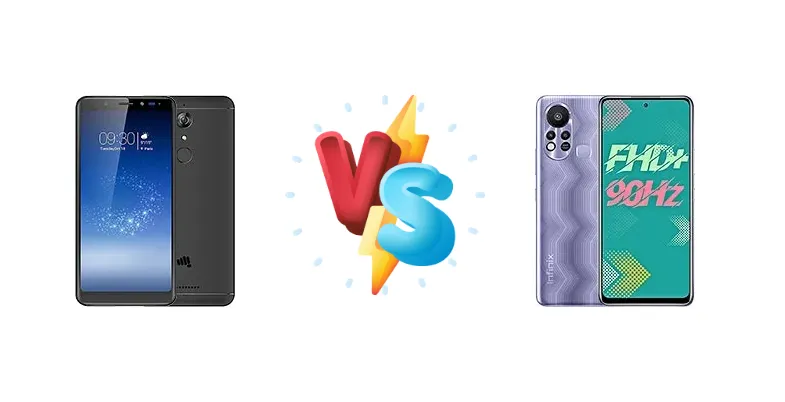
The Micromax Canvas Infinity represented a value proposition in its time, but the smartphone landscape has shifted. The Infinix Hot 11s arrives with a more modern chipset and feature set. This comparison dissects the key differences between these two devices, focusing on how the newer hardware translates to real-world benefits for budget-conscious users.
🏆 Quick Verdict
For the vast majority of users, the Infinix Hot 11s is the superior choice. Its Helio G88 chipset offers significantly improved performance over the Snapdragon 425 in the Canvas Infinity, making it better suited for multitasking, gaming, and modern app usage. While the Canvas Infinity may still suffice for basic tasks, the Hot 11s provides a more future-proof experience.
| Network |
|---|
| 2G bands | GSM 850 / 900 / 1800 / 1900 - SIM 1 & SIM 2 | GSM 850 / 900 / 1800 / 1900 |
| 3G bands | HSDPA 850 / 900 / 1900 / 2100 | HSDPA 850 / 900 / 2100 |
| 4G bands | 3, 5, 40 | 1, 3, 5, 8, 38, 40, 41 |
| Speed | HSPA 42.2/5.76 Mbps, LTE Cat4 150/50 Mbps | HSPA 42.2/5.76 Mbps, LTE Cat4 150/50 Mbps |
| Technology | GSM / HSPA / LTE | GSM / HSPA / LTE |
| Launch |
|---|
| Announced | 2017, August. Released 2017, September | 2021, September 17 |
| Status | Discontinued | Available. Released 2021, September 21 |
| Body |
|---|
| Build | Glass front, aluminum back, aluminum frame | Glass front, plastic back, plastic frame |
| Dimensions | 152 x 73 x 9 mm (5.98 x 2.87 x 0.35 in) | 168.9 x 77 x 8.8 mm (6.65 x 3.03 x 0.35 in) |
| SIM | Dual SIM (Micro-SIM, dual stand-by) | Nano-SIM + Nano-SIM |
| Weight | 160 g (5.64 oz) | 205 g (7.23 oz) |
| Display |
|---|
| Protection | - | NEG Dinorex T2X-1 |
| Resolution | 720 x 1440 pixels, 18:9 ratio (~279 ppi density) | 1080 x 2480 pixels (~399 ppi density) |
| Size | 5.7 inches, 85.7 cm2 (~77.2% screen-to-body ratio) | 6.78 inches, 108.6 cm2 (~83.5% screen-to-body ratio) |
| Type | IPS LCD | IPS LCD, 90Hz, 500 nits (peak) |
| Platform |
|---|
| CPU | Quad-core 1.4 GHz Cortex-A53 | Octa-core (2x2.0 GHz Cortex-A75 & 6x1.8 GHz Cortex-A55) |
| Chipset | Qualcomm MSM8917 Snapdragon 425 (28 nm) | Mediatek MT6769H Helio G88 (12 nm) |
| GPU | Adreno 308 | Mali-G52 MC2 |
| OS | Android 7.1.2 (Nougat), upgradable to Android 8.0 (Oreo) | Android 11, XOS 7.6 |
| Memory |
|---|
| Card slot | microSDXC (dedicated slot) | microSDXC (dedicated slot) |
| Internal | 32GB 3GB RAM | 64GB 4GB RAM, 128GB 4GB RAM, 128GB 6GB RAM |
| | eMMC 5.1 | eMMC 5.1 |
| Main Camera |
|---|
| Features | LED flash, auto-HDR | Quad-LED flash, HDR, panorama |
| Single | 13 MP, f/2.0, 1/3.1", 1.12µm, AF | 8 MP, f/2.0, (wide) |
| Triple | - | 50 MP, f/1.6, (wide), PDAF
Auxiliary lenses |
| Video | 1080p@30fps | 1440p@30fps |
| Selfie camera |
|---|
| Features | LED flash | Dual-LED flash |
| Single | 16 MP, f/2.0, 26mm (wide), 1/3.06", 1.0µm, AF | 8 MP, f/2.0, (wide) |
| Video | 1080p@30fps | 1440p@30fps |
| Sound |
|---|
| 3.5mm jack | Yes | Yes |
| 35mm jack | Yes | Yes |
| Loudspeaker | Yes | Yes, with dual speakers |
| Comms |
|---|
| Bluetooth | 4.1, A2DP | 5.0, A2DP, LE |
| NFC | No | No |
| Positioning | GPS | GPS |
| Radio | FM radio | FM radio |
| USB | microUSB 2.0, OTG | USB Type-C 2.0, OTG |
| WLAN | Wi-Fi 802.11 b/g/n | Wi-Fi 802.11 a/b/g/n |
| Features |
|---|
| Sensors | Fingerprint (rear-mounted), accelerometer, proximity | Fingerprint (rear-mounted), accelerometer, gyro, proximity, compass |
| Battery |
|---|
| Stand-by | Up to 420 h (3G) | - |
| Talk time | Up to 20 h (3G) | - |
| Type | Li-Ion 2980 mAh, removable | 5000 mAh |
| Misc |
|---|
| Colors | Black | Polar Black, Green Wave, Purple |
| Models | HS2 | X6812, X6812B |
| Price | About 10000 INR | About 140 EUR |
Micromax Canvas Infinity
- Potentially lower price point (depending on availability)
- Simple and straightforward user experience
- Lightweight and compact (likely)
- Outdated processor and limited performance
- Poor multitasking capabilities
- Inferior camera quality
- Limited software support
Infinix Hot 11s
- Significantly faster processor (Helio G88)
- Larger, sharper display
- Larger battery capacity with fast charging
- More versatile camera system
- More modern software features
- May be slightly more expensive
- Larger size may not appeal to all users
- Software experience may include bloatware
Display Comparison
Neither device is known for display excellence. The Micromax Canvas Infinity's display specifications are largely unavailable, but given its market segment, it likely features a 720p IPS LCD panel. The Infinix Hot 11s also utilizes an IPS LCD, but its larger size (6.78 inches) and higher resolution (1080 x 2460) result in a sharper image. While neither supports high refresh rates or advanced panel technologies like LTPO, the Hot 11s' higher pixel density provides a noticeable improvement in clarity for media consumption.
Camera Comparison
Camera performance is likely to be a weak point on both devices. The Micromax Canvas Infinity's camera specifications are limited, but it likely features a basic sensor. The Infinix Hot 11s features a 50MP main sensor, which, while not flagship-level, is a significant upgrade. The Hot 11s also includes a depth sensor and a macro lens, though the usefulness of the 2MP macro lens is questionable. Image processing on the Hot 11s is likely more refined, resulting in better dynamic range and detail in favorable lighting conditions. Low-light performance will still be limited on both devices.
Performance
The performance gap is the most significant differentiator. The Micromax Canvas Infinity's Qualcomm MSM8917 Snapdragon 425, with its quad-core Cortex-A53 CPU, is a dated chipset built on a 28nm process. This translates to lower processing power and less efficient power consumption. In contrast, the Infinix Hot 11s boasts the MediaTek MT6769H Helio G88, an octa-core processor (2x2.0 GHz Cortex-A75 & 6x1.8 GHz Cortex-A55) fabricated on a more efficient 12nm node. The Helio G88's Cortex-A75 cores provide a substantial performance boost in CPU-intensive tasks, while its integrated GPU offers a far superior gaming experience. The Hot 11s will handle multitasking and demanding apps with considerably less lag.
Battery Life
The Micromax Canvas Infinity's battery capacity is unknown, but typical for its era (likely around 3000-4000mAh). The Infinix Hot 11s packs a larger 5000mAh battery, providing significantly longer battery life. While the Canvas Infinity may offer acceptable endurance for light usage, the Hot 11s can comfortably last a full day with moderate use. The Hot 11s also supports 18W fast charging, allowing for quicker top-ups compared to the Canvas Infinity's likely slower charging capabilities.
Buying Guide
Buy the Micromax Canvas Infinity if you absolutely need the lowest possible price point and only intend to use the phone for very basic tasks like calls, texts, and light web browsing. It's a functional device for minimal smartphone usage. Buy the Infinix Hot 11s if you want a phone that can handle more demanding apps, occasional gaming, and offers a smoother overall user experience. It's the better investment for anyone looking for a versatile budget smartphone.
Frequently Asked Questions
❓ Does the Helio G88 in the Infinix Hot 11s get noticeably hot during extended gaming sessions?
While the Helio G88 isn't a flagship gaming chip, its 12nm process and thermal design in the Hot 11s generally manage heat well. You may experience some warming during prolonged gaming, but it's unlikely to cause significant throttling or discomfort. Performance will likely dip slightly after an hour of intensive gaming, but it remains playable.
❓ Is the 2MP macro camera on the Infinix Hot 11s actually useful for taking detailed close-up photos?
The 2MP macro camera is a common inclusion in budget smartphones, but its image quality is often limited. While it allows you to focus on very close-up subjects, the low resolution results in images lacking detail and sharpness. It's best used for casual experimentation rather than serious macro photography.
❓ Can the Infinix Hot 11s run popular games like PUBG Mobile smoothly?
The Infinix Hot 11s can run PUBG Mobile, but you'll likely need to use medium graphics settings and a moderate frame rate (around 30-40fps) for a consistently smooth experience. Higher settings may result in frame drops and lag. The Helio G88 is capable, but it's not designed for maximum settings in demanding games.
❓ How much storage does the Micromax Canvas Infinity have, and is it expandable?
The Micromax Canvas Infinity typically came with 16GB of internal storage, which is quite limited by today's standards. Fortunately, it does support microSD card expansion, allowing you to add up to 64GB or 128GB of additional storage for photos, videos, and apps.