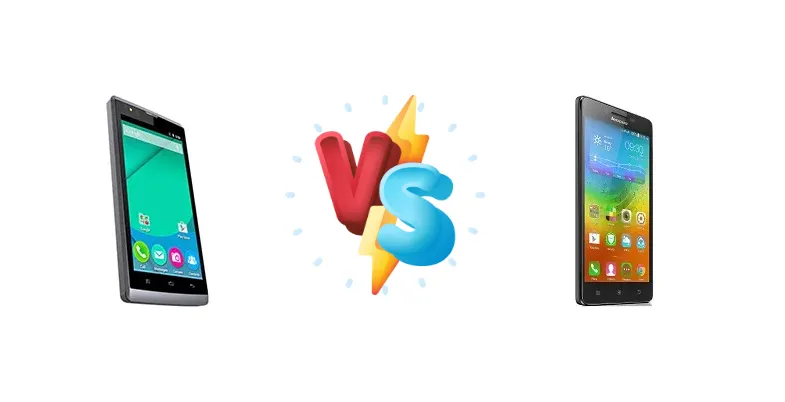
Both the Micromax Canvas Blaze 4G+ Q414 and the Lenovo A6000 Plus represent a segment of the market focused on affordability and essential smartphone functionality. Released around the same timeframe, these devices targeted first-time smartphone users and those seeking a reliable secondary device. This comparison dissects their core components to determine which offers the best value for users prioritizing performance and everyday usability.
🏆 Quick Verdict
For the average user, the Lenovo A6000 Plus is the slightly better choice. While both phones utilize a 28nm process, the Qualcomm MSM8916 Snapdragon 410’s 1.2 GHz clock speed provides a marginal performance advantage over the Mediatek MT6735M’s 1.0 GHz, translating to snappier app loading and multitasking.
| Network |
|---|
| 2G bands | GSM 850 / 900 / 1800 / 1900 - SIM 1 & SIM 2 | GSM 900 / 1800 / 1900 - SIM 1 & SIM 2 |
| 3G bands | HSDPA 900 / 2100 | HSDPA 2100 |
| 4G bands | 3, 5, 40 | 1, 3, 7, 20, 40 - Data only, no voice |
| Speed | HSPA 42.2/11.5 Mbps, LTE Cat4 150/50 Mbps | HSPA, LTE Cat4 150/50 Mbps |
| Technology | GSM / HSPA / LTE | GSM / HSPA / LTE |
| Launch |
|---|
| Announced | 2015, November. Released 2015, November | 2015, April. Released 2015, April |
| Status | Discontinued | Discontinued |
| Body |
|---|
| Dimensions | 131 x 65.5 x 8.2 mm (5.16 x 2.58 x 0.32 in) | 141 x 70 x 8.2 mm (5.55 x 2.76 x 0.32 in) |
| SIM | Dual SIM (Mini-SIM/ Micro-SIM) | Dual SIM (Micro-SIM, dual stand-by) |
| Weight | 119 g (4.20 oz) | 128 g (4.52 oz) |
| Display |
|---|
| Resolution | 480 x 854 pixels, 16:9 ratio (~218 ppi density) | 720 x 1280 pixels, 16:9 ratio (~294 ppi density) |
| Size | 4.5 inches, 55.8 cm2 (~65.0% screen-to-body ratio) | 5.0 inches, 68.9 cm2 (~69.8% screen-to-body ratio) |
| Type | IPS LCD | IPS LCD |
| Platform |
|---|
| CPU | Quad-core 1.0 GHz Cortex-A53 | Quad-core 1.2 GHz Cortex-A53 |
| Chipset | Mediatek MT6735M (28 nm) | Qualcomm MSM8916 Snapdragon 410 (28 nm) |
| GPU | Mali-T720MP2 | Adreno 306 |
| OS | Android 5.1 (Lollipop) | Android 4.4.4 (KitKat), upgradable to 5.2 (Lollipop) |
| Memory |
|---|
| Card slot | microSDHC | microSDHC (dedicated slot) |
| Internal | 8GB 1GB RAM | 16GB 2GB RAM |
| | - | eMMC 4.5 |
| Main Camera |
|---|
| Features | LED flash | LED flash |
| Single | 8 MP, AF | 8 MP, f/2.2, AF |
| Video | 720p@30fps | 720p@30fps |
| Selfie camera |
|---|
| Single | 2 MP | 2 MP |
| Sound |
|---|
| 3.5mm jack | - | Yes |
| 35mm jack | Yes | Yes |
| Loudspeaker | Yes | Yes, with stereo speakers |
| Comms |
|---|
| Bluetooth | 4.0, A2DP | 4.0, A2DP |
| NFC | No | No |
| Positioning | GPS | GPS |
| Radio | FM radio | FM radio |
| USB | microUSB 2.0 | microUSB 2.0 |
| WLAN | Wi-Fi 802.11 b/g/n, hotspot | Wi-Fi 802.11 b/g/n, hotspot |
| Features |
|---|
| Sensors | Accelerometer, proximity | Accelerometer, proximity |
| Battery |
|---|
| Stand-by | Up to 200 h | Up to 264 h (2G) / Up to 264 h (3G) |
| Talk time | Up to 5 h | Up to 22 h (2G) / Up to 13 h (3G) |
| Type | Li-Ion 1750 mAh, removable | Li-Po 2300 mAh, removable |
| Misc |
|---|
| Colors | Black | Black, White, Yellow, Red |
| Price | - | About 110 EUR |
Micromax Canvas Blaze 4G+ Q414
- Potentially lower price point
- Reliable Mediatek chipset
- Suitable for basic smartphone tasks
- Slightly slower processor than the Lenovo A6000 Plus
- Likely less responsive user experience
Lenovo A6000 Plus
- Faster Qualcomm Snapdragon 410 processor
- Slightly smoother multitasking
- Generally better app performance
- May be slightly more expensive
- Similar battery life to the Micromax Canvas Blaze 4G+
Display Comparison
Neither device boasts a standout display. Given the context of these phones, we can assume both utilize IPS LCD panels, common for this price bracket. Detailed specs like resolution and brightness are unavailable, but the focus here is on performance, not visual fidelity. Bezels were likely substantial on both, typical of designs from this era. Color accuracy is expected to be standard for budget displays.
Camera Comparison
Camera performance on both devices is expected to be basic. Without specific sensor details, it’s safe to assume both feature a primary rear camera and a front-facing camera for video calls. Image quality will be adequate for casual snapshots in good lighting conditions, but struggles in low light. The absence of Optical Image Stabilization (OIS) on either device means image stabilization will rely solely on software processing. Any secondary cameras (likely 2MP) are primarily for adding features rather than delivering significant image quality improvements.
Performance
The core difference lies in the chipset: the Micromax utilizes the Mediatek MT6735M, while the Lenovo features the Qualcomm MSM8916 Snapdragon 410. Both are quad-core Cortex-A53 processors built on a 28nm process, indicating similar power efficiency. However, the Snapdragon 410’s 1.2 GHz clock speed represents a 20% increase over the MT6735M’s 1.0 GHz. This translates to faster processing of instructions, resulting in quicker app launches and smoother multitasking. While neither chipset is a powerhouse, the Qualcomm chip offers a noticeable edge in responsiveness. RAM configurations are likely similar (1-2GB), further emphasizing the chipset as the primary performance differentiator.
Battery Life
Battery capacity details are unavailable. However, given the similar chipsets and display technologies, battery life is likely comparable. Both phones would likely offer a full day of moderate use (calls, texts, light browsing). Charging wattage is also unknown, but likely falls within the 5W-10W range, resulting in relatively slow charging times (3-5 hours for a full charge). The 28nm process node of both chipsets contributes to reasonable power efficiency, mitigating the impact of potentially smaller battery capacities.
Buying Guide
Buy the Micromax Canvas Blaze 4G+ Q414 if you prioritize a potentially lower price point and are comfortable with a slightly less responsive user experience. Buy the Lenovo A6000 Plus if you prefer a marginally faster processor for smoother multitasking and app performance, even if it means potentially paying a small premium. Both are suitable for basic tasks like calling, texting, and light social media use.
Frequently Asked Questions
❓ Will the Lenovo A6000 Plus handle popular apps like WhatsApp and Facebook smoothly?
Yes, the Qualcomm Snapdragon 410 in the Lenovo A6000 Plus is capable of running apps like WhatsApp and Facebook without significant lag. The 1.2 GHz clock speed provides a slight performance advantage over the Micromax, ensuring a smoother experience, especially when multitasking.
❓ Is the Mediatek MT6735M in the Micromax Canvas Blaze 4G+ sufficient for casual gaming?
The Mediatek MT6735M can handle basic 2D games and older 3D titles, but don't expect a high-performance gaming experience. More demanding games may experience frame rate drops and lag. The Lenovo A6000 Plus will offer a marginally better gaming experience due to its faster processor.
❓ Which phone is better for someone new to smartphones?
Both phones are suitable for first-time smartphone users. However, the Lenovo A6000 Plus’s slightly faster processor might make the learning curve a little less frustrating, as apps will respond more quickly. Ultimately, the choice depends on budget and availability.