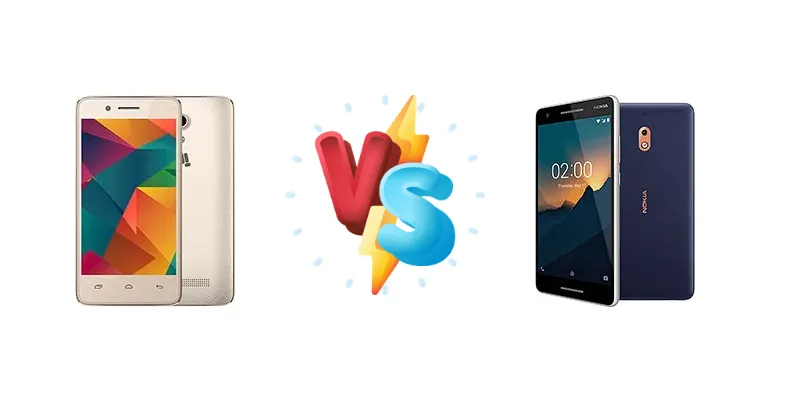
The ultra-budget smartphone segment is fiercely competitive. Both the Micromax Bharat 2+ and Nokia 2.1 aim to deliver a functional Android experience at the lowest possible price point. However, with limited publicly available specifications for the Bharat 2+, this comparison focuses on the Nokia 2.1’s known hardware and extrapolates based on Micromax’s historical positioning in this market.
🏆 Quick Verdict
For the average user prioritizing a known quantity and a slightly smoother experience, the Nokia 2.1 is the better choice. Its Qualcomm Snapdragon 425 chipset provides a demonstrable performance advantage over what is typically found in Micromax’s Bharat series, despite both phones targeting the same price-sensitive consumer.
| Network |
|---|
| 2G bands | GSM 900 / 1800 - SIM 1 & SIM 2 | GSM 850 / 900 / 1800 / 1900 |
| 3G bands | HSDPA 900 / 2100 | HSDPA 850 / 900 / 2100 - APAC, EMEA, India |
| 4G bands | 1, 3, 5, 40 | 1, 3, 5, 7, 8, 20, 38, 40 - APAC, EMEA |
| Speed | HSPA 42.2/5.76 Mbps, LTE Cat4 150/50 Mbps | HSPA 42.2/5.76 Mbps, LTE Cat4 150/50 Mbps |
| Technology | GSM / HSPA / LTE | GSM / HSPA / LTE |
| Launch |
|---|
| Announced | 2017, Q4. Released 2017, Q4 | 2018, May. Released 2018, August |
| Status | Discontinued | Discontinued |
| Body |
|---|
| Build | - | Glass front (Gorilla Glass 3), plastic back, aluminum frame |
| Dimensions | 125 x 63.4 x 10.8 mm (4.92 x 2.50 x 0.43 in) | 153.6 x 77.6 x 9.7 mm (6.05 x 3.06 x 0.38 in) |
| SIM | Dual SIM (Micro-SIM, dual stand-by) | Nano-SIM + Nano-SIM |
| Weight | 120 g (4.23 oz) | 174 g (6.14 oz) |
| Display |
|---|
| Protection | - | Corning Gorilla Glass 3 |
| Resolution | 480 x 800 pixels, 5:3 ratio (~233 ppi density) | 720 x 1280 pixels, 16:9 ratio (~267 ppi density) |
| Size | 4.0 inches, 45.5 cm2 (~57.5% screen-to-body ratio) | 5.5 inches, 83.4 cm2 (~70.0% screen-to-body ratio) |
| Type | TFT | IPS LCD |
| Platform |
|---|
| CPU | - | Quad-core 1.4 GHz Cortex-A53 |
| Chipset | - | Qualcomm MSM8917 Snapdragon 425 (28 nm) |
| GPU | - | Adreno 308 |
| OS | Android 7.0 (Nougat) | Android 8.1 Oreo (Go edition), upgradable to Android 10.0, Android One |
| Memory |
|---|
| Card slot | microSDHC | microSDXC (dedicated slot) |
| Internal | 8GB 1GB RAM | 8GB 1GB RAM |
| Main Camera |
|---|
| Features | LED flash | LED flash |
| Single | 5 MP | 8 MP, AF |
| Video | 720p@30fps | 720p@30fps |
| Selfie camera |
|---|
| Single | 2 MP | 5 MP |
| Video | - | 1080p@30fps |
| Sound |
|---|
| 3.5mm jack | - | Yes |
| 35mm jack | Yes | Yes |
| Loudspeaker | Yes | Yes, with stereo speakers |
| Comms |
|---|
| Bluetooth | 4.0, A2DP | 4.2, A2DP, LE |
| NFC | No | No |
| Positioning | GPS | GPS, GLONASS, BDS |
| Radio | FM radio | FM radio |
| USB | microUSB 2.0 | microUSB 2.0, OTG |
| WLAN | Wi-Fi 802.11 b/g/n | Wi-Fi 802.11 b/g/n |
| Features |
|---|
| Sensors | Accelerometer | Accelerometer, proximity |
| Battery |
|---|
| Charging | - | 10W wired |
| Music play | - | Up to 128 h |
| Stand-by | Up to 160 h (3G) | - |
| Talk time | Up to 16 h (3G) | Up to 19 h (3G) |
| Type | Li-Ion 1600 mAh, removable | Li-Ion 4000 mAh, non-removable |
| Misc |
|---|
| Colors | Gold | Blue/Copper, Blue/Silver, Grey/Silver |
| Models | - | TA-1080, TA-1092, TA-1084, TA-1093, TA-1086 |
| Price | About 50 EUR | About 100 EUR |
| SAR EU | - | 0.83 W/kg (head) 1.67 W/kg (body) |
Micromax Bharat 2+
- Potentially lower price point
- May include regional carrier support
- Simple and straightforward Android experience
- Unknown specifications
- Potentially limited software updates
- Likely lower performance than Nokia 2.1
Nokia 2.1
- Qualcomm Snapdragon 425 chipset
- 4000mAh battery for all-day use
- Android Go for optimized performance
- Low camera resolution
- Slow charging speed
- Limited internal storage
Display Comparison
Specific display details for the Micromax Bharat 2+ are unavailable. The Nokia 2.1 features a 5-inch IPS LCD display. While resolution is likely similar across both devices (around 480x854), the Nokia 2.1’s IPS panel offers wider viewing angles compared to the TN panels often found in this price bracket. Both displays will likely struggle with outdoor visibility due to low peak brightness, but the Nokia 2.1’s panel technology provides a more pleasant viewing experience indoors.
Camera Comparison
Camera specifications for the Micromax Bharat 2+ are unknown. The Nokia 2.1 features a 5MP rear camera and a 2MP front camera. While image quality will be limited by the low sensor resolution, the Nokia 2.1’s camera is likely to perform adequately in well-lit conditions. The 2MP front camera is primarily for video calls and basic selfies. Given Micromax’s track record, the Bharat 2+ likely features a similar or lower resolution camera setup, potentially with even less image processing capability.
Performance
The Nokia 2.1 is powered by the Qualcomm MSM8917 Snapdragon 425, a quad-core 1.4 GHz Cortex-A53 processor. This chipset, built on a 28nm process, provides a baseline level of performance suitable for basic tasks like calling, messaging, and light web browsing. The Micromax Bharat 2+, historically, has utilized MediaTek chipsets in this price range, which generally offer slightly lower CPU and GPU performance than the Snapdragon 425. The 28nm node of the Snapdragon 425, while not cutting-edge, is relatively efficient for its class, offering a balance between performance and battery life. Users expecting to run demanding applications or games will find both phones severely limited.
Battery Life
Battery capacity for the Micromax Bharat 2+ is not specified. The Nokia 2.1 packs a 4000mAh battery, a significant advantage in this segment. Coupled with the relatively efficient Snapdragon 425 and the Android Go operating system, the Nokia 2.1 can realistically achieve all-day battery life with moderate usage. The Nokia 2.1 supports 10W wired charging, which, while slow by modern standards, is typical for this price point. Without knowing the Bharat 2+'s battery capacity, it's difficult to make a direct comparison, but the Nokia 2.1’s larger battery and optimized software give it a clear edge.
Buying Guide
Buy the Micromax Bharat 2+ if you need a phone primarily for basic calling and texting, and are comfortable with potentially limited software updates and a less refined user experience. Buy the Nokia 2.1 if you prefer a more reliable Android Go experience, a known chipset with predictable performance, and the backing of Nokia’s brand reputation for software support, even within the budget segment.
Frequently Asked Questions
❓ Is the Snapdragon 425 in the Nokia 2.1 powerful enough for WhatsApp and Facebook?
Yes, the Snapdragon 425 is sufficient for running social media applications like WhatsApp and Facebook. Android Go, pre-installed on the Nokia 2.1, further optimizes performance for these apps, ensuring a relatively smooth experience even with limited RAM.
❓ How long will the Nokia 2.1's 4000mAh battery last on a single charge with typical usage?
With typical usage – including calls, messaging, and occasional social media browsing – the Nokia 2.1’s 4000mAh battery should easily last a full day. Heavy users may need to charge it overnight, but the battery capacity is a significant advantage in this price segment.
❓ Does the Nokia 2.1 receive regular software updates?
While the Nokia 2.1 is an entry-level device, Nokia has a relatively good track record of providing security updates and occasional Android version upgrades, even for its budget phones. This is a key advantage over many other brands in this price range.