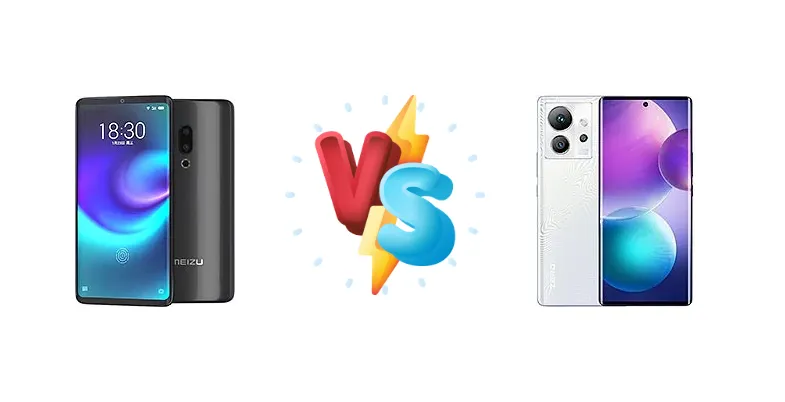
The Meizu Zero, a former flagship boasting a Snapdragon 845, represents a bygone era of premium compact phones. The Infinix Zero Ultra, on the other hand, is a more recent offering centered around a Mediatek Dimensity 920 and, crucially, its groundbreaking 180W charging. This comparison dissects these two devices to determine which offers the best value and experience in today's market.
🏆 Quick Verdict
For the average user, the Infinix Zero Ultra is the clear winner. While the Meizu Zero’s Snapdragon 845 was once a powerhouse, the Dimensity 920 offers comparable real-world performance with improved efficiency, and the 180W charging is a game-changer, fully charging the device in just 12 minutes – a feature the Meizu Zero simply cannot match.
| Network |
|---|
| 2G bands | GSM 850 / 900 / 1800 / 1900 | GSM 850 / 900 / 1800 / 1900 |
| 3G bands | HSDPA 850 / 900 / 2100 | HSDPA 850 / 900 / 1700(AWS) / 1900 / 2100 |
| 4G bands | 1, 3, 5, 8, 34, 38, 39, 40, 41 | 1, 2, 3, 4, 5, 7, 8, 20, 28, 38, 40, 41, 66 |
| 5G bands | - | 1, 2, 3, 5, 20, 28, 38, 40, 41, 71, 77, 78, 79 SA/NSA/Sub6 |
| Speed | HSPA 42.2/5.76 Mbps, LTE (4CA) Cat16 1024/150 Mbps | HSPA 42.2/11.5 Mbps, LTE Cat7 300/75 Mbps, 5G |
| Technology | GSM / CDMA / HSPA / LTE | GSM / HSPA / LTE / 5G |
| | CDMA 800 & TD-SCDMA | 1, 3, 5, 7, 8, 20, 28, 38, 40, 41, 77, 78 SA/NSA/Sub6 |
| Launch |
|---|
| Announced | 2019, January | 2022, October 05 |
| Status | Cancelled | Available. Released 2022, October 25 |
| Body |
|---|
| Build | Glass front, ceramic back, ceramic frame | - |
| Dimensions | 149.8 x 74.3 x 7.9 mm (5.90 x 2.93 x 0.31 in) | 165.5 x 74.5 x 8.8 mm - Coslight Silver165.5 x 75.1 x 9.2 mm - Genesis Noir |
| SIM | eSIM | Nano-SIM + Nano-SIM |
| Weight | - | 213 g (7.51 oz) |
| | IP68 | - |
| Display |
|---|
| Protection | - | Corning Gorilla Glass 3 |
| Resolution | 1080 x 2340 pixels, 19.5:9 ratio (~430 ppi density) | 1080 x 2400 pixels, 20:9 ratio (~387 ppi density) |
| Size | 5.99 inches, 88.1 cm2 (~79.1% screen-to-body ratio) | 6.8 inches, 111.6 cm2 (~90.5% screen-to-body ratio) |
| Type | AMOLED | AMOLED, 120Hz, 900 nits (HBM) |
| Platform |
|---|
| CPU | Octa-core (4x2.8 GHz Kryo 385 Gold & 4x1.8 GHz Kryo 385 Silver) | Octa-core (2x2.5 GHz Cortex-A78 & 6x2.0 GHz Cortex-A55) |
| Chipset | Qualcomm SDM845 Snapdragon 845 (10 nm) | Mediatek Dimensity 920 (6 nm) |
| GPU | Adreno 630 | Mali-G68 MC4 |
| OS | Android 8.1 (Oreo) | Android 12, XOS 12 |
| Memory |
|---|
| Card slot | No | No |
| Internal | 128GB 6GB RAM, 128GB 8GB RAM | 256GB 8GB RAM |
| Main Camera |
|---|
| Dual | 12 MP, f/1.8, 27mm (wide), 1/2.3", 1.55µm, PDAF
20 MP, PDAF | - |
| Features | Dual-LED dual-tone flash, panorama | Dual-LED flash, HDR, panorama |
| Single | - | 32 MP, f/2.0, (wide) |
| Triple | - | 200 MP, f/2.0, (wide), 1/1.22", 0.64µm, dual pixel PDAF, OIS
13 MP, f/2.4, (ultrawide), AF
2 MP |
| Video | 4K@30fps, 1080p@30fps | 4K@30fps, 1080p@30/60fps |
| Selfie camera |
|---|
| Features | - | Dual-LED flash |
| Single | 20 MP, f/2.0, (wide), 1/2.8", 1.0µm | 32 MP, f/2.0, (wide) |
| Video | 1080p@30fps | 1080p@30fps |
| Sound |
|---|
| 3.5mm jack | No | No |
| 35mm jack | No | No |
| Loudspeaker | Yes | Yes, with dual speakers |
| Comms |
|---|
| Bluetooth | 5.0, A2DP, LE | Yes |
| NFC | No | Yes (market/region dependent) |
| Positioning | GPS, GLONASS | GPS |
| Radio | No | FM radio |
| USB | No | USB Type-C 2.0, OTG |
| WLAN | Wi-Fi 802.11 a/b/g/n/ac, dual-band, Wi-Fi Direct | Wi-Fi 802.11 a/b/g/n/ac/6, dual-band |
| Features |
|---|
| Sensors | Fingerprint (under display, optical), accelerometer, gyro, proximity, compass | Fingerprint (under display, optical), accelerometer, gyro, proximity, compass |
| Battery |
|---|
| Charging | 18W wireless | 180W wired, 100% in 12 min |
| Type | Li-Ion, non-removable | 4500 mAh |
| Misc |
|---|
| Colors | Black, White | Coslight Silver, Genesis Noir |
| Models | - | X6820 |
| Price | - | About 500 EUR |
Meizu Zero
- Compact form factor (likely)
- Wireless charging capability
- Premium build quality (expected for its price point at launch)
- Outdated chipset (Snapdragon 845)
- Slower charging speeds (18W wireless)
- Likely lacks modern features (high refresh rate display, advanced camera tech)
Infinix Zero Ultra
- Blazing-fast 180W charging
- More efficient chipset (Dimensity 920)
- Modern features and software support (likely)
- Larger form factor (likely)
- May lack wireless charging (unspecified)
- Infinix's software experience may not appeal to all users
Display Comparison
Neither device's display specifications are provided, so a direct comparison is limited. However, given the Meizu Zero's age, it likely utilizes an older AMOLED panel. The Infinix Zero Ultra, being a newer device, likely benefits from advancements in display technology, potentially including higher peak brightness and improved color accuracy. The absence of refresh rate data is notable; modern mid-range phones typically offer 90Hz or 120Hz panels, a feature the Meizu Zero likely lacks.
Camera Comparison
Without camera specifications, a detailed comparison is impossible. However, given the market positioning, the Infinix Zero Ultra likely features a more advanced camera system. Modern smartphones prioritize high-resolution sensors and sophisticated image processing algorithms. The Meizu Zero, being an older model, likely has a less capable camera, particularly in low-light conditions. The absence of information regarding OIS (Optical Image Stabilization) on either device makes it difficult to assess image stability.
Performance
The core difference lies in the chipsets. The Meizu Zero’s Snapdragon 845, built on a 10nm process, features an octa-core CPU with Kryo 385 cores peaking at 2.8 GHz. While powerful in its time, it's now surpassed by the Infinix Zero Ultra’s Mediatek Dimensity 920, fabricated on a more efficient 6nm node. The Dimensity 920’s CPU configuration – 2x2.5 GHz Cortex-A78 and 6x2.0 GHz Cortex-A55 – offers a balance of performance and power efficiency. The 6nm process allows the Dimensity 920 to deliver comparable, and in some cases, superior performance to the Snapdragon 845 with less thermal throttling, particularly during sustained workloads. The Meizu Zero may struggle with demanding modern games at maximum settings for extended periods.
Battery Life
The Meizu Zero offers 18W wireless charging, a respectable feature for its time. However, the Infinix Zero Ultra completely dominates this category with its 180W wired charging, capable of fully charging the device in just 12 minutes. While battery capacity isn't specified for either device, the Infinix Zero Ultra’s charging speed significantly mitigates any potential disadvantage in battery size. The convenience of a full charge in under 15 minutes is a substantial advantage for users who prioritize uptime.
Buying Guide
Buy the Meizu Zero if you prioritize a compact form factor and are comfortable with an older chipset and slower charging speeds. It's a good option for those seeking a smaller phone experience and don't need the latest features. Buy the Infinix Zero Ultra if you value blazing-fast charging, a more modern chipset with better efficiency, and don't mind a larger device. It's ideal for power users and those constantly on the go.
Frequently Asked Questions
❓ Will the Snapdragon 845 in the Meizu Zero struggle with demanding games like Genshin Impact?
Yes, the Snapdragon 845, while capable, will likely exhibit noticeable throttling and frame rate drops in graphically intensive games like Genshin Impact, especially at higher settings. The Dimensity 920 in the Infinix Zero Ultra, with its more efficient 6nm process, will provide a smoother and more consistent gaming experience.
❓ Is 180W charging safe for the battery in the Infinix Zero Ultra?
Infinix has implemented multiple safety measures to protect the battery during 180W charging, including bypass charging and temperature control. While extremely fast charging can theoretically degrade battery health over time, the Infinix Zero Ultra’s charging system is designed to minimize this effect and ensure safe operation.
❓ Does the Meizu Zero still receive software updates?
Given its age, it's highly unlikely the Meizu Zero receives regular software updates. This poses a security risk and means it will miss out on new features and optimizations available on newer devices like the Infinix Zero Ultra.