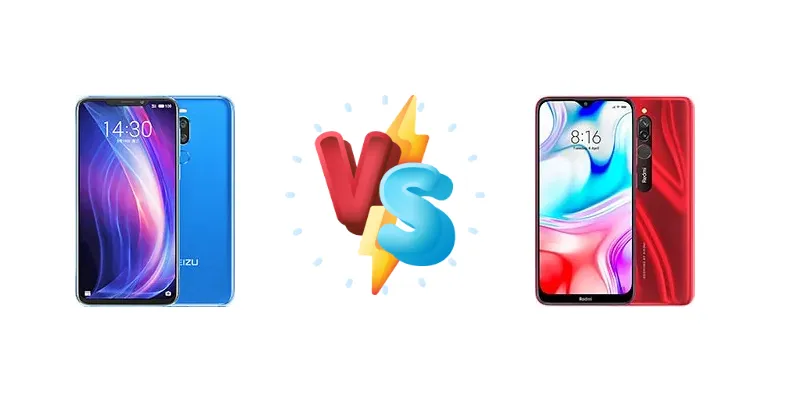
The Meizu X8 and Xiaomi Redmi 8 represent two approaches to the budget smartphone market. The X8, featuring the Qualcomm Snapdragon 710, aimed for a more performance-focused experience, while the Redmi 8 leveraged the Snapdragon 439 to prioritize affordability and battery life. This comparison dissects the key differences to determine which device delivers the best value for your money.
🏆 Quick Verdict
For users prioritizing smooth multitasking and a more responsive experience, the Meizu X8 is the clear winner. Its Snapdragon 710 chipset offers a significant performance advantage over the Redmi 8’s Snapdragon 439. However, the Redmi 8’s 18W charging and potentially lower price make it a viable option for those on a tighter budget.
| Network |
|---|
| 2G bands | GSM 850 / 900 / 1800 / 1900 | GSM 850 / 900 / 1800 / 1900 |
| 3G bands | HSDPA 850 / 900 / 2100 - China | HSDPA 850 / 900 / 1700(AWS) / 1900 / 2100 - Global |
| 4G bands | 1, 3, 5, 8, 34, 38, 39, 40, 41 - China | 1, 2, 3, 4, 5, 7, 8, 20, 38, 40 - Global |
| Speed | HSPA 42.2/5.76 Mbps, LTE Cat15 800/150 Mbps | HSPA, LTE |
| Technology | GSM / CDMA / HSPA / LTE | GSM / HSPA / LTE |
| | CDMA 800 & TD-SCDMA - China | 1, 3, 5, 8, 40, 41 - India |
| Launch |
|---|
| Announced | 2018, September. Released 2018, October | 2019, October 09. Released 2019, October 12 |
| Status | Discontinued | Discontinued |
| Body |
|---|
| Build | - | Glass front (Gorilla Glass 5), plastic back, plastic frame |
| Dimensions | 151.2 x 74.6 x 7.8 mm (5.95 x 2.94 x 0.31 in) | 156.5 x 75.4 x 9.4 mm (6.16 x 2.97 x 0.37 in) |
| SIM | Nano-SIM + Nano-SIM | Nano-SIM + Nano-SIM |
| Weight | 160 g (5.64 oz) | 188 g (6.63 oz) |
| | - | Water-repellent coating |
| Display |
|---|
| Protection | - | Corning Gorilla Glass 5 |
| Resolution | 1080 x 2220 pixels, 18.5:9 ratio (~398 ppi density) | 720 x 1520 pixels, 19:9 ratio (~270 ppi density) |
| Size | 6.2 inches, 97.6 cm2 (~86.5% screen-to-body ratio) | 6.22 inches, 96.6 cm2 (~81.8% screen-to-body ratio) |
| Type | IPS LCD | IPS LCD, 400 nits (typ) |
| Platform |
|---|
| CPU | Octa-core (2x2.2 GHz 360 Gold & 6x1.7 GHz Kryo 360 Silver) | Octa-core (4x1.95 GHz Cortex-A53 & 4x1.45 GHz Cortex A53) |
| Chipset | Qualcomm SDM710 Snapdragon 710 (10 nm) | Qualcomm SDM439 Snapdragon 439 (12 nm) |
| GPU | Adreno 616 | Adreno 505 |
| OS | Android 8.0 (Oreo), Flyme UI | Android 9.0 (Pie), upgradable to Android 10, MIUI 12 |
| Memory |
|---|
| Card slot | No | microSDXC (dedicated slot) |
| Internal | 64GB 4GB RAM, 64GB 6GB RAM, 128GB 6GB RAM | 32GB 3GB RAM, 64GB 4GB RAM |
| | - | eMMC 5.1 |
| Main Camera |
|---|
| Dual | 12 MP, f/1.9, 1/2.55", 1.4µm, dual pixel PDAF
5 MP | - |
| Features | Dual-LED dual-tone flash, panorama | LED flash, HDR, panorama |
| Single | - | 12 MP, f/1.8, 1/2.55", 1.4µm, dual pixel PDAF
Auxiliary lens |
| Video | 1080p@30fps | 1080p@30fps |
| Selfie camera |
|---|
| Features | - | HDR |
| Single | 20 MP, f/2.0, (wide), 1/2.8", 1.0µm | 8 MP, f/2.0, 1/4.0", 1.12µm |
| Video | - | 1080p@30fps |
| Sound |
|---|
| 3.5mm jack | Yes | Yes |
| 35mm jack | Yes | Yes |
| Loudspeaker | Yes | Yes |
| Comms |
|---|
| Bluetooth | 5.0, A2DP, LE | 4.2, A2DP, LE |
| Infrared port | - | Yes |
| NFC | No | No |
| Positioning | GPS, GLONASS | GPS, GLONASS, GALILEO, BDS |
| Radio | No | Wireless FM radio (no wired headphones required) |
| USB | USB Type-C 2.0 | USB Type-C 2.0, OTG |
| WLAN | Wi-Fi 802.11 b/g/n/ac, dual-band, Wi-Fi Direct | Wi-Fi 802.11 b/g/n, Wi-Fi Direct |
| Features |
|---|
| Sensors | Fingerprint (rear-mounted), accelerometer, proximity, compass | Fingerprint (rear-mounted), accelerometer, proximity, compass |
| Battery |
|---|
| Charging | - | 18W wired |
| Type | Li-Ion 3210 mAh, non-removable | Li-Po 5000 mAh, non-removable |
| Misc |
|---|
| Colors | Black, Blue, White | Onyx Black, Ruby Red, Sapphire Blue, Phantom Red |
| Models | X8 | M1908C3IC, MZB8255IN, M1908C3IG, M1908C3IH |
| Price | About 200 EUR | About 210 EUR |
| SAR | - | 0.34 W/kg (head) 1.00 W/kg (body) |
| SAR EU | - | 0.23 W/kg (head) 1.48 W/kg (body) |
Meizu X8
- Significantly faster processor for smoother performance
- More capable ISP for better image processing
- Potentially better sustained performance due to thermal efficiency
- Likely shorter battery life under heavy load
- May be more expensive than the Redmi 8
Xiaomi Redmi 8
- 18W fast charging for quicker top-ups
- More power-efficient chipset for longer battery life
- Likely more affordable price point
- Noticeably slower processor for demanding tasks
- Less capable ISP for image processing
Display Comparison
Neither device is known for a standout display. Given the context data focuses on chipsets, we can infer both likely feature LCD panels common in this price bracket. The X8’s potential for smoother performance *could* translate to a more fluid scrolling experience, but this is dependent on software optimization. Bezels are likely comparable, reflecting the design trends of 2018/2019. Color accuracy is expected to be standard for the segment, prioritizing saturation over fidelity.
Camera Comparison
Without detailed camera specs, a direct comparison is difficult. However, the chipset difference indirectly impacts camera performance. The Snapdragon 710 includes a more capable Image Signal Processor (ISP) than the 439, enabling faster image processing, better dynamic range, and improved low-light performance. It’s reasonable to assume the X8 would produce superior photos and videos, even with similar sensor sizes. The prevalence of 2MP macro/depth sensors in this era suggests both phones likely include them, but their utility is limited.
Performance
The core difference lies in the chipsets. The Meizu X8’s Snapdragon 710, built on a 10nm process, boasts a significantly more powerful CPU configuration – octa-core with 2x2.2 GHz Kryo 360 Gold and 6x1.7 GHz Kryo 360 Silver cores – compared to the Redmi 8’s Snapdragon 439, which uses a less efficient 12nm process and a simpler octa-core setup of 4x1.95 GHz Cortex-A53 and 4x1.45 GHz Cortex A53. This translates to a substantial performance gap in CPU-intensive tasks and gaming. The 710’s architecture is also more modern, offering better sustained performance due to improved thermal management. While RAM configurations aren't specified, the 710 benefits from faster memory support, further enhancing responsiveness.
Battery Life
The Redmi 8’s 18W wired charging is a key advantage. While battery capacity isn’t specified, the Snapdragon 439’s lower power consumption, combined with the faster charging, likely results in a more convenient charging experience. The X8, with its more powerful chipset, will likely drain the battery faster under heavy use, potentially offsetting any capacity advantage. The 12nm process of the 439 contributes to better power efficiency, extending battery life during typical usage scenarios.
Buying Guide
Buy the Meizu X8 if you need a phone capable of handling demanding apps, moderate gaming, and appreciate a snappier user interface. It’s ideal for users who value performance over absolute battery longevity. Buy the Xiaomi Redmi 8 if you prioritize long battery life, fast charging, and are primarily focused on basic smartphone tasks like calling, texting, and light social media use. It’s the better choice for users seeking maximum value for minimal cost.
Frequently Asked Questions
❓ Will the Snapdragon 439 in the Redmi 8 struggle with modern apps like TikTok or Instagram?
While the Snapdragon 439 can handle basic social media apps, you may experience occasional lag or slowdowns when multitasking or using more demanding features within those apps. The Meizu X8’s Snapdragon 710 provides a much smoother experience for these types of applications.
❓ Is the 18W charging on the Redmi 8 a significant advantage over a potentially larger battery on the Meizu X8?
Yes, the 18W charging is a notable benefit. Even if the X8 has a slightly larger battery, the faster charging speed of the Redmi 8 means you’ll spend less time tethered to a wall charger, especially important for users who are frequently on the go.
❓ Can the Meizu X8 handle mobile gaming like PUBG or Call of Duty?
The Snapdragon 710 in the Meizu X8 can handle PUBG and Call of Duty, but you’ll likely need to lower the graphics settings to achieve a playable frame rate. The Redmi 8’s Snapdragon 439 will struggle with these games, even on the lowest settings.