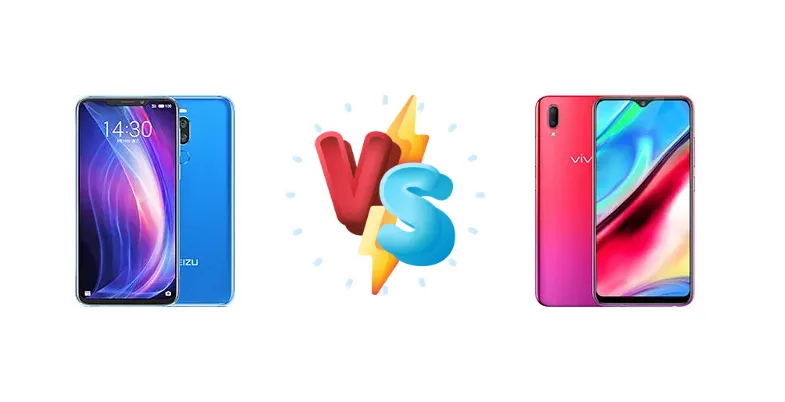
The Meizu X8 and vivo Y93 represent distinct approaches to the budget smartphone market. The X8, equipped with the Qualcomm Snapdragon 710, aims for a balance of performance and features. Conversely, the Y93 utilizes the Snapdragon 439, prioritizing affordability. This comparison dissects their key differences to determine which device best suits your needs.
🏆 Quick Verdict
For users prioritizing smooth multitasking and a more responsive experience, the Meizu X8 is the clear winner. Its Snapdragon 710 chipset offers significantly better performance than the vivo Y93’s Snapdragon 439. While the Y93 is more affordable, the X8’s performance advantage justifies the price difference for most users.
| Network |
|---|
| 2G bands | GSM 850 / 900 / 1800 / 1900 | GSM 850 / 900 / 1800 / 1900 |
| 3G bands | HSDPA 850 / 900 / 2100 - China | HSDPA 850 / 900 / 2100 |
| 4G bands | 1, 3, 5, 8, 34, 38, 39, 40, 41 - China | 1, 3, 5, 8, 34, 38, 39, 40, 41 |
| Speed | HSPA 42.2/5.76 Mbps, LTE Cat15 800/150 Mbps | HSPA 42.2/5.76 Mbps, LTE Cat5 150/75 Mbps |
| Technology | GSM / CDMA / HSPA / LTE | GSM / CDMA / HSPA / LTE |
| | CDMA 800 & TD-SCDMA - China | CDMA 800 & TD-SCDMA - China |
| Launch |
|---|
| Announced | 2018, September. Released 2018, October | 2018, November. Released 2018, November |
| Status | Discontinued | Discontinued |
| Body |
|---|
| Build | - | Glass front, plastic back, plastic frame |
| Dimensions | 151.2 x 74.6 x 7.8 mm (5.95 x 2.94 x 0.31 in) | 155.1 x 75.1 x 8.3 mm (6.11 x 2.96 x 0.33 in) |
| SIM | Nano-SIM + Nano-SIM | Nano-SIM + Nano-SIM |
| Weight | 160 g (5.64 oz) | 163.5 g (5.78 oz) |
| Display |
|---|
| Resolution | 1080 x 2220 pixels, 18.5:9 ratio (~398 ppi density) | 720 x 1520 pixels, 19:9 ratio (~271 ppi density) |
| Size | 6.2 inches, 97.6 cm2 (~86.5% screen-to-body ratio) | 6.2 inches, 95.9 cm2 (~82.4% screen-to-body ratio) |
| Type | IPS LCD | IPS LCD |
| Platform |
|---|
| CPU | Octa-core (2x2.2 GHz 360 Gold & 6x1.7 GHz Kryo 360 Silver) | Octa-core (4x1.95 GHz Cortex-A53 & 4x1.45 GHz Cortex A53) |
| Chipset | Qualcomm SDM710 Snapdragon 710 (10 nm) | Qualcomm SDM439 Snapdragon 439 (12 nm) |
| GPU | Adreno 616 | Adreno 505 |
| OS | Android 8.0 (Oreo), Flyme UI | Android 8.1 (Oreo), Funtouch 4.5 |
| Memory |
|---|
| Card slot | No | microSDXC (dedicated slot) |
| Internal | 64GB 4GB RAM, 64GB 6GB RAM, 128GB 6GB RAM | 64GB 4GB RAM |
| | - | eMMC 5.1 |
| Main Camera |
|---|
| Dual | 12 MP, f/1.9, 1/2.55", 1.4µm, dual pixel PDAF
5 MP | 13 MP, f/2.2, PDAF
Auxiliary lens |
| Features | Dual-LED dual-tone flash, panorama | LED flash, panorama |
| Video | 1080p@30fps | 1080p@30fps |
| Selfie camera |
|---|
| Single | 20 MP, f/2.0, (wide), 1/2.8", 1.0µm | 8 MP, f/2.0 |
| Video | - | 1080p@30fps |
| Sound |
|---|
| 3.5mm jack | Yes | Yes |
| 35mm jack | Yes | Yes |
| Loudspeaker | Yes | Yes |
| Comms |
|---|
| Bluetooth | 5.0, A2DP, LE | 4.2, A2DP, LE |
| NFC | No | No |
| Positioning | GPS, GLONASS | GPS, GLONASS, BDS |
| Radio | No | FM radio |
| USB | USB Type-C 2.0 | microUSB 2.0, OTG |
| WLAN | Wi-Fi 802.11 b/g/n/ac, dual-band, Wi-Fi Direct | Wi-Fi 802.11 b/g/n, Wi-Fi Direct |
| Features |
|---|
| Sensors | Fingerprint (rear-mounted), accelerometer, proximity, compass | Accelerometer, proximity, compass |
| Battery |
|---|
| Type | Li-Ion 3210 mAh, non-removable | 4030 mAh, non-removable |
| Misc |
|---|
| Colors | Black, Blue, White | Starry Black, Sunset Red |
| Models | X8 | 1814, 1815, V1818A, V1818T |
| Price | About 200 EUR | About 200 EUR |
Meizu X8
- Significantly faster processor (Snapdragon 710)
- Better thermal management for sustained performance
- Likely superior camera image processing
- Potentially higher price point
- May have a less optimized software experience (depending on Meizu's Flyme OS)
vivo Y93
- More affordable price
- Decent battery life for basic usage
- Simple and straightforward user experience
- Slow processor (Snapdragon 439)
- Struggles with demanding apps and games
- Inferior camera performance
Display Comparison
Neither device's display specifications are provided, so a direct comparison is limited. However, given the X8's positioning, it likely features a higher-quality panel with better color accuracy and potentially higher brightness. The Y93, targeting a lower price point, likely utilizes a more basic LCD. Bezels are also likely slimmer on the X8, reflecting its slightly more premium aspirations. Without specific data, we can infer the X8 offers a superior visual experience.
Camera Comparison
Without detailed camera specifications, a precise comparison is difficult. However, the X8, being the more premium device, likely features a superior camera system. The Snapdragon 710 also includes a more capable Image Signal Processor (ISP) than the 439, resulting in better image processing, dynamic range, and low-light performance. It’s reasonable to assume the X8 captures sharper, more detailed photos and videos. The Y93 likely relies on software enhancements to compensate for its less powerful ISP.
Performance
The core difference lies in the chipsets. The Meizu X8’s Snapdragon 710 (10nm) is a substantial upgrade over the vivo Y93’s Snapdragon 439 (12nm). The 710’s octa-core configuration, with 2x2.2 GHz Kryo 360 Gold and 6x1.7 GHz Kryo 360 Silver cores, provides significantly more processing power than the 439’s 4x1.95 GHz Cortex-A53 and 4x1.45 GHz Cortex-A53 setup. The 10nm process node of the SD710 also contributes to better thermal efficiency, reducing throttling during sustained workloads. This translates to smoother multitasking, faster app loading times, and a more enjoyable gaming experience on the X8. The 439 is adequate for basic tasks, but will struggle with demanding applications.
Battery Life
Battery capacity isn't specified for either device. However, the Snapdragon 710’s 10nm process node offers better power efficiency than the Snapdragon 439’s 12nm node. This means the X8 could potentially achieve comparable or even better battery life despite potentially having a similar or smaller battery capacity. Charging wattage is also unknown, but the X8’s more advanced chipset might support faster charging technologies.
Buying Guide
Buy the Meizu X8 if you need a phone capable of handling demanding apps, moderate gaming, and a generally smoother user experience. It’s ideal for users who value performance over absolute rock-bottom pricing. Buy the vivo Y93 if you prioritize extreme affordability and basic smartphone functionality – web browsing, social media, and light tasks – and are willing to accept compromises in processing power.
Frequently Asked Questions
❓ Will the vivo Y93 struggle with popular games like PUBG Mobile?
Yes, the Snapdragon 439 in the vivo Y93 is likely to struggle with graphically demanding games like PUBG Mobile. You'll likely need to play at the lowest settings and may still experience frame drops and lag. The Meizu X8’s Snapdragon 710 offers a much smoother gaming experience.
❓ Is the Snapdragon 710 in the Meizu X8 powerful enough for future software updates?
The Snapdragon 710 is a capable chipset that should handle future Android updates for at least a couple of years. Its performance headroom provides a buffer for increased system requirements. However, the longevity will also depend on Meizu’s software support for the X8.
❓ Does the Snapdragon 439 in the vivo Y93 support fast charging?
While the Snapdragon 439 itself doesn't dictate fast charging support, the vivo Y93 may or may not include it. Check the device specifications for details on charging wattage. The X8, with its more advanced chipset, is more likely to support faster charging protocols.