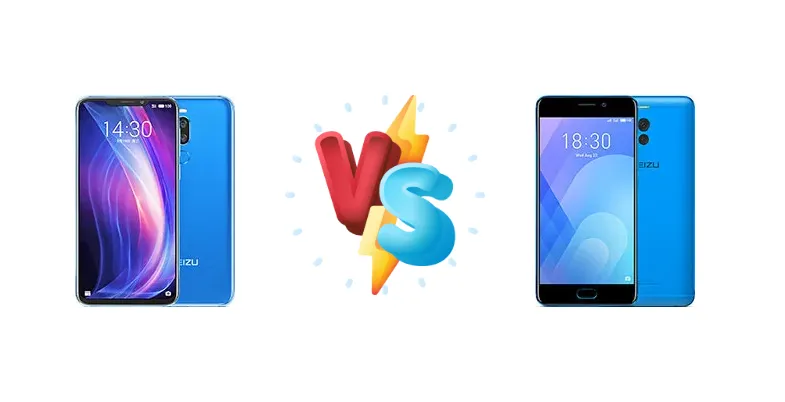
The Meizu X8 and M6 Note represent different approaches to the mid-range smartphone market. The M6 Note, released earlier, prioritized battery life and fast charging within a budget. The X8, arriving later, aimed to elevate performance with a newer chipset, the Snapdragon 710, but at what cost? This comparison dissects the key differences to help you decide which Meizu best suits your needs.
🏆 Quick Verdict
For most users, the Meizu X8 is the better choice. The Snapdragon 710 provides a noticeable performance uplift for demanding tasks and gaming, justifying the likely price premium. However, users prioritizing maximum battery endurance and rapid 24W charging will find the M6 Note a compelling alternative.
| Network |
|---|
| 2G bands | GSM 850 / 900 / 1800 / 1900 | GSM 850 / 900 / 1800 / 1900 - SIM 1 & SIM 2 |
| 3G bands | HSDPA 850 / 900 / 2100 - China | HSDPA 850 / 900 / 1900 / 2100 |
| 4G bands | 1, 3, 5, 8, 34, 38, 39, 40, 41 - China | 1, 3, 5, 7, 8, 20, 38, 40 |
| Speed | HSPA 42.2/5.76 Mbps, LTE Cat15 800/150 Mbps | HSPA, LTE |
| Technology | GSM / CDMA / HSPA / LTE | GSM / CDMA / HSPA / LTE |
| | CDMA 800 & TD-SCDMA - China | CDMA 800 |
| Launch |
|---|
| Announced | 2018, September. Released 2018, October | 2017, August. Released 2017, September |
| Status | Discontinued | Discontinued |
| Body |
|---|
| Build | - | Glass front, aluminum back, aluminum frame |
| Dimensions | 151.2 x 74.6 x 7.8 mm (5.95 x 2.94 x 0.31 in) | 154.6 x 75.2 x 8.4 mm (6.09 x 2.96 x 0.33 in) |
| SIM | Nano-SIM + Nano-SIM | Nano-SIM + Nano-SIM |
| Weight | 160 g (5.64 oz) | 173 g (6.10 oz) |
| Display |
|---|
| Resolution | 1080 x 2220 pixels, 18.5:9 ratio (~398 ppi density) | 1080 x 1920 pixels, 16:9 ratio (~403 ppi density) |
| Size | 6.2 inches, 97.6 cm2 (~86.5% screen-to-body ratio) | 5.5 inches, 82.6 cm2 (~71.0% screen-to-body ratio) |
| Type | IPS LCD | IPS LCD |
| Platform |
|---|
| CPU | Octa-core (2x2.2 GHz 360 Gold & 6x1.7 GHz Kryo 360 Silver) | Octa-core 2.0 GHz Cortex-A53 |
| Chipset | Qualcomm SDM710 Snapdragon 710 (10 nm) | Qualcomm MSM8953 Snapdragon 625 (14 nm) |
| GPU | Adreno 616 | Adreno 506 |
| OS | Android 8.0 (Oreo), Flyme UI | Android 7.1.2 (Nougat), Flyme 7.3 |
| Memory |
|---|
| Card slot | No | microSDXC |
| Internal | 64GB 4GB RAM, 64GB 6GB RAM, 128GB 6GB RAM | 16GB 4GB RAM, 32GB 3GB RAM, 64GB 4GB RAM |
| | - | eMMC 5.1 |
| Main Camera |
|---|
| Dual | 12 MP, f/1.9, 1/2.55", 1.4µm, dual pixel PDAF
5 MP | 12 MP, f/1.9, 1/2.55", 1.4µm, dual pixel PDAF
5 MP, f/2.0, AF |
| Features | Dual-LED dual-tone flash, panorama | quad-LED dual-tone flash, HDR, panorama |
| Video | 1080p@30fps | 1080p@30fps |
| Selfie camera |
|---|
| Single | 20 MP, f/2.0, (wide), 1/2.8", 1.0µm | 16 MP, f/2.0, 26mm (wide), 1/3.06", 1.0µm |
| Video | - | 1080p@30fps |
| Sound |
|---|
| 3.5mm jack | Yes | Yes |
| 35mm jack | Yes | Yes |
| Loudspeaker | Yes | Yes |
| Comms |
|---|
| Bluetooth | 5.0, A2DP, LE | 4.2, A2DP, LE |
| NFC | No | No |
| Positioning | GPS, GLONASS | GPS, GLONASS |
| Radio | No | No |
| USB | USB Type-C 2.0 | microUSB 2.0 |
| WLAN | Wi-Fi 802.11 b/g/n/ac, dual-band, Wi-Fi Direct | Wi-Fi 802.11 a/b/g/n, dual-band |
| Features |
|---|
| Sensors | Fingerprint (rear-mounted), accelerometer, proximity, compass | Fingerprint (front-mounted), accelerometer, gyro, proximity, compass |
| Battery |
|---|
| Charging | - | 24W wired |
| Type | Li-Ion 3210 mAh, non-removable | Li-Ion 4000 mAh, non-removable |
| Misc |
|---|
| Colors | Black, Blue, White | Black, Blue, Gold |
| Models | X8 | M6 Note, MZ-M6 Note |
| Price | About 200 EUR | About 170 EUR |
Meizu X8
- Significantly faster processor for smoother performance
- More capable GPU for improved gaming
- Potentially better camera image processing
- Likely shorter battery life compared to M6 Note
- Charging speed likely slower than M6 Note's 24W
Meizu M6 Note
- Excellent battery life due to efficient chipset
- Fast 24W wired charging
- More affordable price point
- Noticeably slower processor for demanding tasks
- Less capable GPU for gaming
Display Comparison
Details regarding the displays of both phones are missing. However, given the M6 Note's positioning, it likely features a standard IPS LCD panel. The X8, being a slightly more premium offering, may have incorporated a higher-quality panel with improved color accuracy and viewing angles. Bezels are likely comparable, reflecting the design trends of the time. Without specific nit brightness or color gamut data, a definitive display winner cannot be determined.
Camera Comparison
Camera specifications are not detailed enough to make a precise comparison. However, the X8, positioned as a slightly more advanced device, likely features a more sophisticated camera system. Sensor size and lens aperture are critical factors, and without that data, it's difficult to assess image quality. The M6 Note likely relies on software processing to enhance images, while the X8 may benefit from the improved image signal processor (ISP) within the Snapdragon 710. Any 2MP auxiliary cameras on either device are likely of limited utility, primarily for marketing purposes.
Performance
The core difference lies in the chipsets. The Meizu X8’s Snapdragon 710, built on a 10nm process, offers a significant architectural advantage over the M6 Note’s Snapdragon 625 (14nm). The 710’s octa-core CPU, with its 2x2.2 GHz Cortex-A75 'Gold' and 6x1.7 GHz Cortex-A55 'Silver' cores, delivers substantially improved single-core and multi-core performance compared to the 625’s all-Cortex-A53 setup. This translates to faster app loading times, smoother multitasking, and a more responsive user experience. The 710 also boasts a more capable Adreno 616 GPU, providing a better gaming experience. While the 625 is known for its efficiency, the 710’s 10nm process helps mitigate power consumption despite the performance gains. The X8 will demonstrably outperform the M6 Note in CPU and GPU-intensive tasks.
Battery Life
The M6 Note’s 24W wired charging is a clear advantage, allowing for significantly faster top-ups compared to the X8 (charging speed for the X8 is unknown, but likely lower). While battery capacity isn’t specified, the Snapdragon 625’s efficiency could translate to comparable or even slightly better real-world battery life on the M6 Note, despite potentially having a smaller battery. The Snapdragon 710’s increased performance demands more power, potentially offsetting any gains from a larger battery capacity on the X8. The M6 Note’s faster charging is particularly beneficial for users who frequently need to quickly replenish their battery.
Buying Guide
Buy the Meizu X8 if you need a smoother experience for multitasking, gaming, and content creation, and are willing to potentially sacrifice some battery life for that performance. Buy the Meizu M6 Note if you prioritize all-day battery life, fast charging, and a lower price point, and your usage primarily revolves around everyday tasks like calling, texting, and social media.
Frequently Asked Questions
❓ Will the Snapdragon 710 in the X8 handle demanding games like PUBG Mobile smoothly?
Yes, the Snapdragon 710's Adreno 616 GPU is capable of running PUBG Mobile at medium to high settings with stable frame rates. While it won't match the performance of flagship chipsets, it provides a significantly better gaming experience than the Snapdragon 625 in the M6 Note.
❓ How much faster is the charging on the Meizu M6 Note compared to what we might expect on the X8?
The M6 Note's 24W charging is considerably faster than the charging speeds typically found in phones with Snapdragon 710 at the time. Expect a full charge on the M6 Note to take around 90-120 minutes, while the X8 likely requires 2+ hours for a complete top-up.
❓ Is the difference in performance between the Snapdragon 710 and 625 noticeable for everyday tasks like browsing and social media?
For basic tasks, the difference might not be immediately apparent. However, the Snapdragon 710 provides a smoother and more responsive experience when switching between apps, opening heavy websites, and scrolling through content-rich social media feeds. The 625 can feel sluggish in these scenarios.