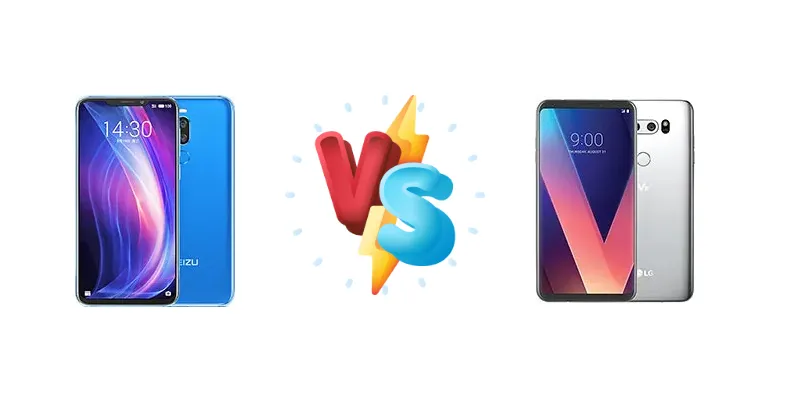
The Meizu X8 and LG V30 represent interesting points in smartphone history. The V30, originally a flagship, now finds itself in a more affordable price bracket, while the X8 aimed to deliver a near-flagship experience at a mid-range cost. This comparison examines whether the V30’s older, more powerful chipset still justifies its price, or if the X8’s more modern architecture offers a better overall experience.
🏆 Quick Verdict
For the average user in 2024, the LG V30 emerges as the stronger choice. While the Snapdragon 710 in the Meizu X8 is efficient, the Snapdragon 835 in the V30 provides a noticeable performance edge, coupled with excellent battery life and a superior display, making it a better long-term investment.
| Network |
|---|
| 2G bands | GSM 850 / 900 / 1800 / 1900 | GSM 850 / 900 / 1800 / 1900 - SIM 1 & SIM 2 (dual-SIM model only) |
| 3G bands | HSDPA 850 / 900 / 2100 - China | HSDPA 850 / 900 / 1700(AWS) / 1800 / 1900 / 2100 |
| 4G bands | 1, 3, 5, 8, 34, 38, 39, 40, 41 - China | 1, 2, 3, 4, 5, 7, 8, 12, 13, 17, 20, 28, 38, 71 |
| Speed | HSPA 42.2/5.76 Mbps, LTE Cat15 800/150 Mbps | HSPA 42.2/5.76 Mbps, LTE (4CA) Cat16 1024/150 Mbps |
| Technology | GSM / CDMA / HSPA / LTE | GSM / HSPA / LTE |
| | CDMA 800 & TD-SCDMA - China | - |
| Launch |
|---|
| Announced | 2018, September. Released 2018, October | 2017, August 31. Released 2017, December 05 |
| Status | Discontinued | Discontinued |
| Body |
|---|
| Build | - | Glass front (Gorilla Glass 5), glass back (Gorilla Glass 5), aluminum frame |
| Dimensions | 151.2 x 74.6 x 7.8 mm (5.95 x 2.94 x 0.31 in) | 151.7 x 75.4 x 7.3 mm (5.97 x 2.97 x 0.29 in) |
| SIM | Nano-SIM + Nano-SIM | · Nano-SIM· Nano-SIM + Nano-SIM |
| Weight | 160 g (5.64 oz) | 158 g (5.57 oz) |
| | - | IP68 dust/water resistant (up to 1.5m for 30 mins)
MIL-STD-810G compliant*
*does not guarantee ruggedness or use in extreme conditions |
| Display |
|---|
| Protection | - | Corning Gorilla Glass 5 |
| Resolution | 1080 x 2220 pixels, 18.5:9 ratio (~398 ppi density) | 1440 x 2880 pixels, 18:9 ratio (~537 ppi density) |
| Size | 6.2 inches, 97.6 cm2 (~86.5% screen-to-body ratio) | 6.0 inches, 92.9 cm2 (~81.2% screen-to-body ratio) |
| Type | IPS LCD | P-OLED, HDR10, Dolby Vision |
| | - | Always-on display |
| Platform |
|---|
| CPU | Octa-core (2x2.2 GHz 360 Gold & 6x1.7 GHz Kryo 360 Silver) | Octa-core (4x2.45 GHz Kryo & 4x1.9 GHz Kryo) |
| Chipset | Qualcomm SDM710 Snapdragon 710 (10 nm) | Qualcomm MSM8998 Snapdragon 835 (10 nm) |
| GPU | Adreno 616 | Adreno 540 |
| OS | Android 8.0 (Oreo), Flyme UI | Android 7.1.2 (Nougat), upgradable to Android 9.0 (Pie) |
| Memory |
|---|
| Card slot | No | microSDXC (dedicated slot) - single-SIM modelmicroSDXC (uses shared SIM slot) - dual-SIM model |
| Internal | 64GB 4GB RAM, 64GB 6GB RAM, 128GB 6GB RAM | 64GB 4GB RAM, 128GB 4GB RAM |
| | - | UFS 2.1 |
| Main Camera |
|---|
| Dual | 12 MP, f/1.9, 1/2.55", 1.4µm, dual pixel PDAF
5 MP | 16 MP, f/1.6, 30mm (standard), 1/3.1", 1.0µm, PDAF, 3-axis OIS
13 MP, f/1.9, 12mm (ultrawide), no AF |
| Features | Dual-LED dual-tone flash, panorama | Laser AF, color spectrum sensor, LED flash, HDR, panorama |
| Video | 1080p@30fps | 4K@30fps, 1080p@30/60fps, 720p@120fps, 24-bit/192kHz stereo sound rec., HDR video |
| Selfie camera |
|---|
| Single | 20 MP, f/2.0, (wide), 1/2.8", 1.0µm | 5 MP, f/2.2, 22mm (wide), 1/5.0", 1.12µm |
| Video | - | 1080p@30fps |
| Sound |
|---|
| 3.5mm jack | Yes | Yes |
| 35mm jack | Yes | Yes |
| Loudspeaker | Yes | Yes |
| | - | 32-bit/192kHz audio
B&O Play certified
24-bit/48kHz audio recording
|
| Comms |
|---|
| Bluetooth | 5.0, A2DP, LE | 5.0, A2DP, LE, aptX HD |
| NFC | No | Yes |
| Positioning | GPS, GLONASS | GPS, GLONASS, GALILEO |
| Radio | No | Stereo FM radio with RDS |
| USB | USB Type-C 2.0 | USB Type-C 3.1, OTG |
| WLAN | Wi-Fi 802.11 b/g/n/ac, dual-band, Wi-Fi Direct | Wi-Fi 802.11 a/b/g/n/ac, dual-band, Wi-Fi Direct, DLNA |
| Features |
|---|
| Sensors | Fingerprint (rear-mounted), accelerometer, proximity, compass | Fingerprint (rear-mounted), accelerometer, gyro, proximity, compass, barometer |
| Battery |
|---|
| Charging | - | 18W wired, PD2.0, QC3, 50% in 36 min
10W wireless |
| Type | Li-Ion 3210 mAh, non-removable | Li-Po 3300 mAh, non-removable |
| Misc |
|---|
| Colors | Black, Blue, White | Aurora Black, Cloud Silver, Moroccan Blue, Lavender Violet, Raspberry Rose |
| Models | X8 | H930, H931, H932, H933, VS996, US998, LS998U, LGM-V300L, LGM-V300K, LGM-V300S, LS998, AS998, H932PR, L-01K, H930DS |
| Price | About 200 EUR | About 500 EUR |
| Tests |
|---|
| Audio quality | - |
Noise -93.2dB / Crosstalk -94.2dB |
| Battery life | - |
Endurance rating 93h
|
| Camera | - |
Photo / Video |
| Display | - |
Contrast ratio: 207000 (nominal), 4.022 (sunlight) |
| Loudspeaker | - |
Voice 66dB / Noise 72dB / Ring 84dB
|
| Performance | - |
AnTuTu: 182374 (v7)
GeekBench: 6365 (v4.4)
GFXBench: 13fps (ES 3.1 onscreen) |
Meizu X8
- Potentially more affordable price point
- More modern design (likely)
- Efficient Snapdragon 710 chipset
- Inferior performance compared to Snapdragon 835
- Likely lower quality display
- Unknown battery capacity and charging speed
LG V30
- Powerful Snapdragon 835 chipset
- Excellent display with high contrast ratio
- Long battery life (93h endurance)
- Older device, potentially limited software updates
- Larger size and weight (likely)
- May be harder to find in new condition
Display Comparison
The LG V30 boasts a significantly more impressive display profile. While both phones utilize 10nm chipsets, the V30’s display features a contrast ratio of 207000:1 (nominal) and 4.022:1 in sunlight, indicating superior visibility and color reproduction in various lighting conditions. The Meizu X8’s display specifications are not provided, suggesting a more standard LCD panel, likely lacking the V30’s OLED vibrancy and outdoor readability. This makes the V30 a better choice for media consumption and photography enthusiasts.
Camera Comparison
Both devices are listed as having Photo/Video capabilities, but detailed camera specifications are absent. However, given the LG V30’s flagship origins, it likely features a more sophisticated camera system with a larger sensor and better image processing. LG flagships of this era were known for their strong camera performance, including optical image stabilization (OIS). The Meizu X8, being a mid-range device, likely compromises on sensor size and image quality. Without specific details, it’s safe to assume the V30 delivers superior photo and video quality.
Performance
The core difference lies in the chipsets. The LG V30’s Snapdragon 835, with its octa-core configuration of 4x2.45 GHz Kryo cores and 4x1.9 GHz Kryo cores, offers a clear advantage over the Meizu X8’s Snapdragon 710 (2x2.2 GHz 360 Gold & 6x1.7 GHz Kryo 360 Silver). While both are 10nm chips, the 835’s higher clock speeds and more powerful core architecture translate to faster app loading times, smoother multitasking, and better gaming performance. The X8’s 710 is a capable mid-range chip, but it won’t match the V30’s sustained performance under heavy load.
Battery Life
The LG V30’s endurance rating of 93 hours is a significant advantage. This, combined with its 18W wired charging (PD2.0, QC3) – capable of reaching 50% charge in 36 minutes – and 10W wireless charging, provides a versatile and convenient charging experience. The Meizu X8’s battery capacity and charging specifications are unknown, but given its mid-range positioning, it likely offers slower charging speeds and potentially shorter battery life compared to the V30. The V30’s charging capabilities are particularly useful for users who need a quick power boost.
Buying Guide
Buy the Meizu X8 if you prioritize a more recent design and are on a very tight budget, accepting a performance trade-off. It’s suitable for casual users who primarily browse, use social media, and make calls. Buy the LG V30 if you value performance for gaming or demanding applications, appreciate a high-quality display with excellent contrast, and want a phone that will likely last longer due to its more robust chipset and battery endurance.
Frequently Asked Questions
❓ Is the Snapdragon 835 in the LG V30 still capable of handling modern games?
Yes, the Snapdragon 835 remains a capable chipset for gaming in 2024. While it won't match the performance of the latest Snapdragon 8 Gen series, it can comfortably run most popular titles at medium to high settings. The X8's Snapdragon 710 will struggle with more demanding games.
❓ How does the LG V30's age affect its software support?
The LG V30 is no longer receiving official software updates from LG. However, the Android community has developed custom ROMs that can provide newer Android versions and security patches, extending the phone's usability. The Meizu X8 may also have limited software support depending on Meizu's update policy.
❓ Does the LG V30 support fast charging, and how quickly does it charge?
The LG V30 supports 18W wired fast charging with both PD2.0 and QC3 standards, allowing it to reach 50% charge in approximately 36 minutes. It also supports 10W wireless charging for added convenience. The Meizu X8's charging speed is unknown but is likely slower.